
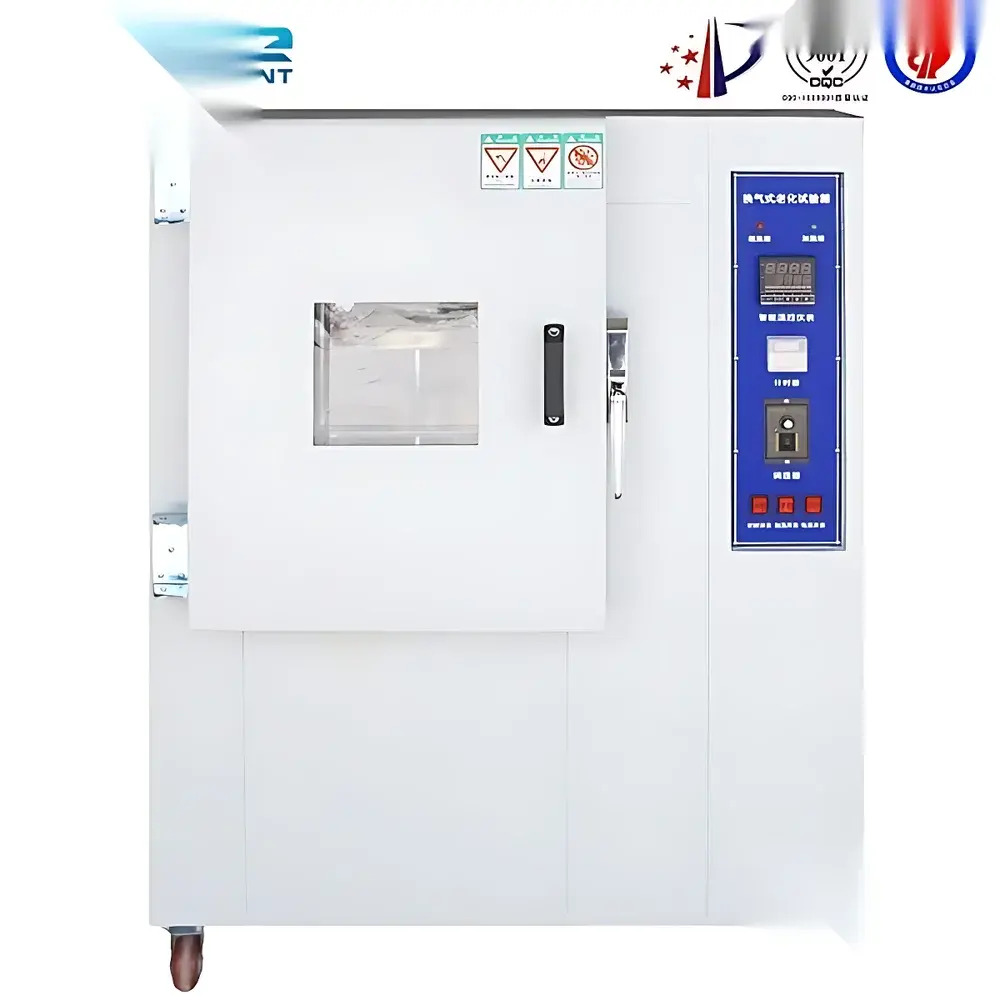
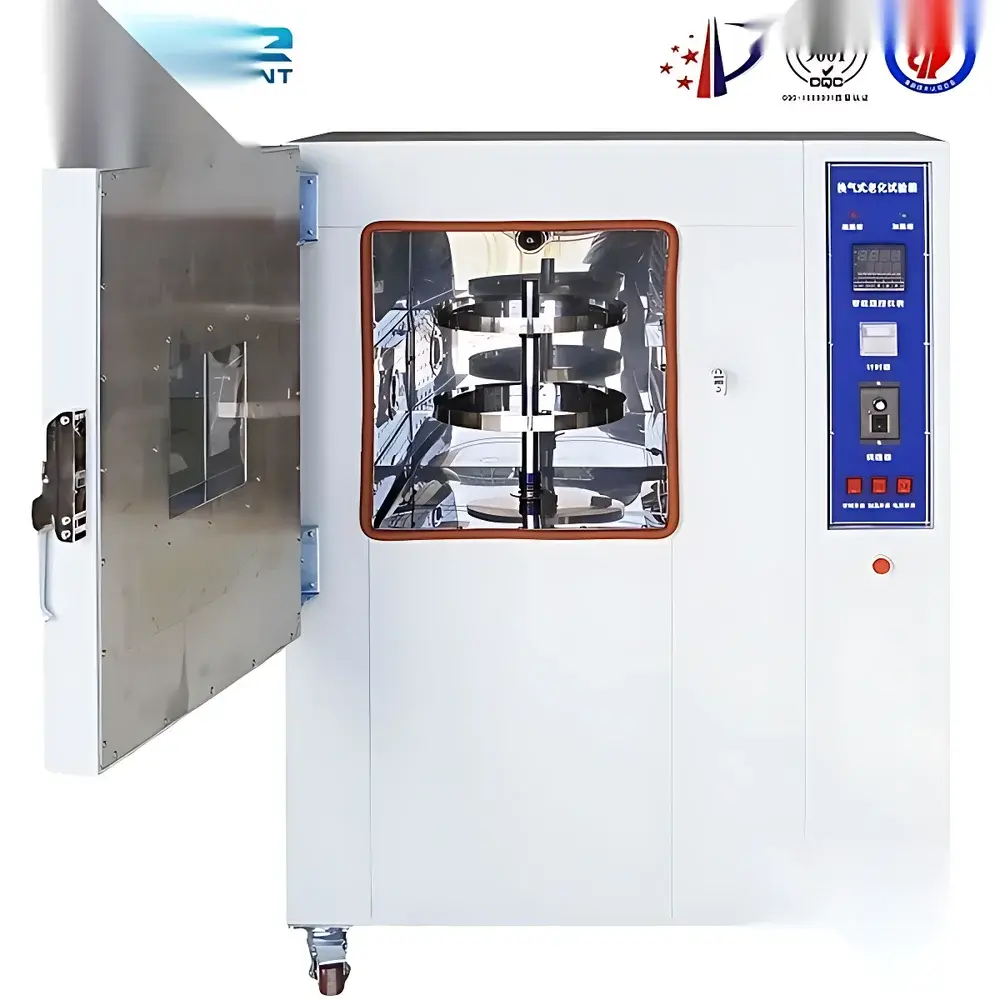
OK-HQ Series High-Temperature Air-Exchange Aging Test Chamber
| Brand | OK |
|---|---|
| Origin | Imported |
| Manufacturer Type | Authorized Distributor |
| Temperature Range | RT+10°C to 200°C / 300°C |
| Temperature Uniformity | ±2°C |
| Temperature Fluctuation | ±0.5°C |
| Air Exchange Rate | 2–100 cycles/hour |
| Adjustable Air Exchange Time | 1 min – 99 h |
| Internal Chamber Dimensions (L×W×H, mm) | 450×450×500 to 800×1000×1000 |
| Power Rating | 4.0–9.0 kW |
| Controller | PID + SSR Microcomputer Digital Controller |
| Temperature Setting/Display Resolution | 0.1°C |
| Timer Range | 1–9999 min |
| Rotating Turntable Diameter | Φ250–Φ700 mm |
| Compliance | ASTM D5423-09 (Type II), ASTM D5374-93 (2005), UL 1581, GB/T, JIS, IEC, VDE |
Overview
The OK-HQ Series High-Temperature Air-Exchange Aging Test Chamber is an engineered environmental test system designed for accelerated thermal aging of polymeric and insulating materials under controlled air exchange conditions. It operates on the principle of forced convection with programmable ventilation—maintaining a defined volumetric air exchange rate while sustaining precise elevated temperatures. This methodology simulates long-term service exposure in real-world environments where oxygen availability, thermal stress, and airflow dynamics jointly govern material degradation kinetics. The chamber is widely deployed in R&D laboratories, quality assurance departments, and certification testing facilities to evaluate thermal oxidative stability of wires, cables, rubber compounds, plastics, textiles, and elastomeric components per internationally recognized aging protocols.
Key Features
- Precision-engineered horizontal forced-air circulation system with dual adjustable baffle plates ensures uniform temperature distribution across the working chamber (±2°C uniformity, ±0.5°C fluctuation).
- Digital microcomputer controller with PID + SSR regulation delivers stable temperature control at resolution of 0.1°C for both setpoint and display.
- Modular air-exchange mechanism enables user-defined ventilation frequency (2–100 cycles/hour) and timing intervals (1 minute to 99 hours), compliant with ASTM D5423-09 Type II oven specifications.
- Stainless steel (SUS304) interior chamber with argon-arc welded seams and A3 steel exterior with electrostatic powder coating provide corrosion resistance and structural integrity.
- Integrated rotating turntable (diameter options: Φ250–Φ700 mm) supports uniform thermal exposure of vertically oriented specimens such as insulated wire reels or cable bundles.
- High-efficiency thermal insulation using ultra-fine glass fiber cotton minimizes energy consumption and external surface temperature rise.
- Large observation window with tempered glass and built-in LED lighting enables continuous visual monitoring without compromising thermal integrity.
- Standard 50 mm diameter test port on left sidewall facilitates integration with external power supplies, data loggers, or sensor feedthroughs.
Sample Compatibility & Compliance
The OK-HQ chamber accommodates a broad range of specimen geometries—including flat sheets, extruded profiles, coiled wires, molded parts, and textile swatches—within its five standard internal volume configurations (100 L to 800 L). Its design conforms to the dimensional, airflow, and thermal performance requirements of ASTM D5423-09 (Type II forced-ventilation laboratory ovens) and ASTM D5374-93 (2005) for thermal aging of electrical insulating materials. Additional alignment with UL 1581 (Section 1060), IEC 60811-201, JIS C 3005, VDE 0472, and GB/T 2951 series standards supports global regulatory submissions. All models support GLP-compliant operation when paired with audit-trail-capable data logging systems.
Software & Data Management
While the base configuration features a stand-alone LED digital controller with timer and PID tuning, optional RS485/RS232 interfaces enable connection to PC-based monitoring platforms. When integrated with compliant software, the system supports time-stamped temperature logging, alarm event history, and configurable export formats (CSV, TXT) suitable for FDA 21 CFR Part 11–aligned documentation workflows. Real-time parameter recording—including actual air exchange count, cumulative heating duration, and chamber temperature deviation—facilitates traceable aging protocol execution and post-test failure analysis.
Applications
- Evaluation of thermal oxidative degradation in PVC, PE, XLPE, EPR, silicone rubber, and fluoropolymer insulation systems.
- Accelerated life testing of automotive wiring harnesses, aerospace cable assemblies, and photovoltaic module encapsulants.
- Comparative aging studies for material formulation optimization under standardized air-exchange conditions.
- Pre-certification screening for compliance with UL, CSA, TÜV, and CCC requirements related to long-term thermal endurance.
- Quality control verification of batch-to-batch consistency in polymer processing and compounding operations.
FAQ
What standards does this chamber specifically meet for wire and cable aging?
It satisfies ASTM D5423-09 (Type II), ASTM D5374-93 (2005), UL 1581 Section 1060, and IEC 60811-201 for thermal aging of electrical insulation materials.
Can the air exchange rate be verified and calibrated?
Yes—the chamber includes integrated digital voltage, current, and watt-hour meters, enabling direct calculation of volumetric airflow via fan power correlation and pressure differential methods per ASTM D5423 Annex A3.
Is the rotating turntable motor rated for continuous operation at 300°C?
The turntable drive uses a high-temperature-rated induction motor with ceramic-insulated windings and is validated for uninterrupted duty at maximum chamber temperature.
Does the controller support multi-segment ramp-soak profiles?
The standard LED controller supports single-setpoint timed operation; optional programmable controllers with up to 99 segments are available upon request.
What safety protections are built into the system?
Comprehensive safeguards include over-temperature cutoff, motor overheat detection, leakage current protection, short-circuit interruption, and phase-loss monitoring for three-phase power variants.



