
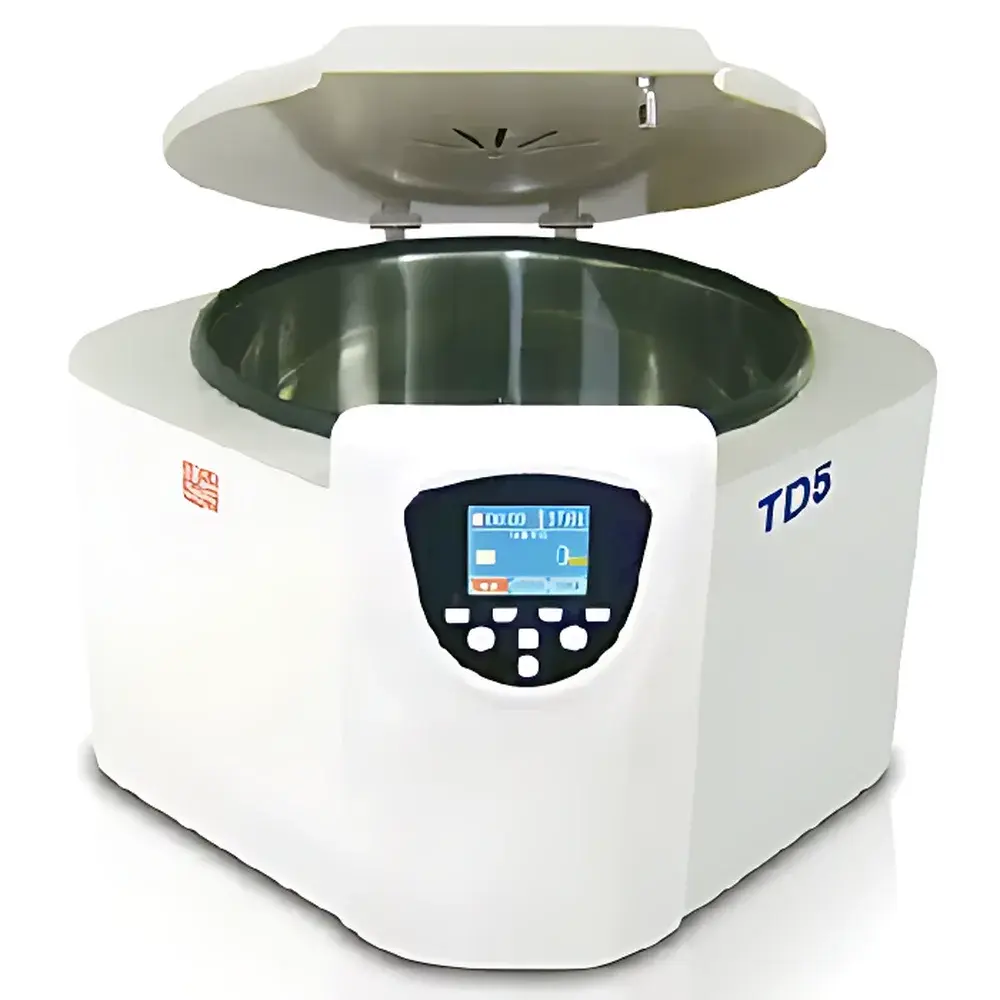
Hercy TD5 Benchtop Low-Speed Centrifuge
| Brand | Hercy |
|---|---|
| Model | TD5 |
| Type | Benchtop Centrifuge |
| Max Speed | 5000 rpm |
| Max RCF | 4800 ×g |
| Max Capacity | 4 × 250 mL |
| Dimensions (L×W×H) | 600 × 540 × 360 mm |
| Weight | 35 kg |
| Power Supply | AC 220 V, 50 Hz |
| Noise Level | ≤60 dB(A) |
| Timer Range | 1 min – 99 h 59 min, continuous or short-spin mode |
| Speed Accuracy | ±50 rpm |
| Acceleration/Deceleration | 10-step programmable |
| Stored Programs | 20 user-defined protocols |
| Drive System | High-torque brushless DC motor with microprocessor control |
| Certifications | ISO 9001:2015, ISO 13485:2016, CFDA registered |
| Compliance | RoHS 2015/863 (silicone rubber sealing gasket), stainless steel 304 rotor chamber, CE-marked safety architecture |
Overview
The Hercy TD5 Benchtop Low-Speed Centrifuge is an engineered solution for routine separation tasks in clinical diagnostics, biobanking, pharmaceutical quality control, and academic research laboratories. Designed around the principles of sedimentation centrifugation—where differential particle migration under controlled gravitational force enables phase separation—the TD5 delivers reproducible, gentle yet effective pelleting of cells, organelles, serum, plasma, whole blood, and other temperature-sensitive biological suspensions. Its operational envelope (up to 5000 rpm / 4800 ×g) places it within the low-speed centrifugation range defined by ISO 21501-4 and IEC 61010-2-020, making it ideal for applications where high g-force-induced structural damage must be avoided—such as isolation of peripheral blood mononuclear cells (PBMCs), platelet-rich plasma (PRP), or large-volume tissue homogenates.
Key Features
- High-torque brushless DC motor paired with Infineon driver modules and custom-developed control firmware ensures stable rotational dynamics, minimal thermal drift, and long-term mechanical reliability.
- Triple-stage damping system—including asymmetric elastomeric mounts, torsional isolation brackets, and a rigid 304 stainless steel centrifuge chamber—suppresses vibration transmission and prevents sample resuspension during deceleration.
- TFT-LCD true-color display with dual-input interface (capacitive touch + physical membrane keys) supports real-time concurrent monitoring of setpoint vs. actual speed, RCF, time remaining, and acceleration/deceleration profile; parameter adjustment is permitted mid-run without interrupting operation.
- Biocontainment-compliant angular and swing-bucket rotors feature integrally molded silicone rubber gaskets compliant with EU RoHS Directive 2015/863, minimizing aerosol escape during high-volume processing of infectious or volatile samples.
- Structural safety architecture includes a three-layer reinforced front panel, powder-coated steel housing, and aviation-grade forged aluminum rotor bodies (angular configuration); all mechanical interlocks meet IEC 61010-2-020 mechanical hazard requirements.
- Wide-input voltage design (100–230 V AC, 50/60 Hz) accommodates global laboratory power infrastructures; optional voltage stabilization module available for regions with unstable grid conditions.
- Intelligent door-lock mechanism utilizes silent electromechanical latching—engaged automatically upon lid closure—ensuring compliance with ISO 13485 clause 7.5.3 on process validation of safety-critical subsystems.
Sample Compatibility & Compliance
The TD5 supports universal compatibility across standard clinical and research consumables: 5–250 mL conical tubes, vacuum collection tubes (e.g., BD Vacutainer®, Greiner Bio-One), microtiter plates (96-well, 384-well), PCR strips, deep-well plates, and cell culture flasks (via adapter kits). Horizontal rotors accept up to 4 × 250 mL bottles or 76 × 2 mL vacuum tubes at 4000 rpm (3080 ×g), while fixed-angle configurations achieve 5000 rpm (4800 ×g) with 4 × 100 mL loads. All rotor assemblies are validated per ISO 15195:2018 for traceable calibration of RCF values. The instrument carries CFDA registration (Class II medical device), conforms to ISO 9001:2015 (quality management) and ISO 13485:2016 (medical device QMS), and incorporates audit-trail-capable firmware for GLP/GMP-aligned environments.
Software & Data Management
While the TD5 operates via embedded firmware without external PC dependency, its 20-program memory bank stores full protocol stacks—including speed, time, acceleration ramp, deceleration curve, and rotor ID—with automatic recall of last-used settings at power-on. Each program entry logs timestamped execution history (start/stop time, actual RCF achieved, deviation alerts) accessible via on-screen navigation. Firmware supports multilingual UI (English, Chinese, Russian, Portuguese) and allows export-ready parameter snapshots via USB port (future firmware update path includes CSV log export). For regulated labs, the system’s deterministic behavior, absence of cloud connectivity, and local-only data storage align with FDA 21 CFR Part 11 Annex A guidance on electronic records integrity.
Applications
- Clinical laboratories: Routine serum/plasma separation from whole blood (e.g., CLSI H18-A3 preanalytical guidelines), PRP preparation, urinalysis sediment concentration.
- Blood banking: Red blood cell washing, buffy coat harvesting, platelet pooling under AABB standards.
- Pharmaceutical QC: Clarification of fermentation broths, excipient suspension homogenization, stability testing of emulsions per USP .
- Agricultural & food safety labs: Milk fat separation (ISO 5537), pesticide residue extraction in aqueous matrices, microbial pellet recovery from enrichment cultures.
- Academic research: Subcellular fractionation prior to Western blotting, plant protoplast isolation, polymerase chain reaction (PCR) cleanup, and nucleic acid precipitation workflows.
FAQ
What is the maximum relative centrifugal force (RCF) achievable with the TD5?
The TD5 achieves a maximum RCF of 4800 ×g when using the 4 × 100 mL horizontal rotor at 5000 rpm.
Does the TD5 support regulatory-compliant data integrity requirements?
Yes—the device maintains local execution logs with timestamps and parameter fidelity, satisfying core elements of FDA 21 CFR Part 11 for non-networked instruments in GLP environments.
Can the TD5 accommodate microtiter plates?
Yes—optional 2 × 2 × 96-well enzyme plate carriers are certified for use at 4000 rpm (2360 ×g), enabling high-throughput ELISA plate processing.
Is rotor calibration traceable to national standards?
All factory-calibrated rotors include ISO 15195:2018–compliant RCF certification documentation, with optional third-party verification available upon request.
What safety certifications does the TD5 hold?
It complies with IEC 61010-2-020 (laboratory equipment safety), carries CFDA Class II registration, and meets ISO 13485:2016 for medical device manufacturing quality systems.



