
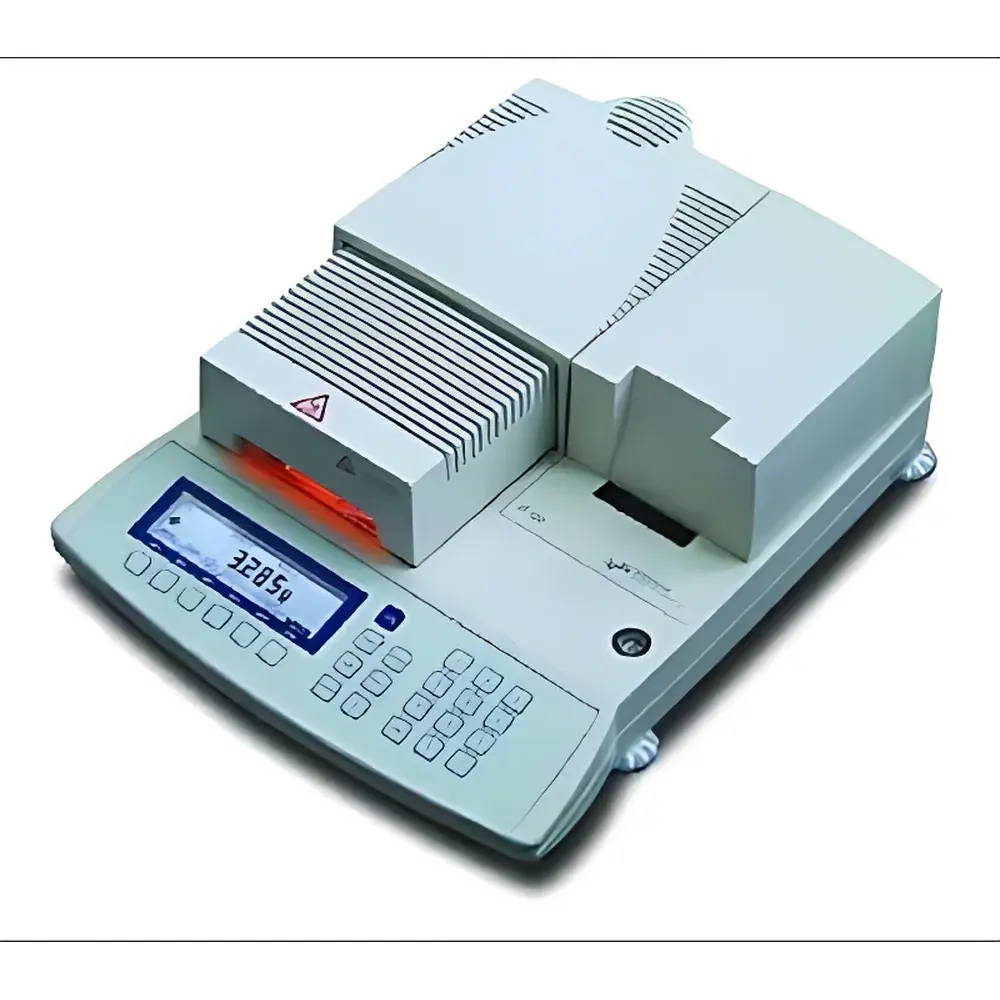
Denver IR-120 Advanced Infrared Moisture Analyzer
| Brand | Denver |
|---|---|
| Origin | USA |
| Model | IR-120 |
| Weighing Range | 120 g |
| Readability | 0.1 mg |
| Moisture Resolution | 0.0001% |
| Repeatability | ±0.1% (≥1 g sample), ±0.02% (≥5 g sample) |
| Heating Temperature Range | 30–230 °C (1 °C increments) |
| Heating Modes | Standard, Rapid, Gentle, Step (3-stage, 0.1–999 min per stage) |
| Pre-stored Methods | 30 |
| Built-in Calibration Weight | Yes |
| GLP-Compliant Printing | Yes |
| Interface | RS-232C |
| Dimensions (W×D×H) | 350 × 453 × 156 mm |
| Weight | 8.0 kg |
Overview
The Denver IR-120 Advanced Infrared Moisture Analyzer is a high-precision, thermogravimetric instrument engineered for rapid and reproducible moisture content determination across pharmaceutical, food, chemical, polymer, and quality control laboratories. It operates on the principle of infrared drying coupled with monolithic electromagnetic force compensation weighing—enabling real-time mass loss tracking during thermal dehydration. Unlike conventional halogen or ceramic heaters, the IR-120 integrates a quartz-coated CQR (Controlled Quartz Radiator) heating element with a reflective quartz mirror assembly, delivering uniform radiant energy distribution while minimizing thermal inertia and ensuring stable temperature ramp profiles. Its integrated forced-air convection system enhances thermal homogeneity across heterogeneous sample surfaces, significantly reducing edge effects and improving correlation with reference oven-drying methods (e.g., ASTM D4442, ISO 4611, USP <921>). With a 120 g capacity and 0.1 mg readability, the IR-120 achieves moisture quantification down to 0.0001%—making it suitable for low-moisture materials such as anhydrous APIs, lithium battery cathode powders, and desiccated biological matrices.
Key Features
- Monolithic electromagnetic force compensation weighing system with internal automatic calibration via built-in reference weights—ensuring long-term drift stability and traceable accuracy per ISO/IEC 17025 requirements.
- Quartz CQR infrared heater with motorized slide-out design: enables safe, tool-free access to the sample chamber for residue removal without disassembly or cooling delay.
- Forced-air convection module synchronized with heating profile—minimizes thermal gradients and improves repeatability, especially for granular, fibrous, or layered samples.
- Three-tier programmable heating strategy: Standard (single-phase ramp), Rapid (high-power initial drying), Gentle (low-temperature stabilization), and multi-step Step mode (up to three independently configurable segments).
- Intuitive menu-driven interface with soft-key labeling, alphanumeric sample ID entry, and tactile dust-resistant keypad—designed for glove-compatible operation in cleanroom or production environments.
- GLP-compliant data logging: All measurements include timestamp, operator ID (password-protected), method name, calibration status, ambient conditions (optional sensor input), and full audit trail exportable via RS-232C.
Sample Compatibility & Compliance
The IR-120 accommodates solid, semi-solid, and powdered samples up to 120 g—including hygroscopic salts, freeze-dried proteins, ceramic precursors, and composite resins. Its open-chamber geometry supports irregular geometries and minimizes sample compaction artifacts. The instrument complies with key regulatory frameworks governing analytical instrumentation: FDA 21 CFR Part 11 (when paired with validated software), ISO 8573-3 (for compressed air–assisted drying verification), and ASTM E1447 (standard practice for moisture analyzer validation). Optional IQ/OQ documentation packages are available for GMP-aligned installations. All printed reports adhere to GLP formatting standards—including mandatory fields for analyst signature, instrument ID, calibration certificate number, and environmental deviation flags.
Software & Data Management
While the IR-120 operates autonomously with its embedded firmware, optional PC connectivity via RS-232C enables integration with LIMS or enterprise QA systems. Raw mass-vs.-time datasets are exportable in CSV format, preserving all intermediate weight readings at user-defined intervals (1–60 s). The built-in reproTEST function executes three consecutive dryings under identical parameters—automatically calculating RSD and flagging outliers per ICH Q2(R2) guidelines. All method parameters—including target temperature, dwell time, termination criteria (slope-based or time-based), and post-dry cooling delay—are stored securely with version control and password-restricted editing rights.
Applications
- Pharmaceutical QC: Residual solvent quantification in lyophilized products; moisture mapping of tablet blends prior to compression.
- Food science: Water activity correlation studies; shelf-life modeling of snack coatings and cereal matrices.
- Materials engineering: Moisture uptake kinetics in carbon fiber prepregs; binder volatilization profiling in additive manufacturing feedstocks.
- Environmental testing: Soil moisture equivalence against gravimetric oven standards (ISO 11465).
- Academic research: Kinetic modeling of dehydration mechanisms using Arrhenius-derived activation energy calculations from multi-temperature runs.
FAQ
What standards does the IR-120 support for method validation?
The IR-120 meets ASTM D4442, ISO 4611, and USP <921> performance criteria when operated with validated heating protocols and traceable calibration weights.
Can the IR-120 be integrated into a regulated QA/QC workflow?
Yes—it supports 21 CFR Part 11 compliance when used with validated third-party data capture software and configured with user access controls, electronic signatures, and immutable audit logs.
How often must the internal calibration weight be verified?
Per ISO/IEC 17025, internal calibration should be confirmed daily before first use using an external Class E2 standard weight; full recalibration is recommended every 6 months or after mechanical shock.
Is the heating unit serviceable in the field?
The motorized CQR heater module is designed for user-level replacement without tools or factory service—typical field swap time is under 90 seconds.
Does the IR-120 require external ventilation or exhaust ducting?
No—its sealed convection path and low-emission quartz heater eliminate need for fume hoods; however, volatile organic samples may require optional activated carbon filter attachment.




