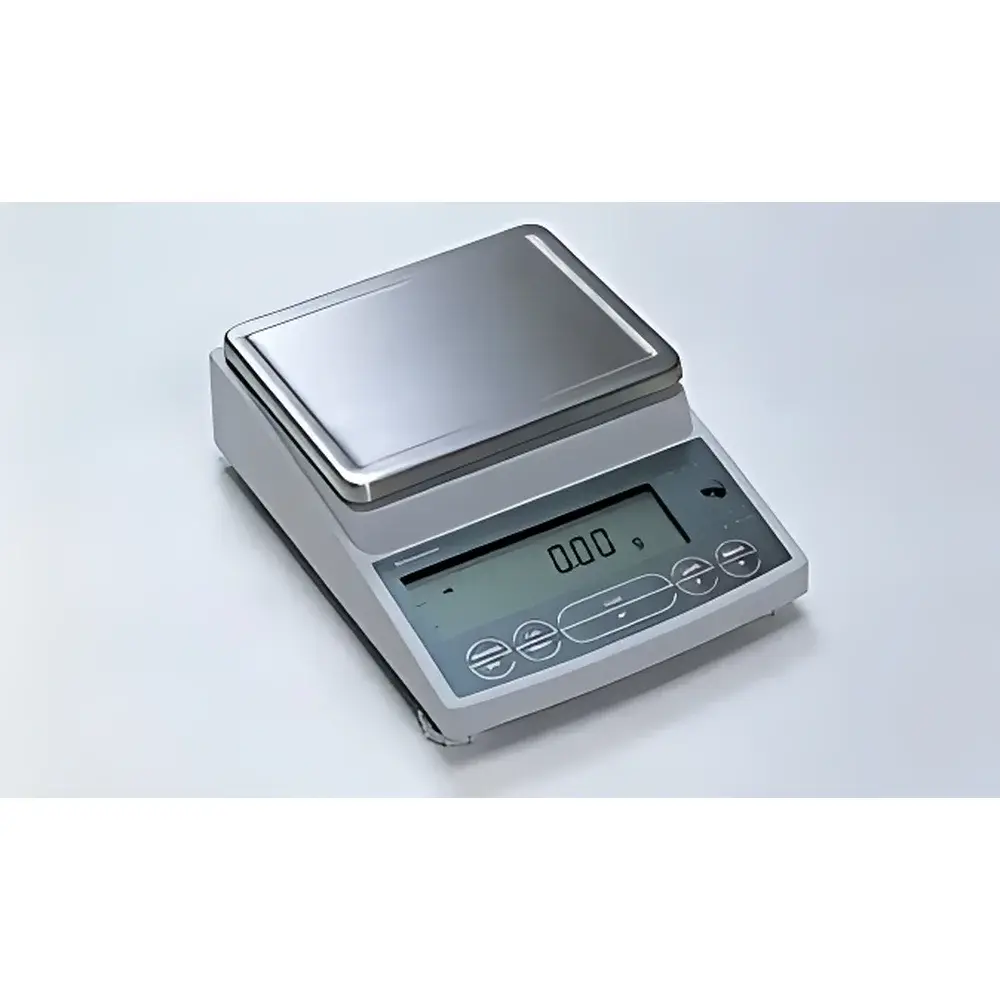
Shimadzu BL Series Economical Platform Balance
| Brand | Shimadzu |
|---|---|
| Origin | Japan |
| Model | BL Series |
| Weighing Capacity | 220 g to 3200 g |
| Minimum Display | 0.001 g to 0.1 g |
| Pan Dimensions | 100 × 100 mm or 160 × 124 mm |
| Response Time | ~1 s (S-type) |
| Power Consumption | ≤12 VA |
| Sensor Type | Electromagnetic Force Compensation |
| Unit Options | g, %, ct (carat) |
| Interface Options | RS-232C (IFB-102A, P/N 321-41167-10) |
| Optional Accessories | EP-80 Printer (P/N 321-62675), Protective Cover Set (P/N 321-61226), Draft Shield (P/N 321-53901, 321-55654), Rechargeable Battery (P/N 321-61691-02), AC Adapter (standard) |
Overview
The Shimadzu BL Series Economical Platform Balance is an entry-level yet technically robust analytical weighing solution engineered for laboratories, quality control environments, and educational institutions requiring reliable mass measurement without premium instrumentation costs. Built upon Shimadzu’s proprietary electromagnetic force compensation (EMFC) sensor architecture—shared with higher-tier precision balances—the BL Series delivers exceptional linearity, repeatability, and long-term stability across its full range of capacities (220 g to 3200 g). Unlike strain-gauge-based platforms, EMFC technology eliminates mechanical hysteresis and drift, enabling consistent performance under variable ambient conditions and frequent use. The balance operates on a stable internal feedback loop that dynamically nulls the load-induced displacement via coil current modulation, ensuring true static equilibrium measurement. With response times of approximately one second for S-type models and intuitive visual feedback via analog-style bar-graph display, the BL Series bridges the functional gap between basic industrial scales and laboratory-grade instruments—while maintaining compliance-ready design principles suitable for routine QC documentation.
Key Features
- Electromagnetic force compensation (EMFC) sensor system—identical core transduction principle used in Shimadzu’s high-accuracy analytical balances, delivering superior reproducibility and minimal zero drift.
- Multi-unit display capability: grams (g), percentage (%), and carats (ct), selectable via single-key operation for rapid unit conversion in gemology, pharmaceutical formulation, or raw material batching.
- Analog-style bar-graph indicator provides immediate visual confirmation of weight stabilization—enhancing operator confidence during dynamic or comparative weighing tasks.
- Standard square weighing pans (100 × 100 mm or 160 × 124 mm) accommodate diverse sample containers and facilitate easy cleaning and calibration verification.
- One-touch direct connection to optional EP-80 thermal printer (P/N 321-62675) for traceable hardcopy output—no driver installation required.
- RS-232C interface (IFB-102A, P/N 321-41167-10) supports bidirectional communication with LIMS or custom data acquisition software; compatible with standard terminal emulators and spreadsheet automation protocols.
- Low power consumption (≤12 VA) enables continuous operation from AC adapter (included) or optional rechargeable battery pack (P/N 321-61691-02), supporting mobile lab or field-deployed applications.
Sample Compatibility & Compliance
The BL Series accommodates solid, granular, and powdered samples within its specified pan dimensions and maximum load limits. Optional draft shields (P/N 321-53901, 321-55654) are available for BL-220H, BL-320H, and BL-320S models to mitigate air-current interference during low-mass measurements (e.g., <100 mg). While not certified for GLP/GMP-regulated critical process steps, the balance’s EMFC architecture, traceable calibration routines, and audit-ready data export functionality support adherence to ISO/IEC 17025 clause 6.4 (equipment management) and ASTM E1223-22 (guidelines for balance selection and verification). Its digital output conforms to NIST Handbook 44 Appendix D requirements for non-automatic weighing instruments used in commercial testing and internal quality assurance workflows.
Software & Data Management
Data capture is enabled through native RS-232C serial protocol using standard ASCII command sets (e.g., “W” for weight query, “U” for unit change). No proprietary software license is required for basic data logging; integration with Excel, LabVIEW, or Python-based scripts is straightforward via pySerial or similar libraries. For regulated environments, third-party compliant software packages—including those validated per FDA 21 CFR Part 11—may be deployed alongside the IFB-102A interface to enforce electronic signature, audit trail, and data integrity controls. All firmware versions undergo Shimadzu’s internal verification protocol prior to release, with version history documented in the instrument’s service manual (available upon request).
Applications
- Routine QC checks in food, chemical, and polymer manufacturing (e.g., batch weight verification, ingredient dispensing).
- Teaching laboratories for introductory metrology, density determination, and stoichiometric experiments.
- Jewelry workshops performing carat-weight verification and sorting.
- Pharmaceutical R&D labs conducting excipient pre-weighing and tablet mass uniformity sampling.
- Environmental testing facilities measuring soil or sediment subsamples prior to digestion or extraction.
- Warehousing and logistics operations requiring calibrated gross/net/tare weighing with printout traceability.
FAQ
Is the BL Series suitable for ISO/IEC 17025-accredited testing?
It may be used for non-critical measurements within accredited scopes, provided calibration is performed by an ISO/IEC 17025-accredited provider and uncertainty budgets are established per ILAC G8:2022.
Can the balance be calibrated internally without external weights?
No—internal calibration is not supported; external calibration using Class F1 or better weights is required per manufacturer specifications.
Does the RS-232C interface support automatic data logging at timed intervals?
Yes, when paired with compatible host software or scripting tools, the interface allows programmable polling intervals (e.g., every 2–30 seconds) based on ASCII command timing.
Are draft shields included as standard equipment?
Draft shields are standard only on BL-220H and BL-320H models; for other variants, they are optional accessories (P/N 321-53901 or 321-55654).
What is the recommended recalibration frequency?
Shimadzu recommends daily zero-checking and periodic full calibration—at minimum weekly for routine QC use, or before each critical measurement series in research settings.