
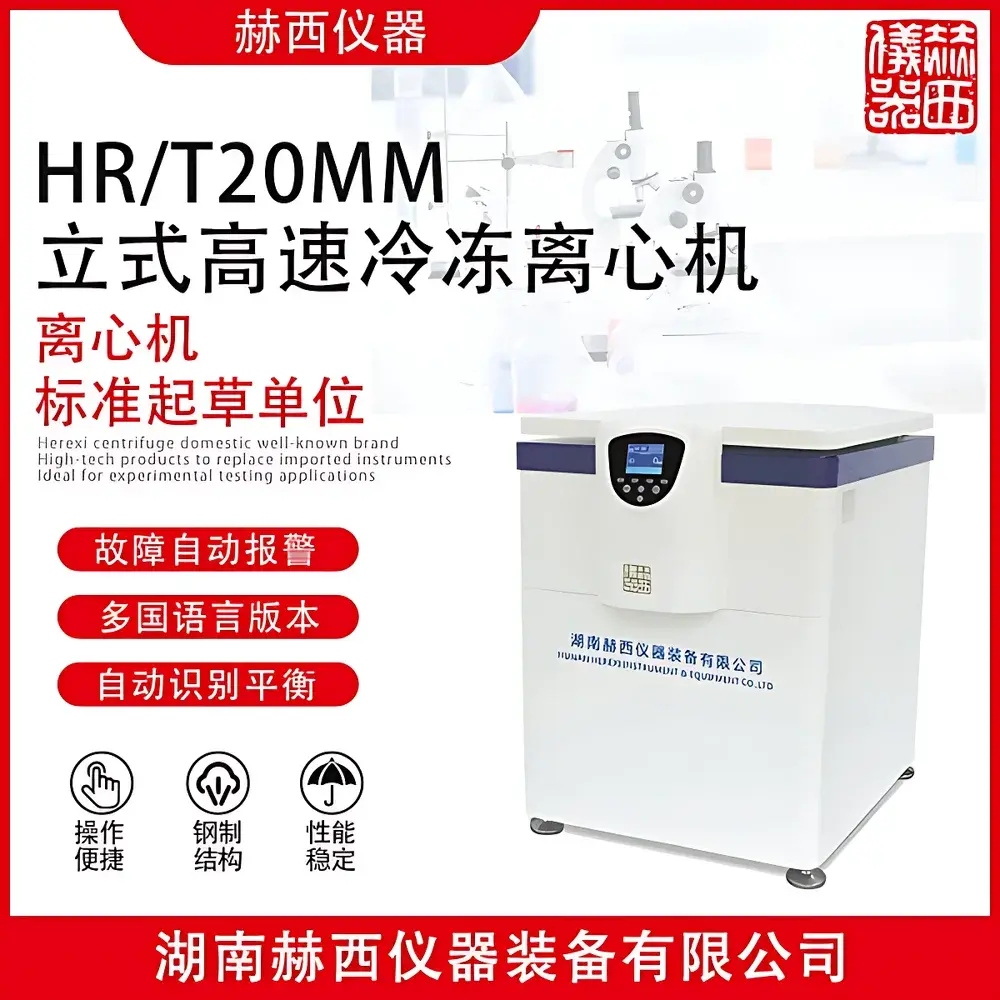
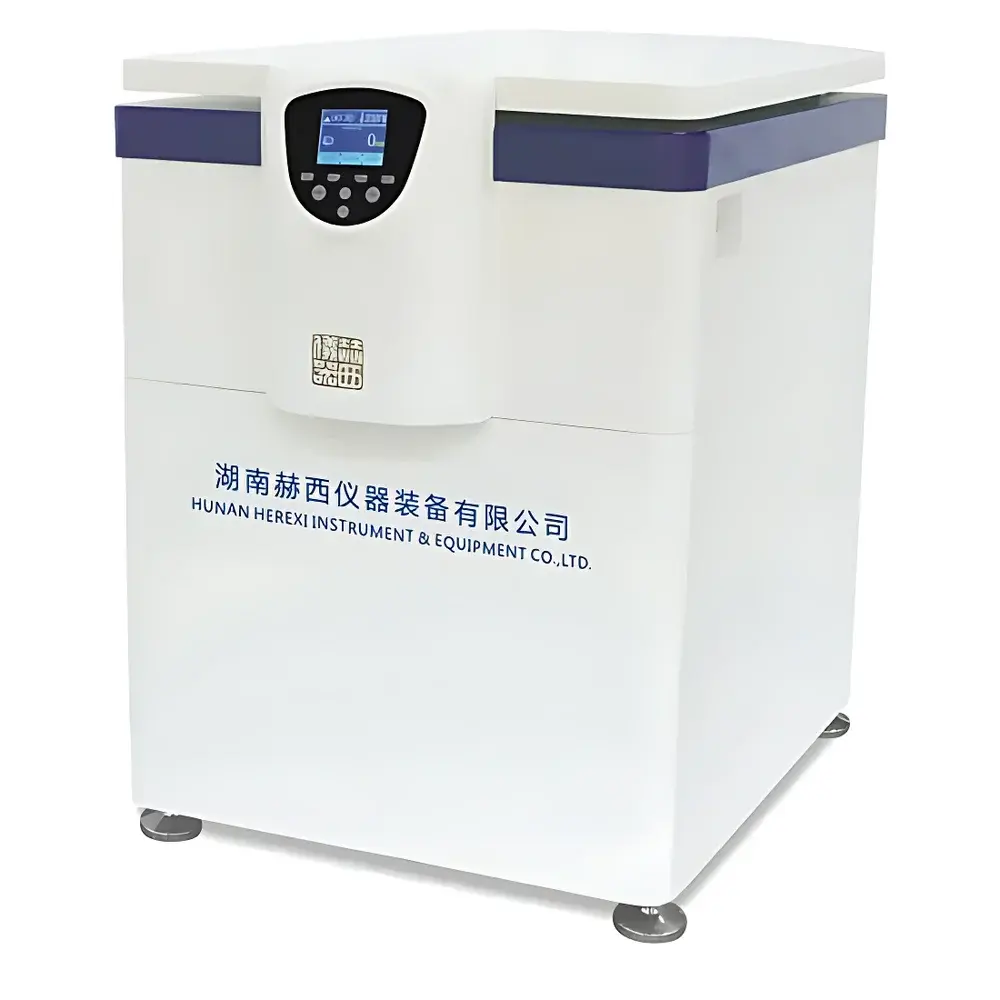
Herxi HR/T20MM High-Speed Refrigerated Floor-Standing Centrifuge
| Brand | Herxi |
|---|---|
| Origin | Hunan, China |
| Model | HR/T20MM |
| Instrument Type | Floor-standing centrifuge |
| Category | High-speed refrigerated centrifuge (10,000–30,000 rpm) |
| Configuration | Fixed-angle rotor centrifuge |
| Max Capacity | 4 × 750 mL |
| Max Speed | 21,000 rpm |
| Max RCF | 31,750 × g |
| Dimensions (L×W×H) | 710 × 560 × 770 mm |
| Weight | 150 kg |
| Temperature Range | −20 °C to +40 °C |
| Temp. Accuracy | ±1 °C |
| Refrigerant | R404a (non-CFC) |
| Acceleration/Deceleration Rates | 10 selectable |
| Programs | 35 pre-set + user-programmable |
| Timer Range | 0–99 h 59 min |
| Noise Level | ≤65 dB(A) |
| Rotor Autoidentification | Yes |
| Safety Certifications | CE, ISO 13485, ISO 9001, IEC 61010-2-020 |
| Sterilization Compatibility | All rotors & accessories autoclavable at 121 °C for 20 min |
| Drive System | Brushless AC frequency-controlled motor with dsPIC30F microcontroller and FSBB30CH intelligent drive module |
| Display | 4.3″ TFT true-color touchscreen |
| Braking Time | <60 s from max speed |
| Rotor Lock | Electromechanical quiet latch |
| Vibration Damping | Dual-stage composite isolation system |
Overview
The Herxi HR/T20MM is a high-performance floor-standing refrigerated centrifuge engineered for demanding separation workflows in regulated and research-intensive laboratories. It operates on the principle of sedimentation under controlled centrifugal force—generating up to 31,750 × g at 21,000 rpm—to resolve heterogeneous mixtures based on particle density, size, and shape. Designed for high-throughput sample processing, its 4 × 750 mL maximum capacity supports large-volume applications in biopharmaceutical manufacturing, clinical diagnostics, blood banking, and upstream/downstream bioprocessing. The unit integrates a non-ozone-depleting R404a refrigeration system capable of maintaining sample temperature below 4 °C even at full rotational speed—a critical capability for preserving thermolabile macromolecules such as monoclonal antibodies, viral vectors, and primary cell lysates. Its structural architecture complies with IEC 61010-2-020 for laboratory equipment safety and meets ISO 13485 requirements for medical device-related quality management systems.
Key Features
- Brushless AC frequency-controlled motor with integrated dsPIC30F digital signal controller and FAIRCHILD FSBB30CH intelligent drive module—ensuring precise speed regulation (±50 rpm), extended service life, and low electromagnetic interference.
- Electromechanical quiet-latch door mechanism with fail-safe engagement and automatic imbalance detection—halting operation within milliseconds upon detection of mass asymmetry exceeding tolerance thresholds.
- Dual-stage composite vibration damping system combining elastomeric mounts and aerodynamically optimized airflow channels—reducing operational noise to ≤65 dB(A) and minimizing transmission of mechanical resonance to adjacent instrumentation.
- 4.3″ TFT true-color touchscreen interface with dual-control logic (touch + physical keys), real-time display of RCF, speed, temperature, radius correction factor, and elapsed time—enabling intuitive parameter adjustment without menu nesting.
- Programmable deceleration profiles (10 acceleration/deceleration rates) and 35 configurable run protocols—including 20 factory-default methods—supporting reproducible method transfer across shifts and sites.
- Rotor auto-identification via embedded RFID or optical encoding—preventing mismatched rotor usage and enforcing speed/temperature limits per rotor geometry and material specification.
Sample Compatibility & Compliance
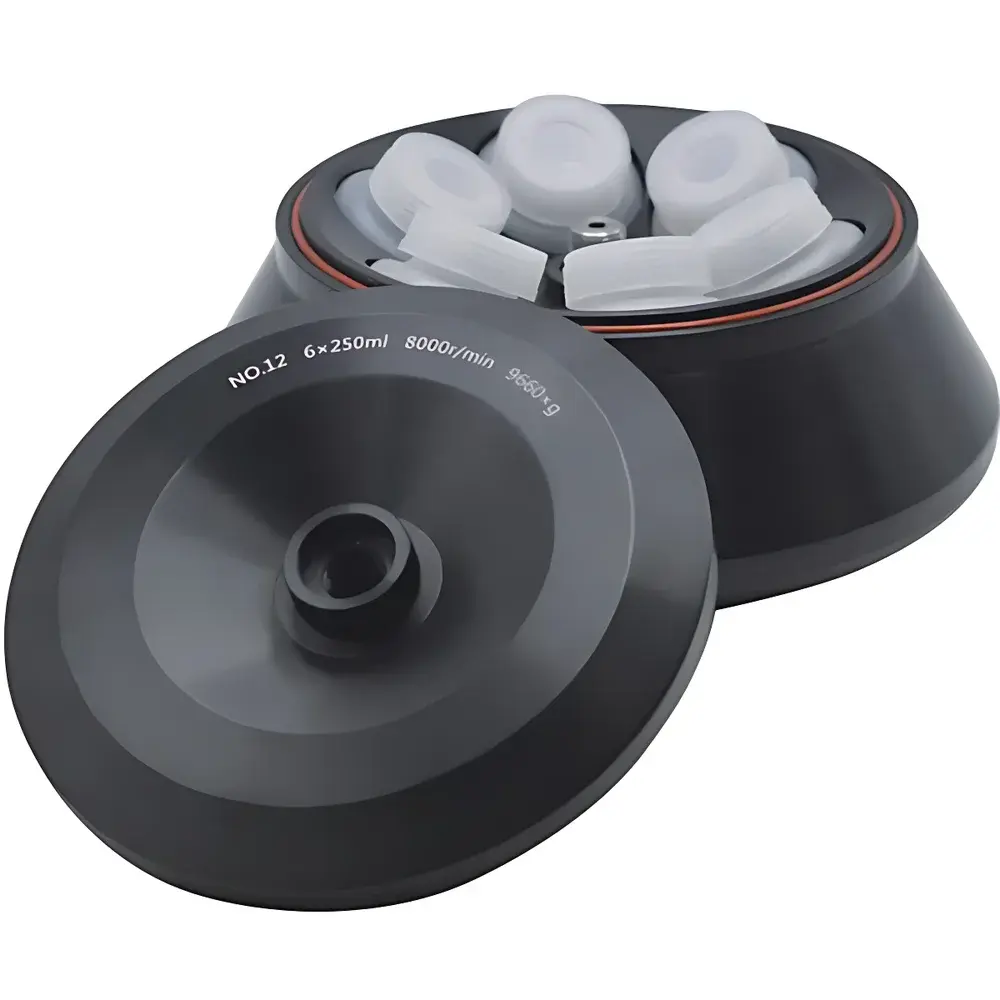
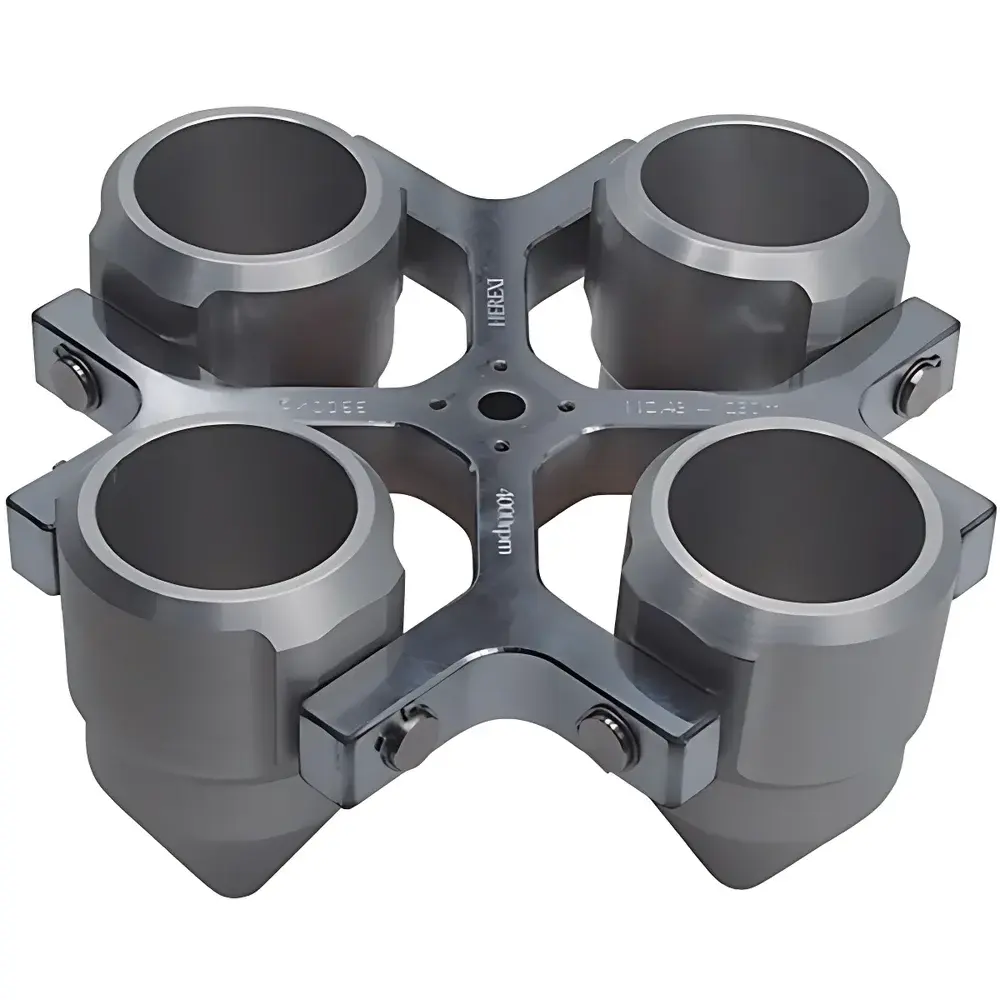
The HR/T20MM accommodates a broad range of sample containers—from microcentrifuge tubes (1.5–2.0 mL) to high-capacity bottles (up to 750 mL)—via interchangeable fixed-angle and swing-bucket rotors. All standard rotors and accessories are validated for autoclaving at 121 °C for 20 minutes (EN 285 compliant), while gas-tight rotor assemblies and lids undergo rigorous validation for prion inactivation at 140 °C for 2 hours—meeting WHO and EC guidelines for TSE risk mitigation. The system’s thermal management maintains setpoint stability (±1 °C) across ambient conditions ranging from 10–32 °C, satisfying CLSI EP10-A3 requirements for temperature uniformity during analytical centrifugation. Certification to CE, ISO 9001, and ISO 13485 confirms conformity with EU Medical Device Regulation (MDR 2017/745) Annex I essential requirements and supports integration into GMP-compliant environments.
Software & Data Management
While the HR/T20MM operates as a standalone instrument, its microcontroller architecture supports optional RS-485 or USB-to-serial connectivity for external logging and remote monitoring. All run parameters—including speed, RCF, temperature, time, rotor ID, and event timestamps—are stored in non-volatile memory with audit-trail capability. The system records operational anomalies (e.g., overtemperature, overspeed, door interlock breach) with time-stamped entries, aligning with ALCOA+ principles for data integrity. Though not natively 21 CFR Part 11 compliant, the firmware architecture permits third-party integration with LIMS or ELN platforms that enforce electronic signature, role-based access control, and change history tracking—facilitating compliance with FDA, EMA, and PMDA regulatory expectations.
Applications
- Cell pellet harvesting and subcellular fractionation in mammalian, insect, and microbial expression systems.
- Clinical specimen processing: platelet-rich plasma (PRP) separation, buffy coat isolation, and cryoprecipitate recovery from whole blood units.
- Vaccine development: purification of virus-like particles (VLPs), adjuvant formulation, and removal of host-cell DNA/RNA contaminants.
- Food safety testing: concentration of pathogens (e.g., Salmonella, Listeria) from enrichment broths prior to PCR or immunoassay detection.
- Agricultural biotechnology: extraction and clarification of plant-derived proteins, exosomes, and extracellular vesicles for functional characterization.
FAQ
What is the minimum temperature achievable at maximum speed?
At 21,000 rpm, the chamber temperature remains stable at ≤4 °C when set to −20 °C, due to active heat dissipation through the dual-circuit R404a refrigeration system.
Can this centrifuge be used for continuous operation over multiple cycles?
Yes—the brushless motor and reinforced bearing assembly are rated for ≥20,000 hours MTBF; however, thermal duty cycle must comply with manufacturer-specified cooldown intervals between consecutive high-RCF runs.
Is rotor calibration required before first use?
No—factory-calibrated radius values are embedded in each rotor’s identification chip; manual radius input is only needed for custom or legacy rotors lacking auto-ID capability.
Does the unit support gradient centrifugation?
Yes—when equipped with swing-bucket rotors and compatible gradient media (e.g., sucrose, iodixanol), the HR/T20MM enables rate-zonal and isopycnic separations with programmable deceleration to preserve band integrity.
How is compliance with GLP/GMP documentation verified?
Each unit ships with a Factory Acceptance Test (FAT) report including speed accuracy verification, temperature uniformity mapping (per ISO 13485 Annex C), and safety interlock validation—serving as baseline documentation for IQ/OQ protocol development.



