
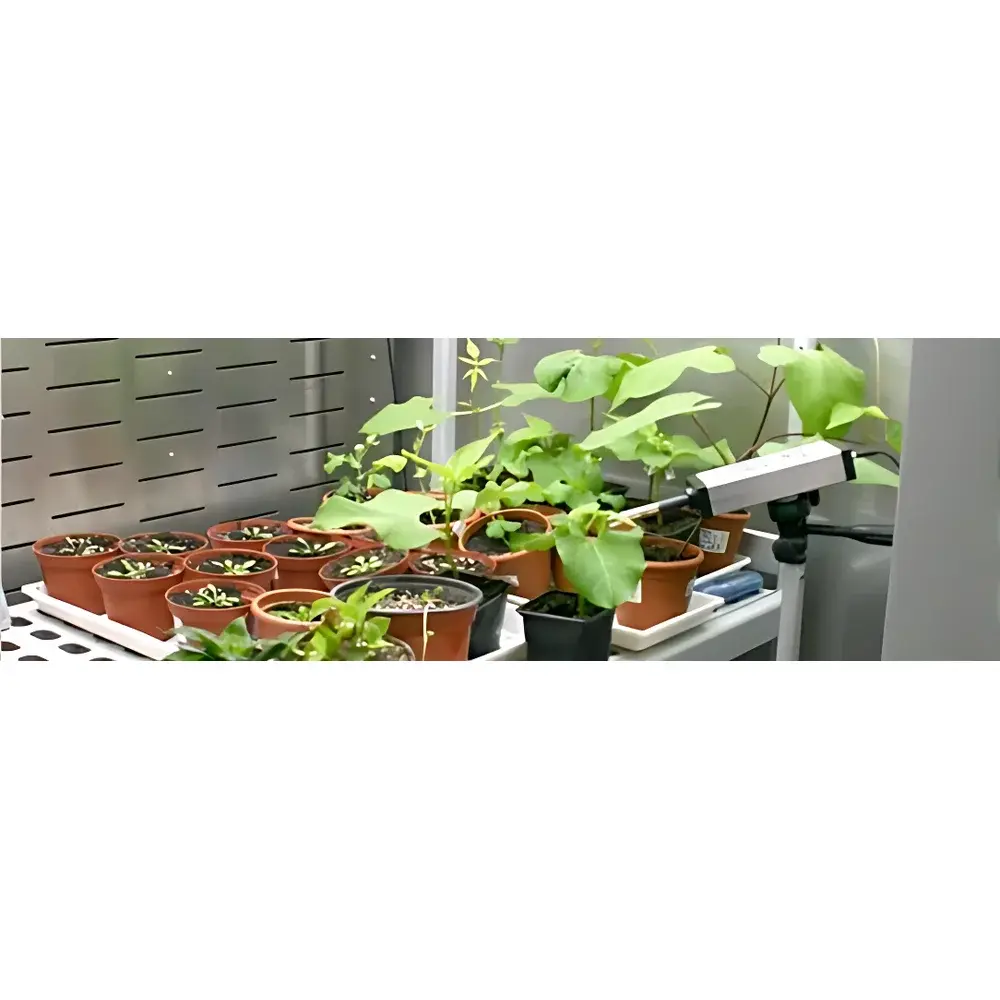
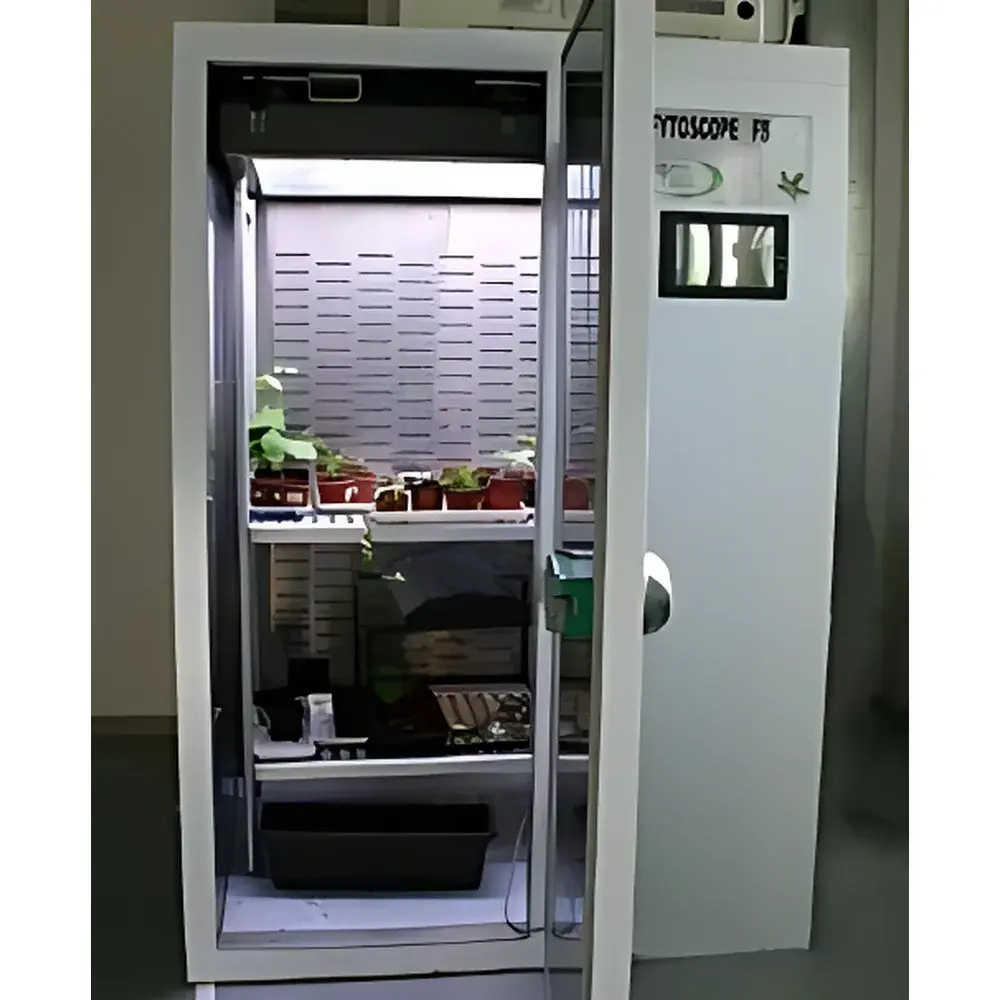
Fytoscopes FS3400 Large-Scale LED Illumination Plant Growth Chamber
| Origin | Czech Republic |
|---|---|
| Manufacturer Type | Authorized Distributor |
| Origin Category | Imported |
| Model | FS3400 |
| Price | Upon Request |
| External Dimensions (L×D×H) | 226 × 120 × 210 cm |
| Internal Height | 189 cm |
| Volume | 3400 L |
| Light Source | Cool White + Far-Red LEDs (independently controllable) |
| Maximum Photosynthetic Photon Flux Density (PPFD) | 1600 µmol·m⁻²·s⁻¹ at 125 cm distance |
| Uniform Illumination Area | 0.9 m² |
| Temperature Control Range | 0–45 °C (performance dependent on ambient conditions and lighting load) |
| Relative Humidity Range | 35–95 % RH |
| Programmable Parameters | Light intensity, spectral composition (via channel ratio), photoperiod, ramped dawn/dusk transitions, cloud-simulation cycles, temperature setpoints, humidity setpoints |
| Chlorophyll Fluorescence Monitoring | Automated Ft and Qy acquisition with integrated optical lens system |
| Optional Modules | High-precision multi-gas mixing system (up to 4 gases |
Overview
The Fytoscopes FS3400 Large-Scale LED Illumination Plant Growth Chamber is an engineered environmental simulation platform designed for reproducible, high-fidelity plant physiology and ecological research. Unlike conventional growth chambers relying on fluorescent or HID lamps, the FS3400 employs a fully programmable, spectrally tunable LED array as its sole illumination source—eliminating heat-induced thermal gradients and enabling precise control over photosynthetically active radiation (PAR) and far-red (FR) components critical for phytochrome-mediated developmental responses. Its 3400 L internal volume accommodates whole-plant studies across diverse species—from Arabidopsis thaliana rosettes to tall cereals such as maize, wheat, and rice—and supports in-chamber operator access for non-invasive phenotyping and sampling. The chamber integrates closed-loop regulation of temperature (0–45 °C), relative humidity (35–95 % RH), and dynamic light regimes—including sunrise/sunset ramping, stochastic cloud cover simulation, and multi-phase photoperiods—thereby replicating diurnal and seasonal environmental cues with sub-minute temporal resolution.
Key Features
- Full-spectrum LED illumination system with independently adjustable cool white (400–700 nm) and far-red (700–750 nm) channels, delivering up to 1600 µmol·m⁻²·s⁻¹ PPFD at 125 cm height with ≥90 % spatial uniformity across 0.9 m²
- 10.5-inch industrial-grade color touchscreen controller mounted on the front panel, providing real-time graphical visualization of setpoints and measured values for temperature, humidity, and all light parameters
- Embedded chlorophyll fluorescence monitoring module capable of automated, non-destructive acquisition of minimal fluorescence (Ft) and quantum yield of PSII (Qy) at user-defined intervals
- Modular gas control option supporting up to four independent gas streams (e.g., CO₂, N₂, O₂, synthetic air) with mass flow controllers calibrated per ISO 6145-7, enabling controlled atmosphere experiments compliant with ASTM D5197 and ISO 16142
- Programmable environmental logic engine allowing nested conditional sequences—for example, coupling humidity ramping with light intensity modulation during simulated drought recovery protocols
- Built-in diagnostic subsystem logging operational anomalies, sensor drift alerts, and actuator response latency; exportable logs support GLP/GMP traceability requirements
Sample Compatibility & Compliance
The FS3400 accommodates intact plant systems from seedling trays to mature canopy structures, with internal height (189 cm) and volumetric capacity permitting vertical growth studies without mechanical constraint. It is routinely deployed in laboratories conducting OECD TG 208 (terrestrial plant toxicity testing), ISO 11269-2 (photosynthesis inhibition assays), and US EPA OPPTS 850.4400 (plant metabolism studies). Optional gas mixing and fluorescence modules are validated for use under FDA 21 CFR Part 11-compliant configurations when paired with optional electronic signature and audit trail software. All sensors meet IEC 60751 Class A tolerance standards for Pt100 temperature probes and ISO 4611 humidity calibration traceability.
Software & Data Management
The embedded controller runs a deterministic real-time OS with deterministic scheduling for time-critical light transitions and sensor polling. Up to 100 user-defined environmental programs can be stored locally and edited via intuitive drag-and-drop interface. Environmental data—including fluorescence kinetics, temperature/humidity derivatives, and light spectral power distribution—are timestamped and exported via Ethernet (TCP/IP) or USB 2.0 in CSV or HDF5 format. Remote access is supported through secure HTTP(S) endpoints with role-based authentication, enabling centralized monitoring across multi-chamber installations. Optional software packages include compliance-ready data archiving with SHA-256 checksum validation and automatic metadata tagging per MIAPPE v1.1 standards.
Applications
- Phenotypic screening under climate-relevant stress combinations (e.g., elevated CO₂ + variable photoperiod + humidity cycling)
- Time-resolved analysis of non-photochemical quenching (NPQ) dynamics in response to rapid light transitions
- Long-term ecophysiological modeling of C₃/C₄ species under spectrally defined canopy shade treatments
- Cultivation of photoautotrophic microorganisms—including cyanobacteria and eukaryotic algae—when integrated with optional orbital shakers (ISO 8570-compliant mounting)
- Pre-clinical evaluation of agrochemical efficacy under standardized photobiological conditions per EPPO PM 7/112 guidelines
- Calibration reference chamber for field-deployable chlorophyll fluorometers (e.g., against PAM-2500 or IMAGING-PAM benchmarks)
FAQ
What is the maximum sustained PPFD achievable at plant canopy level?
The FS3400 delivers up to 1600 µmol·m⁻²·s⁻¹ PPFD at 125 cm above the baseplate; actual canopy-level irradiance depends on plant height, leaf area index, and reflectance properties.
Can the chlorophyll fluorescence module operate concurrently with full-spectrum illumination?
Yes—the integrated optical path uses pulsed saturation pulses synchronized with LED dimming cycles to avoid interference, ensuring accurate Qy measurement under active photosynthetic conditions.
Is remote firmware update supported over Ethernet?
Firmware updates require authenticated USB media insertion; network-based updates are disabled by default to maintain regulatory compliance and system integrity.
Does the chamber support third-party integration via Modbus or OPC UA?
Native protocol support includes HTTP RESTful API and ASCII serial command set; Modbus TCP and OPC UA gateways are available as certified add-on modules.
How is temperature uniformity validated across the growth volume?
Uniformity is characterized per ISO 16710 using 9-point thermocouple mapping under steady-state operation; typical deviation is ≤±0.8 °C at 25 °C setpoint with 500 µmol·m⁻²·s⁻¹ illumination.



