
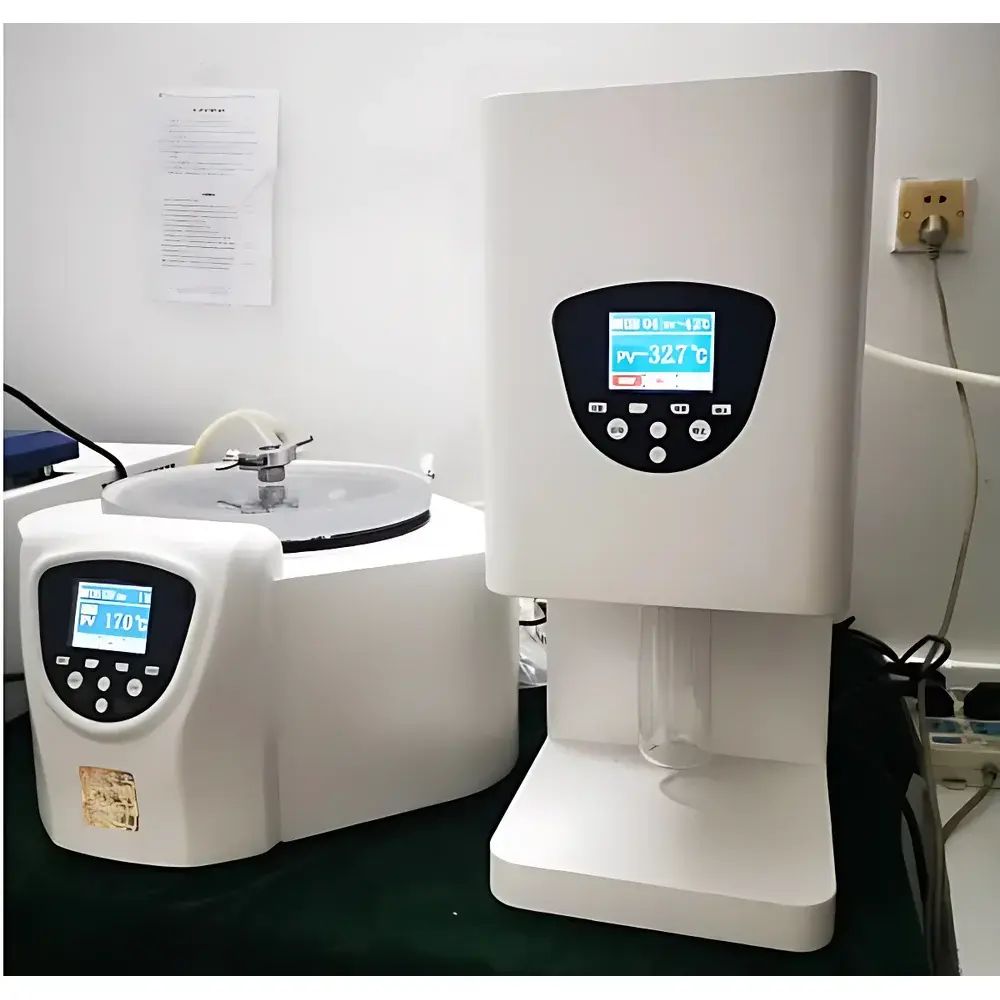
Herx ZLS-4 Vacuum Centrifugal Concentrator
| Brand | Herx |
|---|---|
| Origin | Hunan, China |
| Model | ZLS-4 |
| Instrument Type | Vacuum Centrifugal Concentrator |
| Temperature Range | Ambient to +60 °C (optional heating) |
| Temperature Control Accuracy | ±1 °C |
| Maximum Sample Capacity | 6 × 250 mL |
| Rotational Speed | 1500–2000 rpm |
| Vacuum Interface | φ12 mm |
| Power Supply | AC 220 V / 50 Hz |
| Max. Power Consumption | 1.5 kW |
| Noise Level | <50 dB(A) |
| Chamber Material | Anodized Aluminum Alloy |
| Display | TFT-LCD Touchscreen with Dual Keypad Interface |
| Drive System | Brushless DC Motor with Contactless Magnetic Drive |
| Cold Trap Options | CT40 or CT50 |
| Compatible Vacuum Pumps | Diaphragm Pump, Domestic Oil-Sealed Pump, or Imported Oil-Sealed Pump |
| Rotor Configurations | 2×96-well, 62×1.5 mL, 12×10 mL, 6×50 mL, 6×250 mL, or 6×2×50 mL |
| Optional Adapters | 6×5×20 mL |
Overview
The Herx ZLS-4 Vacuum Centrifugal Concentrator is an engineered solution for gentle, efficient, and scalable solvent removal from heat-sensitive biological and chemical samples. It operates on the principle of simultaneous centrifugation, vacuum-induced evaporation, and controlled thermal input—enabling rapid concentration without thermal degradation, foaming, or sample loss. Unlike rotary evaporation (limited to single-vessel processing) or lyophilization (time-intensive and energy-demanding), the ZLS-4 leverages moderate centrifugal force (1500–2000 rpm) to suppress bubble formation and prevent splashing, while vacuum lowers the boiling point of solvents—accelerating evaporation at ambient or precisely regulated temperatures (up to +60 °C). The system’s thermally uniform aluminum chamber—treated via anodized electrophoretic coating—resists corrosion from common organic solvents (e.g., ethanol, methanol, acetonitrile, chloroform) and aqueous buffers. Integrated cold trap compatibility (CT40/CT50) ensures high-efficiency condensate capture and solvent recovery, supporting both cost-effective operation and environmental compliance.
Key Features
- Modular split-body design enables flexible configuration with interchangeable rotors and optional accessories—supporting seamless workflow integration across diverse lab environments.
- Transparent polymethyl methacrylate (PMMA) lid allows real-time visual monitoring of sample status without interrupting vacuum or rotation.
- Microprocessor-based control system (using ELM327-compatible MCU and Infineon motor driver ICs) delivers stable, low-noise operation (<50 dB(A)) and precise parameter regulation.
- TFT-LCD color touchscreen with dual-input mode (touch + physical keys) displays both setpoints and real-time values—including centrifugal force (×g), temperature, vacuum level, and elapsed time.
- Programmable timer range: 1 minute to 99 hours 59 minutes—suitable for overnight unattended runs under GLP-compliant conditions.
- Optional heated chamber (ambient to +60 °C, ±1 °C accuracy) provides controllable thermal energy input to sustain evaporation kinetics without exceeding sample integrity thresholds.
- Corrosion-resistant anodized aluminum rotor chamber and non-contact magnetic drive eliminate maintenance requirements and reduce mechanical wear.
- Multiple rotor configurations accommodate volumes from 1.5 mL microcentrifuge tubes to 250 mL conical tubes—enabling high-throughput processing (up to 62 samples per run) with zero cross-contamination.
Sample Compatibility & Compliance
The ZLS-4 is validated for use with a broad spectrum of analytes and matrices requiring non-destructive concentration: nucleic acids (DNA/RNA in ethanol or isopropanol precipitates), oligonucleotides, peptides, PCR amplicons, HPLC fractions, SPE eluates, metabolites, forensic toxicology extracts, environmental water extracts, food residue standards, and pharmaceutical intermediates. Its operation aligns with widely adopted laboratory quality frameworks—including ISO/IEC 17025 method validation requirements for sample preparation steps, USP guidelines for evaporation-based sample handling, and FDA 21 CFR Part 11 considerations when paired with audit-trail-capable LIMS or ELN systems. The system supports traceable parameter logging (temperature, vacuum, time, speed) and includes over-temperature alarm functionality—facilitating compliance with GMP/GLP documentation standards for regulated bioanalytical laboratories.
Software & Data Management
While the ZLS-4 operates as a standalone instrument with embedded firmware, its programmable parameters (set temperature, vacuum threshold, rotational speed, duration) are fully recordable via manual logbooks or external data acquisition systems. The intuitive interface permits storage of up to 10 user-defined protocols—each preserving target temperature, vacuum setpoint, ramp profiles, and hold times. For laboratories implementing digital workflows, the device’s analog output signals (0–10 V or 4–20 mA) can be interfaced with SCADA or LabVIEW-based platforms for automated data capture and long-term trend analysis. All operational events—including power cycles, error codes, and alarm triggers—are timestamped internally and accessible via service diagnostics mode, supporting root-cause analysis during internal audits.
Applications
- DNA/RNA purification and ethanol precipitation recovery
- Concentration of low-abundance biomarkers from plasma, urine, or tissue homogenates
- Post-HPLC fraction collection and solvent exchange prior to MS analysis
- Solid-phase extraction (SPE) eluate concentration for pesticide residue screening
- Preparative-scale oligonucleotide synthesis workup
- ADMET study sample preparation (e.g., microsomal incubation supernatants)
- High-throughput screening (HTS) library compound concentration
- Toxicological and forensic sample cleanup (e.g., blood, hair, oral fluid extracts)
- Environmental analysis of PFAS, PAHs, or PCBs in aqueous extracts
- Stabilization of labile enzymes or antibodies prior to lyophilization or storage
FAQ
What vacuum pump is recommended for optimal performance with the ZLS-4?
For general aqueous and moderately volatile organic solvents (e.g., ethanol, acetone), a chemically resistant diaphragm pump is sufficient. For high-boiling-point solvents (e.g., DMSO, DMF) or continuous high-throughput operation, an oil-sealed vacuum pump—preferably imported with integrated gas ballast and vapor trap—is advised to maintain stable pressure below 10 mbar.
Can the ZLS-4 be used for lyophilization?
No. The ZLS-4 is not a freeze dryer; it does not include cryogenic cooling capability. It performs vacuum-assisted evaporation at or above ambient temperature—making it unsuitable for sublimation-based drying but ideal for rapid solvent removal where thermal lability is a concern.
Is remote monitoring or Ethernet connectivity supported?
The base ZLS-4 model lacks built-in network interfaces. However, analog signal outputs allow integration into centralized lab monitoring systems using third-party DAQ hardware and compatible software platforms.
How is solvent recovery achieved, and what maintenance does the cold trap require?
Condensed vapors are captured in the optional CT40 or CT50 cold trap, which operates at ≤−40 °C or ≤−50 °C respectively. Traps must be defrosted and emptied between runs when processing >50 mL total solvent volume; regular cleaning with isopropanol prevents residue buildup and maintains thermal efficiency.
Does the ZLS-4 meet CE or UL safety certification requirements?
The instrument complies with IEC 61010-1:2010 for electrical safety in laboratory equipment. CE marking is applicable for export to EU markets; UL listing requires additional regional certification testing and is available upon request for OEM or institutional procurement contracts.
Related Products



