
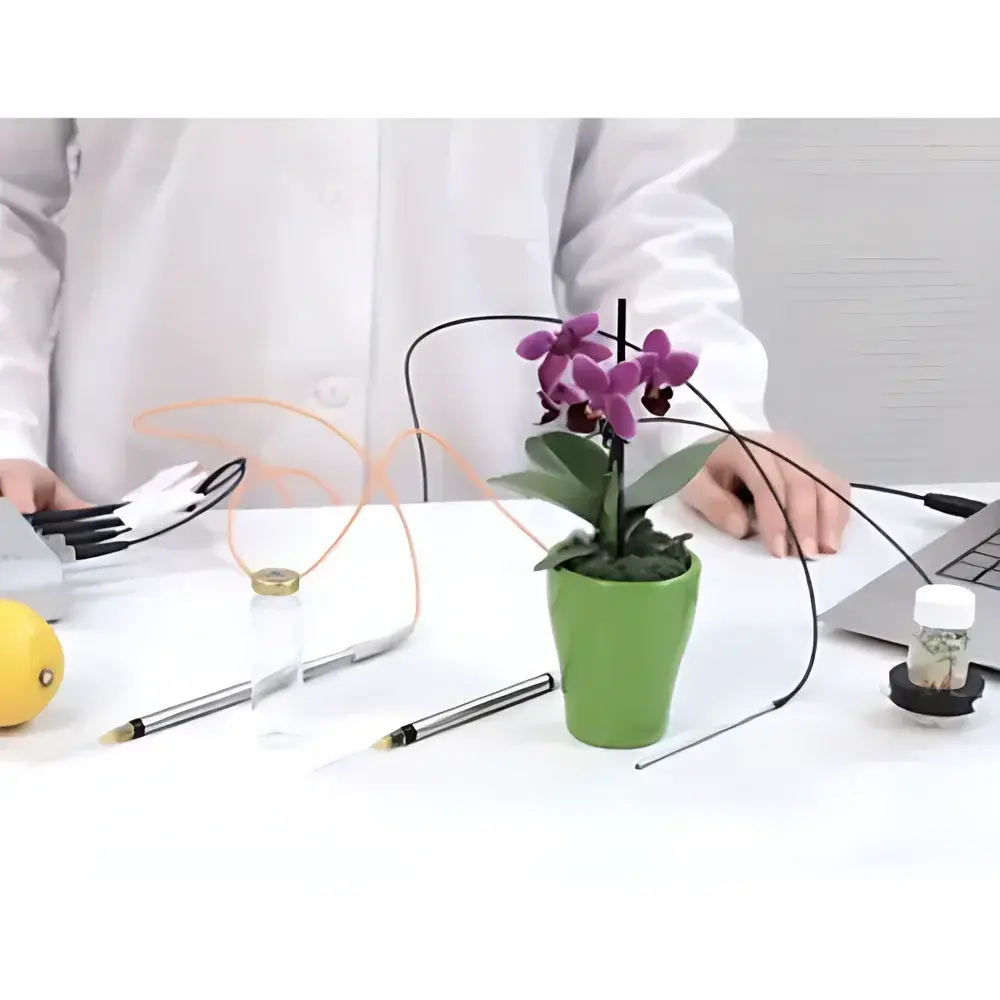
PyroScience RF-O2 Advanced Fluorescence-Based Fiber-Optic Oxygen Meter for Plant Physiology
| Brand | PyroScience |
|---|---|
| Origin | Germany |
| Model | RF-O2 Plant |
| Measurement Principle | Phase-Fluorescence Quenching (REDFLASH) |
| Oxygen Range (Full Scale) | 0–100% O₂ (gas phase), 0–44 mg/L (aqueous) |
| Oxygen Range (Trace) | 0–21% O₂ (gas), 0–9 mg/L (aqueous) |
| Detection Limit | 0.005% O₂ (gas), 0.002 mg/L (aq) |
| Sampling Frequency | Up to 20 Hz |
| Temperature Compensation | Real-time, integrated Pt100 channel |
| Environmental Operating Range | 0–50 °C, non-condensing |
| Interface | USB 2.0 (bus-powered), UART serial |
| Dimensions | 78 × 120 × 24 mm |
| Weight | 290 g |
| Software Suite | Pyro Workbench (acquisition & calibration), Pyro Data Inspector (respiration rate calculation, drift correction) |
| Compliance | ASTM D882-22 (oxygen permeability reference), ISO 20645:2021 (microbial respiration protocols), GLP-compliant audit trail in Pyro Workbench v3.8+ |
Overview
The PyroScience RF-O2 Advanced Fluorescence-Based Fiber-Optic Oxygen Meter for Plant Physiology is a precision-engineered, phase-fluorescence quenching instrument designed specifically for non-invasive, real-time oxygen monitoring in plant tissues and aquatic photosynthetic systems. It implements the patented REDFLASH (Red Fluorescence Lifetime Analysis for Sensing Hypoxia) optical sensing principle—where oxygen molecules dynamically quench the phosphorescence lifetime of immobilized ruthenium-based fluorophores embedded in sensor tips. Unlike electrochemical or Clark-type sensors, the RF-O2 consumes zero oxygen during measurement, eliminating artifacts from local oxygen depletion—a critical advantage when quantifying low-flux respiratory activity in delicate plant organs such as root tips, meristems, seeds, or algal colonies. Its fiber-optic architecture decouples sensing from electronics, enabling measurements in electrically noisy environments, high-magnetic-field setups (e.g., MRI-compatible phenotyping rigs), or confined geometries (e.g., microcosms, rhizoboxes, or leaf cuvettes). The system supports both gas-phase (0–100% O₂) and aqueous-phase (0–44 mg/L DO) operation with trace-mode capability down to 5 ppm O₂, making it suitable for hypoxic root-zone studies, anoxic seed germination assays, and high-resolution photobioreactor profiling.
Key Features
- Zero-oxygen-consumption measurement ensures metabolic integrity during long-term respirometry of intact plant tissues
- Multi-channel configurations (1/2/4 channels) allow simultaneous monitoring of spatial O₂ gradients across root zones, leaf laminae, or multi-species microcosms
- Integrated environmental compensation: on-board barometric pressure (300–1100 mbar, ±3 mbar accuracy) and relative humidity (0–100% RH, ±0.2% RH) sensors enable precise partial-pressure normalization for gas-phase data
- Real-time temperature compensation via dedicated Pt100 input channel; eliminates thermal drift in kinetic respiration assays
- Bus-powered USB 2.0 interface (20 mA @ 5 VDC) enables portable field deployment without external power supplies or battery management
- High temporal resolution up to 20 Hz supports dynamic response capture during light-dark transitions, flooding events, or rapid metabolic shifts
- Modular sensor ecosystem: interchangeable probe types—including micro-insertion needles (Ø150 µm), surface-adhesive films, flow-through chambers, and solvent-resistant bare fibers—for tissue-specific adaptation
- Analog output (0–2.5 VDC) and broadcast mode facilitate integration into third-party DAQ systems (e.g., NI CompactDAQ, LabJack) or custom environmental control platforms
Sample Compatibility & Compliance
The RF-O2 system accommodates heterogeneous biological matrices without sample preparation or chemical reagents. Solid plant tissues (roots, hypocotyls, floral buds, tubers, calli) are measured using sterile micro-probes inserted under stereomicroscopic guidance or surface-mounted optical films applied directly to epidermal layers. Liquid-phase applications include algal suspensions in stirred bioreactors, sediment porewater profiling via optode-tipped micropipettes, and dissolved O₂ kinetics in sealed respirometry vials. Sensor materials comply with ISO 10993-5 (cytotoxicity) and USP Class VI standards, ensuring compatibility with live-cell imaging and long-duration incubations. All firmware and software modules adhere to GLP requirements per FDA 21 CFR Part 11: electronic signatures, version-controlled calibration logs, immutable audit trails, and user-access-level permissions are fully implemented in Pyro Workbench v3.8+. Data export formats (CSV, HDF5, MATLAB .mat) support traceability in ISO/IEC 17025-accredited labs.
Software & Data Management
Pyro Workbench serves as the central acquisition and configuration hub, supporting concurrent operation of up to 10 PyroScience devices. It provides hardware-level sensor calibration (two-point: 0% O₂ via sodium dithionite capsule, 20.9% O₂ ambient air), automatic drift correction, and real-time visualization of O₂ concentration, temperature, pressure, and humidity. Raw fluorescence phase data are stored alongside metadata (sensor ID, calibration date, operator, experimental notes) in timestamped binary archives compliant with FAIR principles. Pyro Data Inspector performs post-acquisition analysis including linear/nonlinear regression of O₂ decline curves, calculation of mass-specific respiration rates (nmol O₂·g⁻¹·min⁻¹), statistical comparison across treatments (ANOVA with Tukey HSD), and baseline drift modeling using Savitzky-Golay filtering. Exported datasets retain full provenance for integration into R, Python (Pandas/SciPy), or commercial statistics packages (JMP, GraphPad Prism).
Applications
- Quantification of organ-specific respiratory demand: e.g., differential O₂ consumption in tomato hypocotyls vs. roots under partial submergence (Mignolli et al., Plant Cell Environ. 2021)
- In situ hypoxia mapping in Arabidopsis crown gall tumors induced by Agrobacterium tumefaciens, revealing localized metabolic reprogramming (Tanaka et al., Front. Plant Sci. 2019)
- Net photosynthetic O₂ evolution kinetics in isolated thylakoids or intact algal cells under variable PAR and CO₂ regimes
- Respiratory inhibition screening for mitochondrial electron transport chain inhibitors (e.g., antimycin A, rotenone) in excised root segments
- Long-term O₂ dynamics in soil-rhizosphere microcosms, correlating with microbial community shifts assessed via 16S rRNA sequencing
- Validation of computational models of O₂ diffusion in plant vascular bundles using high-spatial-resolution sensor arrays
FAQ
How does the RF-O2 differ from traditional Clark-type oxygen electrodes?
The RF-O2 uses optical fluorescence quenching rather than electrochemical reduction, eliminating cathodic O₂ consumption, electrolyte leakage, and electrode poisoning—critical for repeated measurements on living plant tissues.
Can I measure oxygen inside intact leaves without damaging photosynthetic function?
Yes—surface-mount optical films (e.g., OXYFILM-100) provide non-penetrative, reversible O₂ monitoring with micron-scale spatial resolution and minimal light absorption interference.
Is the system compatible with automated phenotyping platforms?
Yes—USB HID emulation and ASCII-based UART protocol enable seamless integration with conveyor-based imaging systems, robotic arm handlers, and climate-controlled growth chambers via standard industrial controllers.
What is the recommended recalibration interval for long-term experiments?
For GLP-compliant workflows, recalibrate before each experimental block using certified zero- and span-gas standards; Pyro Workbench logs all calibration events with digital signatures.
Does the software support batch processing of multiple respirometry time-series?
Yes—Pyro Data Inspector includes scriptable batch analysis mode for automated respiration rate extraction across hundreds of samples, with customizable QC thresholds and outlier rejection algorithms.
Related Products




