
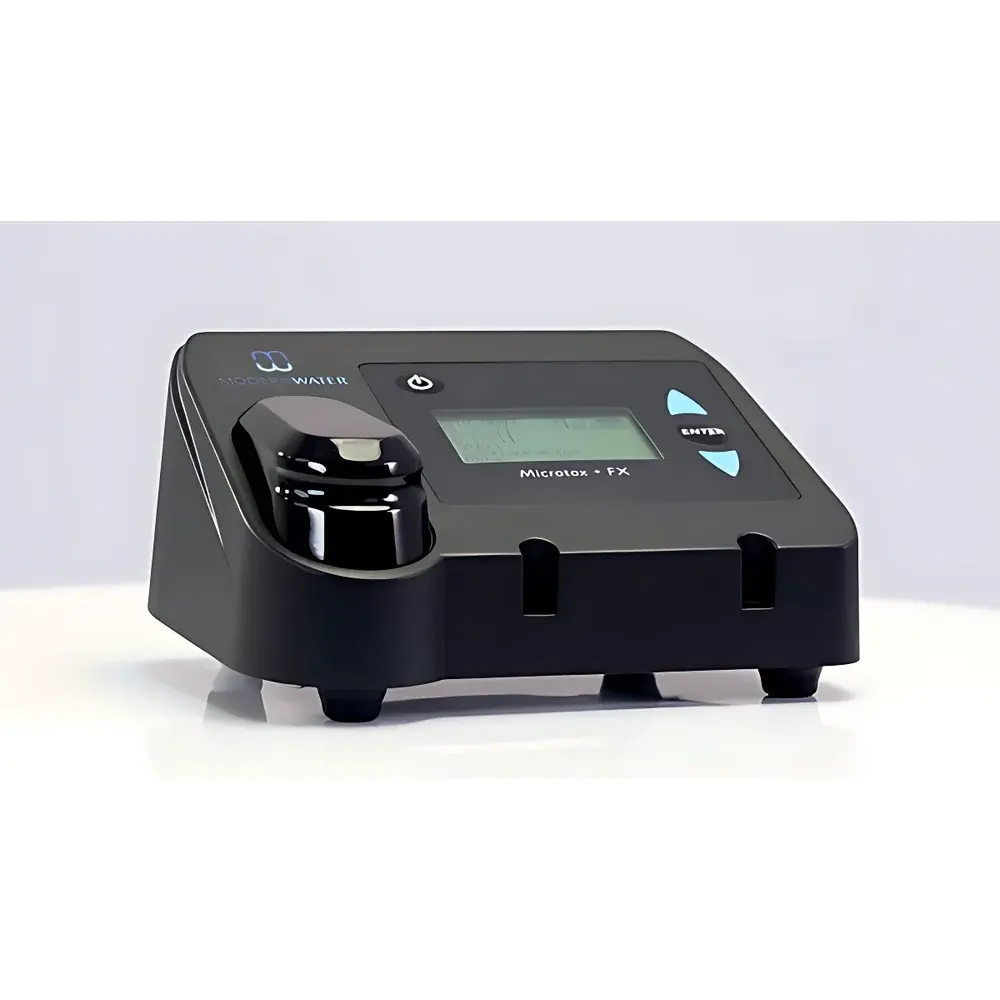
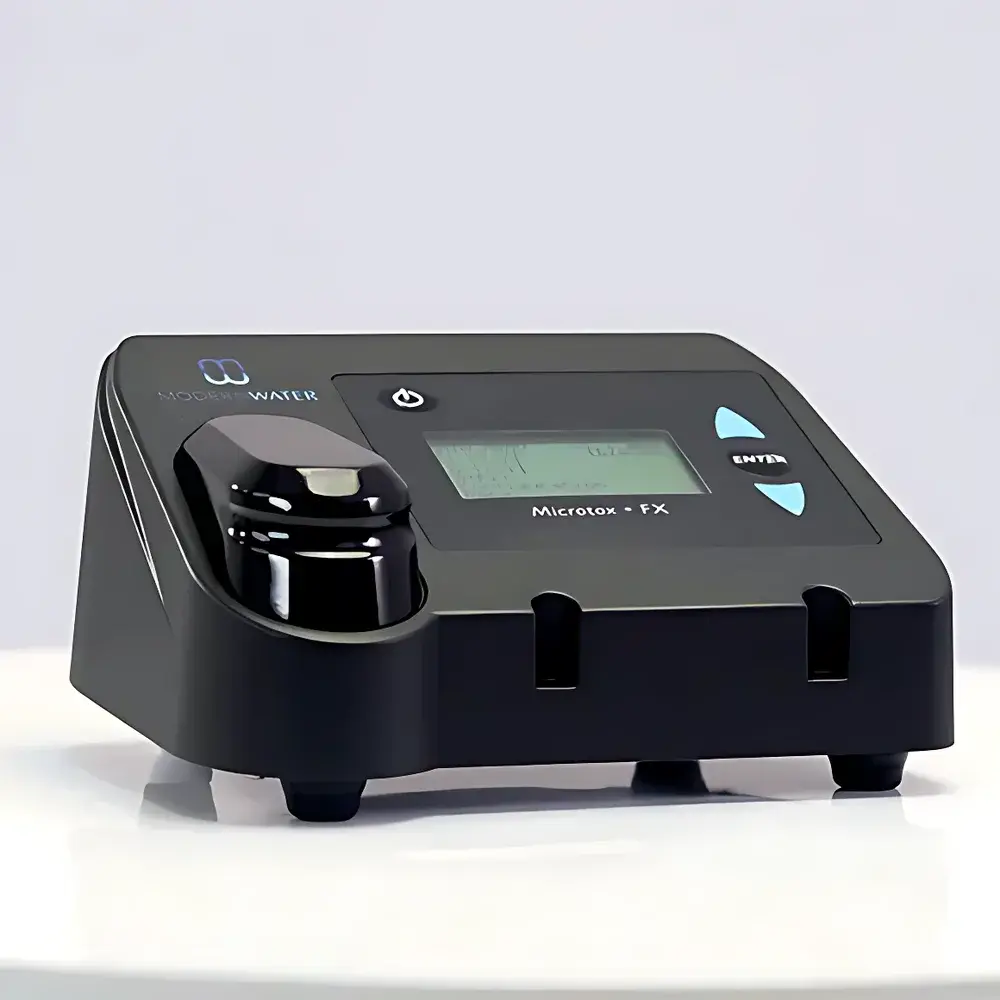
Modern Water Microtox® FX Portable Bioluminescent Toxicity Analyzer
| Brand | Modern Water |
|---|---|
| Origin | United Kingdom |
| Manufacturer Type | Authorized Distributor |
| Origin Category | Imported |
| Model | Microtox® FX |
| Instrument Type | Portable |
| Biological Agent | Aliivibrio fischeri (bioluminescent bacteria) |
| Operating Temperature | 0°C – 40°C |
| Reagent Storage/Use Temperature | 10°C – 28°C |
| Repeatability | CV < 20% in Q-Tox and B-Tox modes |
| Photon Counting Range | 1 – ~60,000,000 counts |
| Assay Duration | 1–60 minutes |
Overview
The Modern Water Microtox® FX is a field-deployable, dual-function bioluminescence-based analyzer engineered for rapid, quantitative assessment of acute aquatic toxicity and microbial contamination. It leverages the well-characterized metabolic response of the marine bacterium Aliivibrio fischeri, which emits visible light (λmax ≈ 490 nm) as a byproduct of cellular respiration via the luciferase enzyme system. In the presence of toxicants—whether organic pollutants, heavy metals, pesticides, or industrial effluents—the electron transport chain is disrupted, leading to an immediate, dose-dependent reduction in bioluminescent output. Simultaneously, the instrument supports ATP-based microbiological quantification using firefly luciferin–luciferase reagents, where each ATP molecule catalyzes a single photon emission event. This dual-mode capability enables concurrent evaluation of chemical toxicity and viable biomass—critical for source water protection, emergency response, and process water integrity monitoring.
Key Features
- Dual-mode operation: Integrated toxicity screening (Q-Tox/B-Tox protocols) and ATP quantification in a single compact platform
- Field-optimized design: Ruggedized, IP54-rated enclosure with integrated rechargeable Li-ion battery supporting 8–10 hours of continuous operation under typical assay conditions
- Optimized photodetection: Thermoelectrically stabilized photomultiplier tube (PMT) with high quantum efficiency (>25% at 490 nm) and low dark current (<0.5 pA)
- Standardized assay kinetics: Pre-programmed exposure durations (5, 15, 30 min) aligned with ISO 11348-3 and ASTM D5660-17 guidelines for acute toxicity testing
- Reagent compatibility: Supports lyophilized A. fischeri test kits (Microtox® Acute Reagents) and commercial ATP assay reagents compliant with ISO 22118 and EPA Method 1681
- Onboard calibration: Automatic dark-current compensation and real-time photomultiplier gain stabilization ensure measurement consistency across ambient temperature gradients (0–40°C)
Sample Compatibility & Compliance
The Microtox® FX accepts liquid samples without filtration in most cases—including raw surface water, treated drinking water, wastewater effluents, industrial process streams, stormwater runoff, and elutriates from sediments or soils. For turbid or particulate-laden matrices, optional centrifugation or membrane filtration (0.45 µm) is recommended per ISO 11348-1. All toxicity results are reported as % inhibition relative to solvent controls and converted to EC50 values using probit or logistic regression models embedded in the firmware. The system complies with GLP principles for field data capture, maintains full audit trails (user ID, timestamp, assay parameters), and supports 21 CFR Part 11-compliant electronic signatures when paired with validated software configurations. Manufacturing adheres to ISO 13485:2016 for medical device–grade quality management—ensuring traceability of critical components including PMT assemblies and optical filters.
Software & Data Management
Instrument control, data acquisition, and reporting are managed via the Microtox® Omni Software (v5.x), compatible with Windows 10/11. The software provides real-time luminescence decay curve visualization, automated EC50 calculation with confidence intervals (95%), and batch export to CSV, PDF, or LIMS-ready XML formats. Raw photon count data includes metadata tags for sample ID, operator, location (GPS-enabled when connected to external module), reagent lot number, and environmental conditions. Audit logs record all parameter changes, result overrides, and user logins—supporting regulatory review under EPA, EU WFD, and WHO Guidelines for Drinking-water Quality. Firmware updates are digitally signed and verified prior to installation to maintain cryptographic integrity.
Applications
- Rapid screening of drinking water distribution systems during contamination events (e.g., accidental spills, infrastructure breaches)
- Pre-compliance verification of industrial discharge permits against local toxicity limits (e.g., Canada’s Wastewater Systems Effluent Regulations)
- Monitoring biofouling potential in cooling towers and recirculating industrial water loops via ATP trends
- Field validation of remediation effectiveness at brownfield sites using sediment/water elutriate assays
- Emergency response triage for unknown chemical releases—providing actionable toxicity thresholds within minutes, independent of compound-specific identification
- Validation of UV disinfection efficacy through parallel ATP depletion and toxicity neutralization metrics
FAQ
How does Microtox® FX differentiate between cytotoxic and metabolic inhibitors?
The instrument does not identify mechanisms of action; it measures net respiratory inhibition. However, comparative kinetic profiling (e.g., 5-min vs. 30-min exposure) combined with reference toxicant libraries can support preliminary mechanistic inference.
Can the system quantify specific contaminants like heavy metals or pesticides?
No—it provides a functional, whole-effluent toxicity endpoint. Compound-specific identification requires complementary techniques such as ICP-MS or GC-MS.
Is calibration required before each use?
No daily calibration is needed; the system performs automatic dark-current and gain normalization at startup. Annual PMT sensitivity verification using NIST-traceable light sources is recommended.
What is the shelf life of the lyophilized A. fischeri reagents?
When stored at –20°C, unopened vials retain viability for ≥24 months; after reconstitution, they remain stable for 48 hours at 10–15°C.
Does the instrument meet regulatory acceptance criteria for compliance reporting?
Yes—its methodology is cited in multiple national frameworks, including the U.S. EPA’s Whole Effluent Toxicity (WET) testing guidance and the EU’s Water Framework Directive Annex V biological monitoring protocols.







