
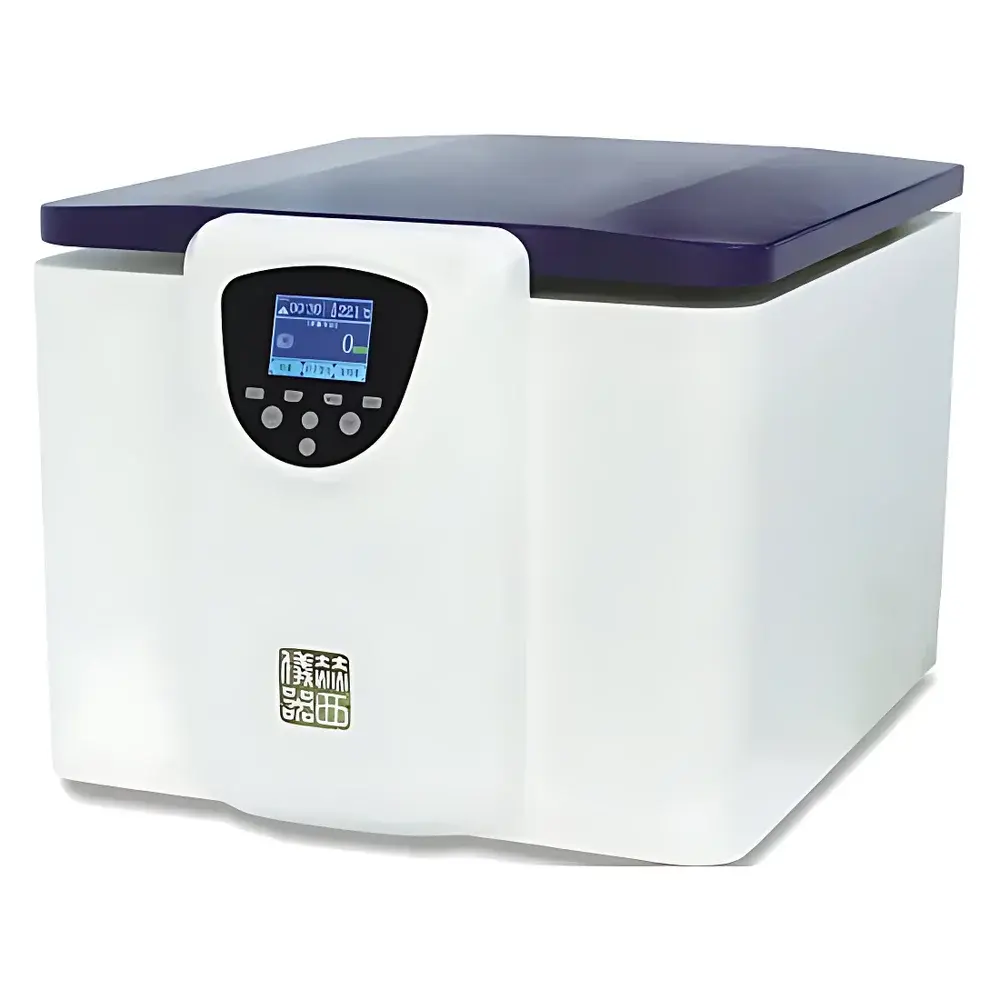
Hesix DD5 Benchtop Low-Speed High-Capacity Centrifuge
| Brand | Hesix |
|---|---|
| Origin | Hunan, China |
| Model | DD5 |
| Instrument Type | Benchtop Centrifuge |
| Max Speed | 5000 rpm |
| Max RCF | 4800 ×g |
| Max Capacity | 4 × 500 mL |
| Acceleration/Deceleration | 10-step control |
| Timer Range | 1–99 min / Continuous / Short Spin |
| Noise Level | ≤60 dB(A) |
| Power Supply | AC 220 V, 50 Hz |
| Weight | 65 kg |
| Dimensions (L×W×H) | 630 × 500 × 420 mm |
| Certifications | CFDA Registered, ISO 9001:2015 & ISO 13485:2016 Compliant |
| Rotor Types | Fixed-angle, Horizontal, Microplate (96-well), Vacuum Blood Tube Adapters |
Overview
The Hesix DD5 Benchtop Low-Speed High-Capacity Centrifuge is engineered for reliable, high-throughput separation of biological, clinical, and pharmaceutical samples in regulated laboratory environments. Designed according to core principles of sedimentation centrifugation—leveraging differential particle density and size under controlled gravitational forces—the DD5 delivers consistent performance at speeds up to 5000 rpm and relative centrifugal forces (RCF) up to 4800 ×g. Its 4 × 500 mL maximum capacity enables efficient processing of large-volume clinical specimens such as whole blood, plasma, serum, cell suspensions, and vaccine preparations without requiring batch splitting or repeated runs. The instrument operates within the low-speed centrifugation range (≤5000 rpm), making it particularly suited for applications where structural integrity of fragile cells, organelles, or macromolecular complexes must be preserved—such as peripheral blood mononuclear cell (PBMC) isolation, platelet-rich plasma (PRP) preparation, and diagnostic immunoassay workflows.
Key Features
- Brushless AC motor with high-torque output and integrated driver module (Infineon) ensures stable rotational dynamics, minimal thermal drift, and extended service life.
- Triple-stage damping system combined with precision-balanced rotor assembly reduces mechanical vibration and acoustic emission to ≤60 dB(A), supporting compliance with ISO 14040-based lab noise management protocols.
- TFT-LCD color display with dual-input interface (capacitive touch + physical keys) supports real-time monitoring of setpoint vs. actual values—including speed, RCF, time, and temperature (if equipped with refrigerated variant)—with on-the-fly parameter adjustment during active runs.
- Biocontainment-compliant fixed-angle rotors feature seamless silicone O-rings conforming to EU RoHS Directive 2015/863, preventing aerosol escape during high-risk biospecimen handling.
- Stainless steel 304 centrifuge chamber, powder-coated steel housing, and triple-layer reinforced front panel meet IEC 61010-1 safety requirements for Class II medical electrical equipment.
- Intelligent door-lock mechanism utilizes electromagnetic latching activated by gentle lid closure—eliminating manual locking steps while ensuring interlock integrity per EN 61010-2-020.
- Programmable deceleration profiles (10 selectable rates) minimize resuspension of pelletized material; 20 user-defined protocols can be stored and recalled with one-touch activation.
Sample Compatibility & Compliance
The DD5 accommodates a broad spectrum of primary and secondary sample containers, including standard conical tubes (5–500 mL), vacuum blood collection tubes (2–15 mL), microtiter plates (96-well, 2 × 96, 4 × 96 formats), and deep-well plates. All rotors are manufactured from aerospace-grade forged aluminum (angle rotors) or reinforced polyamide composites (horizontal buckets), certified for autoclaving at 121°C for 20 minutes. The device holds CFDA registration (Class II medical device) and production license, and its quality management system is independently audited and certified to ISO 9001:2015 and ISO 13485:2016 standards—ensuring traceability, documentation control, and design validation aligned with FDA 21 CFR Part 820 and EU MDR Annex II requirements.
Software & Data Management
While the DD5 operates as a standalone instrument with embedded firmware, its operational logs—including run ID, timestamp, rotor ID, speed, RCF, duration, and fault codes—are retained in non-volatile memory for ≥10,000 cycles. Audit trail functionality complies with GLP and GMP data integrity expectations: all parameter changes during runtime are timestamped and attributed, and no record can be deleted or overwritten. Optional RS-232/USB interfaces support export of CSV-formatted run reports for integration into LIMS or ELN platforms. Firmware updates follow secure signed-package protocols compliant with IEC 62443-3-3 SL2 cybersecurity guidelines.
Applications
- Clinical diagnostics: Serum/plasma separation from whole blood, urinalysis sediment concentration, CSF processing.
- Vaccinology & biologics: Clarification of bacterial lysates, harvest of viral vectors, purification of recombinant proteins.
- Transfusion medicine: PRP and platelet-poor plasma (PPP) preparation, red blood cell washing.
- Research labs: Isolation of extracellular vesicles, nucleic acid precipitation, yeast/bacterial pellet harvesting.
- Pharmaceutical QC: Stability testing of suspensions, particulate matter analysis per USP , excipient homogeneity verification.
FAQ
Is the DD5 suitable for use in GLP-compliant laboratories?
Yes—the device’s audit-trail-enabled firmware, ISO 13485-certified manufacturing, and full parameter logging meet key GLP data integrity requirements outlined in OECD Principles of Good Laboratory Practice.
Can horizontal rotors be used for vacuum blood tube processing?
Yes—multiple horizontal bucket configurations support direct centrifugation of standard 5 mL, 7 mL, and 10 mL vacuum tubes, including gel-separator types, at up to 4000 rpm and 3420 ×g.
Does the DD5 offer temperature control?
The base model is non-refrigerated; however, a refrigerated variant (DD5-R) is available with PID-controlled cooling from ambient to –20°C, validated per ISO 13485 thermal uniformity specifications.
What safety certifications does the DD5 hold?
The unit conforms to IEC 61010-1 (safety), IEC 61000-6-3 (EMC), and EN 61010-2-020 (centrifuge-specific mechanical safety), in addition to CFDA and ISO 13485 regulatory approvals.
How often should rotor calibration be performed?
Rotor calibration is not required for routine operation; however, periodic verification of speed accuracy (±50 rpm tolerance) and RCF calculation is recommended annually using NIST-traceable tachometry equipment, as specified in the maintenance manual.



