
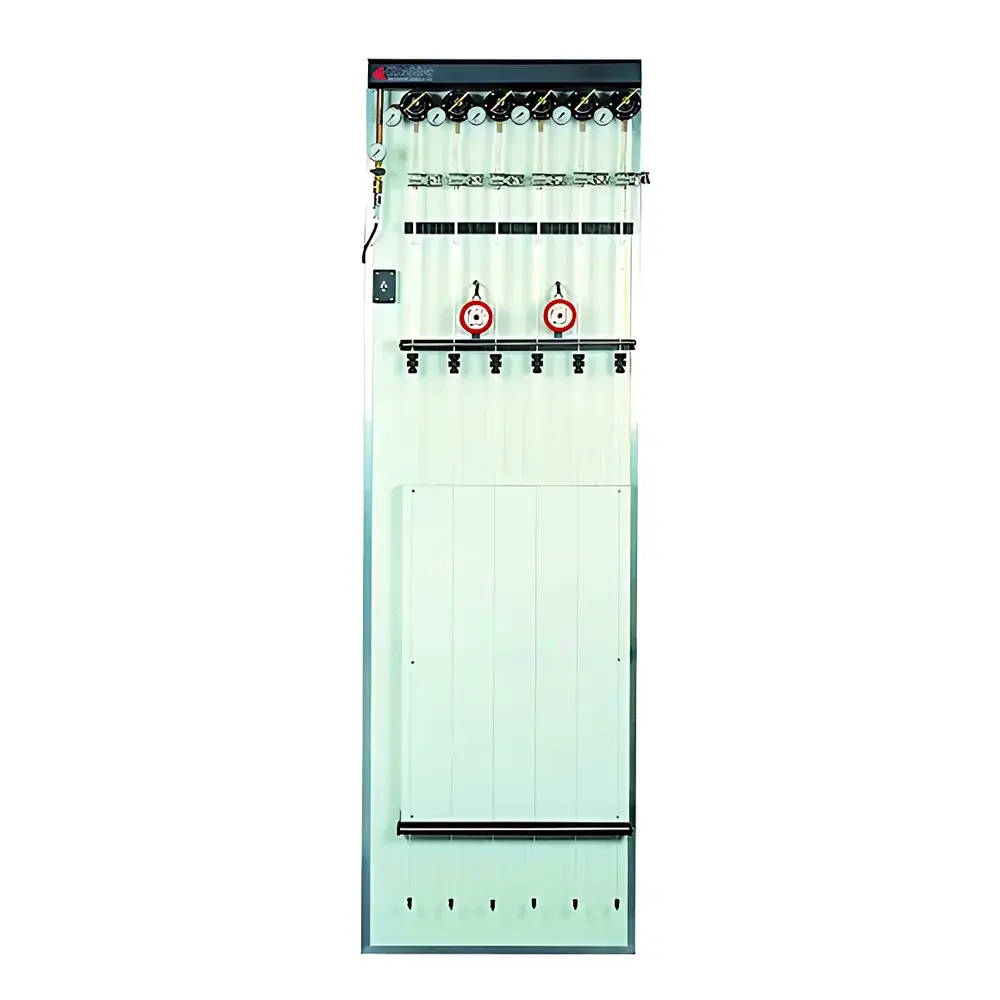
Koehler K41594 Fluorescent Indicator Adsorption (FIA) Hydrocarbon Analyzer for Liquid Petroleum Products
| Brand | Koehler |
|---|---|
| Origin | USA |
| Model | K41594 |
| Application Method | Fluorescent Indicator Adsorption (ASTM D1319) |
| Max Sample Boiling Point | ≤315°C |
| Column Configurations | 2-, 4-, or 6-position |
| Operating Pressure Range | 0–15 psi |
| Power Supply | 230 V, 50/60 Hz |
| Dimensions (W×D×H) | 20 × 66 × 208 cm |
| Weight | 45.5 kg |
| Analysis Tube ID × Length | 3 mm × 1200 mm |
| Column Sealing | O-ring compression fitting |
| Silica Gel Loading | Integrated porous polyethylene disc + electronic shaker (on/off + amplitude control) |
| Pressure Control | Independent regulator per column |
| Material | Stainless steel clamping seals |
Overview
The Koehler K41594 Fluorescent Indicator Adsorption (FIA) Hydrocarbon Analyzer is a precision-engineered laboratory instrument designed for the quantitative determination of saturates, olefins, and aromatics in liquid petroleum distillates boiling below 315°C. It implements the standardized fluorescent indicator adsorption method described in ASTM D1319, as well as aligned specifications in IP 147, ISO 3575, and UOP 21. The system operates on the principle of differential adsorption affinity between hydrocarbon classes on activated silica gel, enhanced by a fluorescent dye mixture that co-migrates with each fraction. Under ultraviolet illumination, distinct, sharply defined bands—aromatics (violet), olefins (blue), and saturates (yellow)—appear along the length of the calibrated adsorption column. Volume percent composition is determined directly from band length measurements relative to the total resolved hydrocarbon zone, eliminating reliance on gravimetric corrections or external calibration curves.
Key Features
- Modular multi-column architecture supporting 2-, 4-, or 6-position configurations for single or parallel FIA analyses—enabling throughput flexibility without compromising reproducibility.
- Independent stainless steel pressure regulation per column, with continuous digital pressure indication and fine-tuned control across 0–15 psi range—critical for consistent elution kinetics and band resolution.
- O-ring compression sealing system simplifies rapid attachment/detachment of analysis tubes to upper column assemblies, minimizing downtime between runs and reducing operator-induced variability.
- Optimized geometric fittings—including tapered adapters and quick-release twist-lock couplings—for seamless transitions between standard 3 mm I.D. analysis tubes (1200 mm length) and auxiliary components.
- Integrated porous polyethylene support disc within each analysis tube ensures uniform silica gel bed formation and prevents channeling during dry packing or solvent elution.
- Dedicated electronic oscillator with on/off toggle and adjustable amplitude setting facilitates controlled, repeatable dry-silica loading—reducing void formation and improving column efficiency and inter-run consistency.
Sample Compatibility & Compliance
The K41594 is validated for use with gasoline, naphthas, reformates, hydrotreated distillates, and other light petroleum fractions meeting the volatility and boiling point constraints of ASTM D1319. It supports both neat samples and those pre-treated per ASTM D4057 (manual sampling) or D5842 (automated sampling). All wetted parts are chemically resistant to hydrocarbons and common eluents (e.g., isopropyl alcohol, 95% ethanol). The instrument design conforms to general laboratory safety standards (ANSI Z535, IEC 61010-1), and its mechanical stability supports GLP-compliant operation when paired with documented SOPs and analyst training records. While the analyzer itself does not generate electronic audit trails, its manual measurement protocol is fully compatible with FDA 21 CFR Part 11–governed environments when integrated into paper-based or LIMS-linked data capture workflows.
Software & Data Management
The K41594 is a benchtop hardware platform with no embedded microprocessor or proprietary software. All calculations—including band-length interpolation, volume percent derivation, and reporting—are performed manually using the calibrated scale printed on each analysis tube or via optional Koehler-supplied calculation worksheets (K-DOC-1319 Rev. C). This analog-first architecture ensures full transparency, eliminates firmware dependency, and simplifies validation in regulated laboratories where software qualification burdens must be minimized. Users may digitize results using validated spreadsheets or LIMS interfaces; Koehler provides traceable reference materials (e.g., K-STD-1319 Calibration Kits) and uncertainty budgets aligned with ISO/IEC 17025 requirements for method verification.
Applications
- Quality control of motor gasoline and aviation turbine fuels per ASTM D4814 and D1655 specifications.
- Refinery process monitoring of catalytic reformer and fluid catalytic cracker (FCC) naphtha streams.
- Research-grade hydrocarbon class distribution profiling for fuel formulation studies and additive interaction assessments.
- Regulatory compliance testing for benzene content estimation (indirectly, via aromatic band correlation) and olefin saturation tracking in downstream hydrotreating units.
- Educational use in petroleum engineering curricula to demonstrate chromatographic separation fundamentals and adsorption thermodynamics.
FAQ
What standards does the K41594 explicitly support?
ASTM D1319, IP 147, ISO 3575, and UOP 21—covering hydrocarbon type analysis of petroleum distillates up to 315°C.
Can the instrument accommodate non-standard tube dimensions?
No—the system is engineered exclusively for 3 mm I.D. × 1200 mm glass analysis tubes with integrated polyethylene support discs; dimensional deviations compromise band resolution and quantitative accuracy.
Is operator training required for method compliance?
Yes—ASTM D1319 mandates documented analyst competency, including visual band interpretation under UV light, pressure stabilization technique, and meniscus alignment during measurement; Koehler offers on-site or virtual application training (K-TRN-FIA-01).
How is method precision verified?
Via repeated analysis of certified reference materials (CRMs) such as NIST SRM 2710a or Koehler K-STD-1319 series, with repeatability assessed against ASTM D1319’s stated limits (e.g., ≤1.0 vol% R for aromatics in gasoline).
Does the unit require preventive maintenance beyond routine cleaning?
Yes—quarterly inspection of O-rings, pressure regulator calibration, and oscillator amplitude verification are recommended; full service intervals are outlined in the K41594 Maintenance Manual (K-MAN-K41594 Rev. B).





