
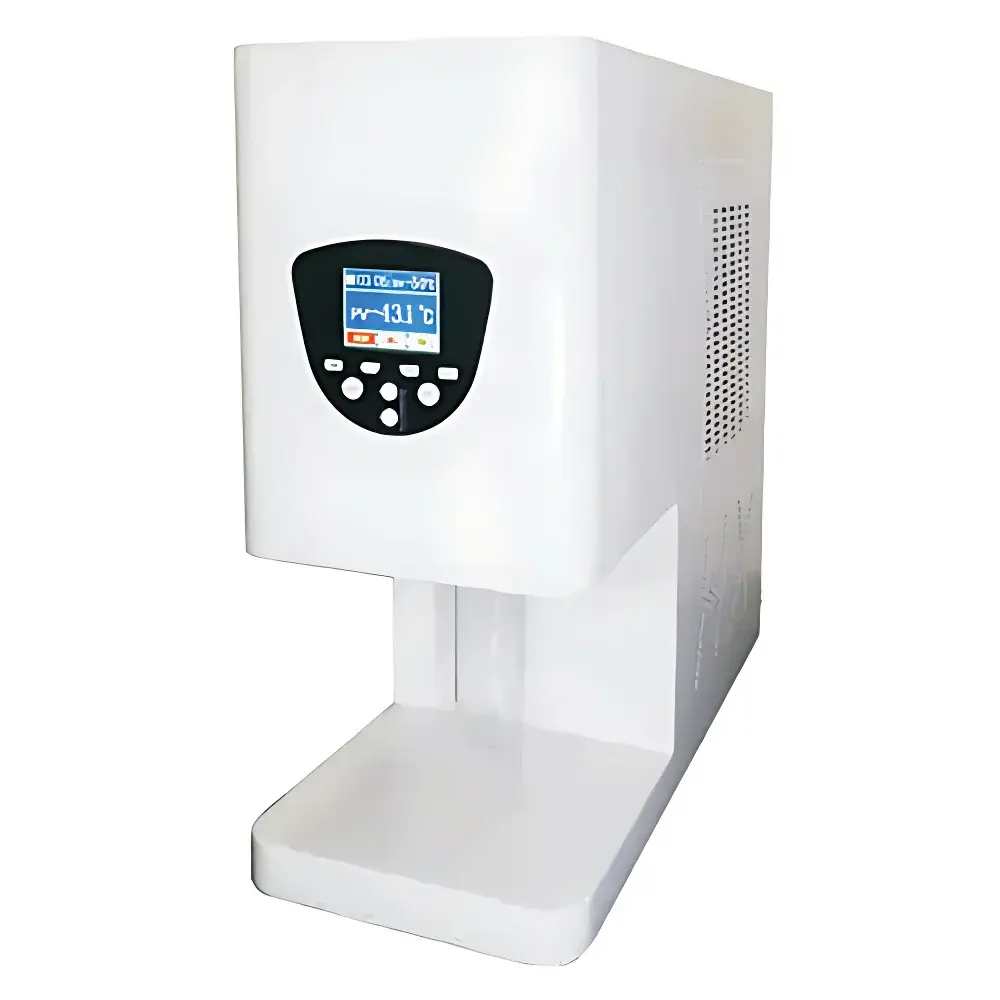
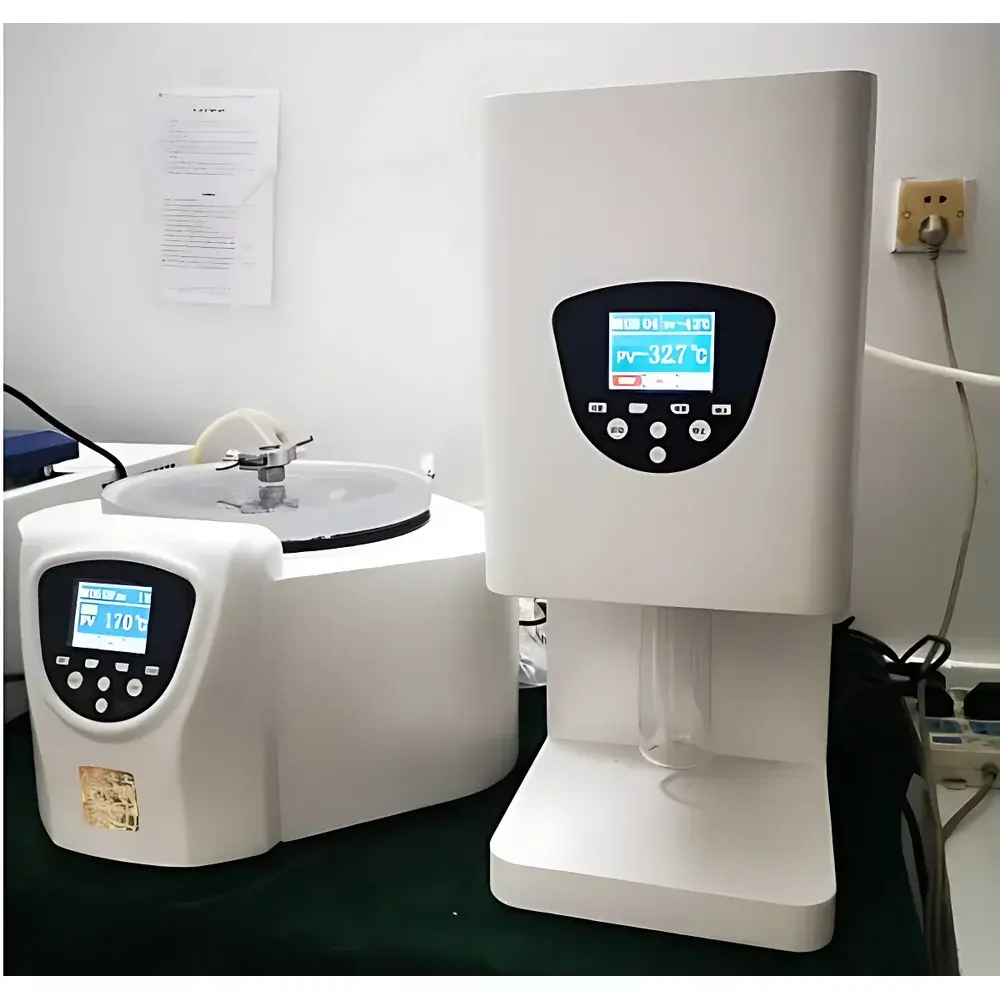
Hexion CT-50 Cryogenic Cold Trap
| Brand | Hexion |
|---|---|
| Model | CT-50 |
| Temperature Range | –50 °C to Ambient |
| Adjustable Setpoint Range | –45 °C to Ambient |
| Temperature Control Accuracy | ±1 °C |
| Cooling Method | Compressor-based, R404a Refrigerant |
| Max. Power Consumption | 380 W |
| Condensing Surface Area | 760 cm² |
| Max. Solvent Capture Capacity | 284 mL/6 h (Ethanol, –35 °C to –40 °C) / 260 mL/12 h (Water, –15 °C) |
| Collection Vessel Options | 300 mL or 600 mL Borosilicate Glass |
| Dimensions (W×D×H) | 580 × 250 × 560 mm |
| Weight | 54 kg |
| Protection Features | Compressor Overload Protection, High-Pressure Cut-off, Timed Compressor Rest, Auto-Demand Defrost Control, Thermal Self-Regulation |
| Interface | TFT-LCD Touch + Physical Keypad |
| Circulation Type | Closed-loop |
| Power Supply | AC 220 V, 50 Hz, 15 A |
| Operating Ambient | 15–30 °C |
| Inlet/Outlet Port | Φ12 mm Bayonet Fitting |
Overview
The Hexion CT-50 Cryogenic Cold Trap is a precision-engineered vacuum accessory designed for high-efficiency vapor capture and system protection in laboratory-scale vacuum applications. Operating on the principle of cryocondensation, the CT-50 cools internal condensing surfaces to temperatures as low as –50 °C, enabling selective phase transition of volatile solvents and vapors—particularly water, ethanol, acetone, chloroform, and other common organic solvents—into liquid or solid phases before they reach downstream vacuum pumps or analytical instruments. This physical separation significantly reduces backstreaming contamination, extends pump service life, improves ultimate vacuum performance by one to two orders of magnitude, and enhances reproducibility in vacuum-dependent processes such as rotary evaporation, freeze-drying, molecular distillation, and vacuum centrifugal concentration. The unit integrates seamlessly with vacuum systems via standardized Φ12 mm bayonet ports and maintains operational integrity under continuous duty cycles within ambient lab conditions (15–30 °C).
Key Features
- High-performance dual-mode control interface: 4.3-inch TFT-LCD color display with intuitive touch navigation complemented by tactile physical keys for reliable operation under gloved-hand or high-humidity conditions.
- Optimized thermal architecture: Hermetically sealed closed-loop refrigeration circuit using an imported non-CFC compressor and environmentally compliant R404a refrigerant, delivering stable sub-ambient temperatures from –50 °C to ambient with ±1 °C setpoint accuracy.
- Pre-cooling and standby cooling functions enable rapid thermal stabilization prior to system startup and maintain target temperature during idle periods—critical for time-sensitive protocols and multi-step workflows.
- Large-area condensing surface (760 cm²) fabricated from high-purity, chemically resistant borosilicate glass, minimizing adsorption hysteresis and ensuring consistent capture efficiency across repeated cycles.
- Modular collection vessel design: Interchangeable 300 mL and 600 mL sodium-calcium glass flasks rated for thermal shock resistance and solvent compatibility; all vessels feature wide-mouth geometry for easy cleaning and residue removal.
- Comprehensive safety system: Integrated compressor overload protection, high-pressure switch cutoff, programmable compressor rest intervals, intelligent defrost management, and real-time thermal self-regulation to prevent icing-induced flow restriction or thermal runaway.
Sample Compatibility & Compliance
The CT-50 is validated for use with a broad spectrum of low-boiling-point solvents and condensable vapors encountered in pharmaceutical, chemical synthesis, environmental, and academic research settings. Its design conforms to general laboratory safety standards for Class II refrigerated equipment per IEC 61010-1 and supports GLP-compliant documentation when paired with external data loggers. While not certified to specific ISO or ASTM vacuum test standards (e.g., ISO 21360-1, ASTM D3924), its performance metrics—including capture capacity, temperature stability, and pressure reduction efficacy—are empirically aligned with typical requirements for vacuum concentrators operating under USP , FDA 21 CFR Part 11–enabled environments, and ISO 14644-1 Class 5–7 cleanroom support infrastructure.
Software & Data Management
The CT-50 operates as a standalone hardware-controlled device without embedded network connectivity or proprietary software. All operational parameters—including setpoint temperature, real-time surface temperature, runtime, and fault codes—are displayed locally on the TFT-LCD interface with timestamped event logging accessible via front-panel navigation. For integration into automated workflows, analog voltage outputs (0–5 V) and digital relay signals (dry contact) are available for external monitoring and interlock control (e.g., pump shutdown upon overtemperature or pressure anomaly). No firmware updates or cloud-based configuration tools are required; calibration verification is performed using traceable NIST-certified thermocouples at user-defined intervals.
Applications
- Vacuum centrifugal concentration systems: Enhances evaporation rate and final dryness by reducing partial pressure of condensable vapors, particularly critical in nucleic acid, protein, and metabolite purification workflows.
- Rotary evaporator protection: Prevents oil backstreaming and solvent-laden vapor ingress into vacuum pumps, extending maintenance intervals and preserving pump oil integrity.
- Cryo-trapping in gas chromatography sample introduction: Captures moisture and high-boiling matrix components prior to column injection, improving peak resolution and column longevity.
- Lyophilization pre-chamber support: Acts as auxiliary cold trap during primary drying to manage sublimation vapor load and stabilize chamber pressure profiles.
- Distillation and extraction setups: Selectively condenses target fractions based on volatility differentials—e.g., separating ethanol from aqueous extracts or recovering dichloromethane after SPE elution.
FAQ
What is the recommended operating temperature for optimal ethanol capture?
For maximum ethanol (95%) condensation efficiency, set the CT-50 to –35 °C to –40 °C. At this range, the unit achieves its rated capacity of 284 mL per 6 hours using a 600 mL collection flask.
Can the CT-50 be used continuously for >24 hours?
Yes—the unit supports uninterrupted operation under nominal load conditions. The built-in compressor rest cycle and thermal regulation algorithms ensure long-term reliability without manual intervention.
Is the collection flask interchangeable between different cold trap models?
No—flasks are specifically engineered for the CT-50’s internal geometry and port alignment. Only Hexion-branded 300 mL and 600 mL borosilicate glass vessels with Φ12 mm bayonet fittings are compatible.
Does the CT-50 require periodic refrigerant recharging?
Under normal operating conditions and absence of mechanical damage or seal failure, the sealed refrigeration circuit requires no refrigerant servicing over its operational lifetime.
How does the CT-50 improve vacuum system base pressure?
By condensing vapors that would otherwise contribute to total pressure, the CT-50 effectively lowers the partial pressure of condensable species—typically improving ultimate vacuum by 10–100× depending on solvent load and pump type.



