
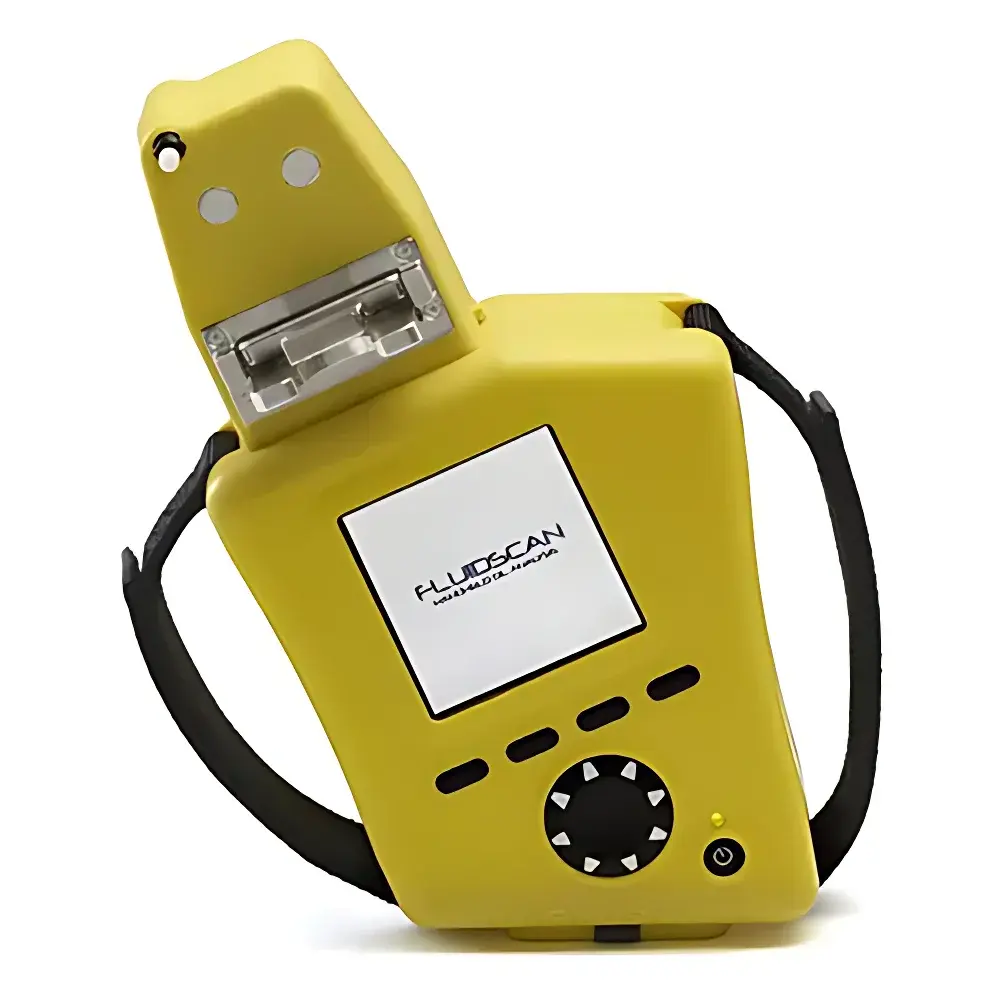
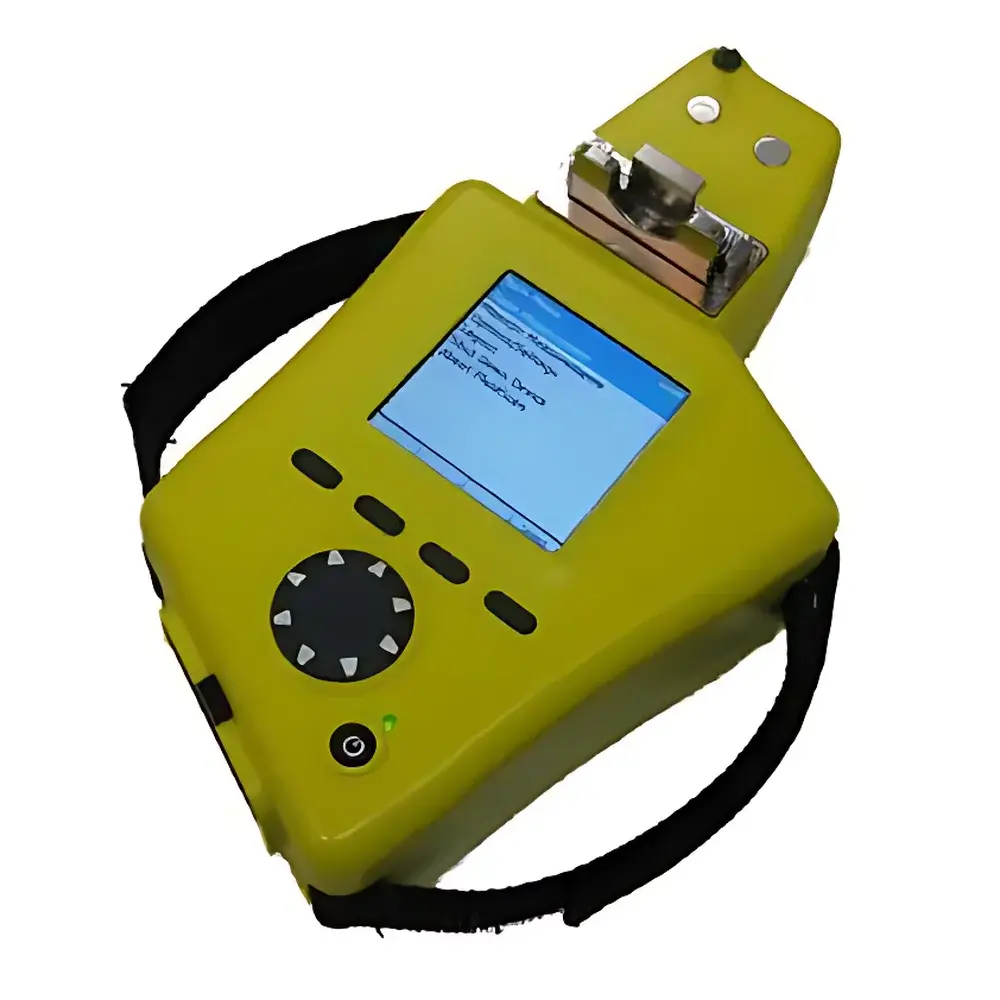
Spectro Scientific FluidScan 1000 Portable Oil Condition Analyzer
| Brand | Spectro Scientific |
|---|---|
| Origin | USA |
| Model | FluidScan 1000 |
| Instrument Type | Portable |
| Wavelength Range | 900–4000 cm⁻¹ |
| Measurement Principle | Fourier Transform Near-Infrared (FT-NIR) Spectroscopy |
| Sample Method | Direct Drop-on-Cell Dispersive Analysis |
| Software | Fluid Manager™ |
| Compliance | ASTM D7889, ASTM E2412, ASTM E1655 |
| Application Domain | Industrial Lubrication Monitoring in Petrochemical, Power Generation, and Heavy Machinery Sectors |
Overview
The Spectro Scientific FluidScan 1000 Portable Oil Condition Analyzer is an engineered field-deployable FT-NIR spectrometer designed for real-time, quantitative assessment of in-service lubricants without laboratory dependency. Operating on the principle of Fourier Transform Near-Infrared spectroscopy, the instrument captures molecular absorption signatures across a broad spectral range (900–4000 cm⁻¹), enabling chemometric quantification of critical oil health parameters—including water content, Total Acid Number (TAN), Total Base Number (TBN), oxidation, nitration, sulfation, soot loading, and glycol or fuel dilution. Unlike conventional benchtop IR systems requiring solvent extraction or sample dilution, the FluidScan 1000 employs a robust, temperature-stabilized transmission cell that accepts a single drop (≈30 µL) of undiluted oil—eliminating reagent use, cross-contamination risk, and operator variability. Its architecture supports both proactive condition-based maintenance and predictive asset management strategies aligned with ISO 55000 and ANSI/SMRP RP-1 frameworks.
Key Features
- Field-ready ruggedized design with IP65-rated enclosure, integrated rechargeable battery (≥8 hours continuous operation), and shock-absorbing rubberized casing for industrial environments.
- Proprietary calibration-free chemometric engine trained on >500 reference oils—covering mineral, synthetic, turbine, hydraulic, gear, compressor, and engine lubricants—enabling immediate deployment without user calibration.
- ASTM-compliant measurement traceability: meets precision requirements of ASTM D7889 (field FTIR testing of used oils), repeatability benchmarks per ASTM E2412, and data processing validation per ASTM E1655.
- Zero-solvent workflow: no cleaning solvents required between samples; optical path self-cleans via thermal desorption and inert gas purge during idle cycles.
- Intuitive color-coded status dashboard with user-configurable alarm thresholds (e.g., TAN > 2.5 mg KOH/g triggers amber alert; water > 500 ppm activates red warning).
- On-device result interpretation: displays quantitative values with uncertainty estimates, trend arrows indicating directional change vs. prior readings, and pass/fail flags against OEM-specified limits.
Sample Compatibility & Compliance
The FluidScan 1000 accommodates all common industrial and automotive lubricants—including Group I–V base stocks, PAOs, PAGs, ester-based synthetics, and bio-derived formulations—without matrix-specific method development. It is validated for direct analysis of dark, viscous, or particulate-laden oils (up to ISO VG 680) due to its high signal-to-noise ratio detector and adaptive background subtraction algorithm. Regulatory alignment includes full support for NESHAP RICE compliance when paired with MiniVisc 3050 for extended drain interval justification, as well as audit readiness for ISO 17025-accredited laboratories and FDA 21 CFR Part 11–governed facilities (via Fluid Manager™ audit trail and electronic signature modules). All spectral data files (.spc) adhere to JCAMP-DX v5.0 format for interoperability with LIMS and CMMS platforms.
Software & Data Management
Fluid Manager™ software serves as the central hub for instrument control, spectral library expansion, report generation, and fleet-wide analytics. It enables secure synchronization of field results to networked servers or cloud repositories using TLS 1.2–encrypted HTTP(S) protocols. Key capabilities include automated PDF/Excel report generation with embedded spectra and metadata (operator ID, location GPS stamp, equipment tag, sampling date/time), hierarchical asset tree mapping for multi-site roll-up dashboards, and version-controlled database updates—allowing users to append proprietary reference oils with full spectral and validation documentation. The software maintains immutable audit logs compliant with GLP/GMP record retention standards, including timestamped edits, user authentication events, and calibration history.
Applications
- Rotating equipment monitoring: early detection of oxidation onset in turbine oils (ASTM D2440), acid buildup in gearboxes, and water ingress in hydraulic systems.
- Reciprocating engine reliability: quantification of nitration and soot accumulation in diesel generator sets subject to NESHAP RICE reporting obligations.
- Wind turbine gearbox health: trending of TBN depletion and additive depletion kinetics under variable load conditions.
- Compressor lubricant life extension: discrimination between thermal degradation and contamination-driven failure modes in air and gas compressors.
- Marine propulsion systems: onboard verification of cylinder oil alkalinity reserve and fuel dilution in low-speed two-stroke engines.
- Manufacturing plant predictive maintenance programs: integration with CMMS (e.g., IBM Maximo, SAP PM) via API-driven data ingestion for automated work order triggering.
FAQ
Does the FluidScan 1000 require annual recalibration?
No. The instrument utilizes a permanently aligned interferometer and sealed reference cavity; calibration stability is verified daily via internal reference scan—no user-performed recalibration is necessary per ASTM D7889 Section 8.2.
Can it analyze used oils containing heavy metal particles or sludge?
Yes. The transmission cell design and spectral preprocessing algorithms accommodate moderate particulate loading (<5% v/v); for highly contaminated samples, optional centrifugation or filtration (per ASTM D2272) is recommended prior to analysis.
Is Fluid Manager™ compatible with Windows 11 and macOS Ventura or later?
Fluid Manager™ v5.3+ supports Windows 10/11 (64-bit) and macOS 12 Monterey through macOS 14 Sonoma; virtualized deployment on Linux-based servers is supported via Docker containerization.
How are new oil baselines established for custom lubricants not in the default database?
Users may import spectral libraries from accredited labs or generate in-house baselines using ≥10 representative virgin oil samples; Fluid Manager™ guides statistical validation per ASTM E1655 Annex A1.
What cybersecurity certifications does the device hold?
The FluidScan 1000 complies with IEC 62443-3-3 SL2 requirements for industrial control systems and has undergone penetration testing per NIST SP 800-115; firmware updates are cryptographically signed and delivered over HTTPS-only channels.
Related Products






