
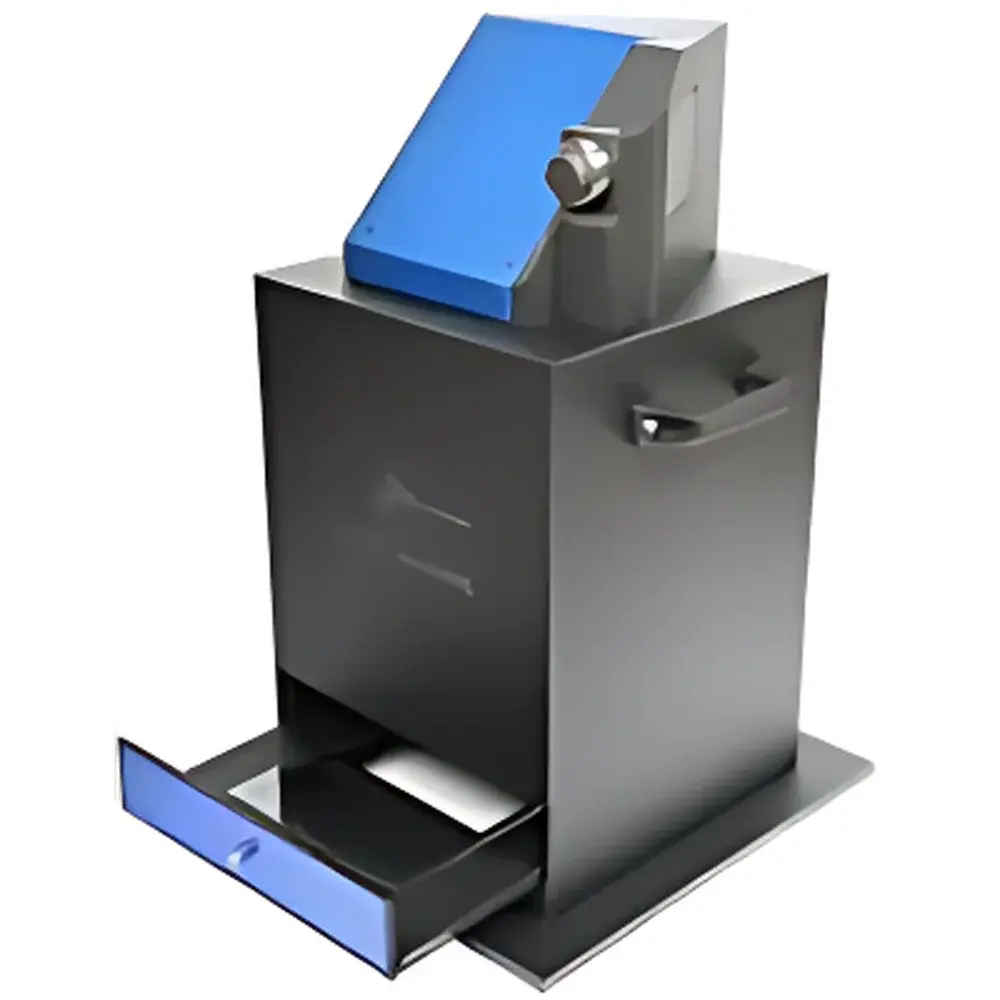
CentriTower Zebrafish and Drosophila High-Throughput Behavioral Analysis System
| Brand | Loligo Systems |
|---|---|
| Origin | France |
| Model | CentriTower |
| Optical System | Telecentric lens assembly |
| Camera | 5.1 MP industrial sensor (2472 × 2064) |
| Frame Rate | 75 fps |
| Field of View | 137 mm × 102 mm |
| IR Backlight | 850 nm, 160 mm × 160 mm uniform illumination |
| Tower Dimensions | 380 mm × 370 mm × 575 mm (W × D × H) |
| Software | LoligoTrack behavioral analytics suite with ROI-based multi-animal tracking, kinematic point annotation, and batch processing |
Overview
The CentriTower Zebrafish and Drosophila High-Throughput Behavioral Analysis System is an engineered optical platform designed for quantitative, high-fidelity video-based ethological analysis of small model organisms under controlled illumination and mechanical stability. Built upon telecentric imaging principles, the system eliminates parallax error and optical distortion across its full field of view—critical for pixel-accurate spatial calibration and reproducible trajectory reconstruction. It operates on a rigid tower architecture that isolates specimens from ambient light interference while maintaining ergonomic access to microplate-based assay formats including 96-well PCR plates, deep-well plates, Petri dishes, and custom chamber inserts. The integrated 850 nm infrared backlight ensures high-contrast silhouette imaging without photostimulatory artifacts, preserving natural locomotor and exploratory behaviors in both aquatic (zebrafish larvae, daphnia, copepods) and terrestrial (Drosophila melanogaster adults and pupae) models. Its USB 3.1 interface enables deterministic data streaming at sustained 75 fps, supporting time-resolved analysis of rapid kinematic events such as tail flicks, wing beats, or escape responses.
Key Features
- Telecentric optical path delivering zero-parallax, distortion-free imaging across the entire 137 mm × 102 mm field of view—enabling sub-pixel positional accuracy and reliable inter-trial comparability.
- 5.1 megapixel global-shutter CMOS sensor (2472 × 2064 resolution) optimized for low-noise, high-dynamic-range capture under near-infrared illumination.
- Modular tower enclosure with matte-black interior surfaces and light-tight construction—minimizing stray reflections and ensuring consistent contrast across experiments.
- Uniform 850 nm IR backlight panel (160 mm × 160 mm active area) providing spectrally neutral illumination that avoids visual system activation in vertebrates and invertebrates alike.
- Standardized adapter interfaces for seamless integration with common labware: ANSI/SLAS-compliant microplates, glass-bottom dishes, and custom-machined behavioral arenas.
- Scalable configuration support: Optional coupling with Loligo’s high-throughput respirometry modules—including zebrafish embryo/larval O2 consumption assays, adult zebrafish intermittent-flow respirometry, and Drosophila CO2 emission monitoring systems.
Sample Compatibility & Compliance
The CentriTower supports simultaneous tracking of up to 96 individuals per frame in standard microplate wells, with robust segmentation performance across morphologically heterogeneous populations (e.g., mixed-stage zebrafish embryos or polymorphic Drosophila strains). Its optical design conforms to ISO 10993-5 biocompatibility guidelines for non-invasive observation hardware and meets mechanical stability requirements outlined in OECD Test Guideline 203 (Fish Acute Toxicity Test) and 211 (Daphnia sp. Acute Immobilisation Test) for motion-sensitive endpoints. The system architecture supports GLP-compliant audit trails when deployed with LoligoTrack software configured for FDA 21 CFR Part 11–enabled environments, including electronic signatures, session logging, and immutable raw-data archiving.
Software & Data Management
LoligoTrack is a validated behavioral analytics engine built for precision ethomics. It implements dual-algorithm detection—background subtraction and contrast-thresholding—with adaptive noise suppression suitable for variable lighting conditions and low-SNR recordings. The software enables hierarchical region-of-interest (ROI) definition, allowing independent analysis of nested zones (e.g., center vs. periphery in open-field assays). Users may annotate anatomical landmarks (head centroid, tail tip, midline points) for kinematic parameter derivation—including angular velocity, body bend amplitude, turn angle distribution, and inter-individual distance (IID) metrics (mean, mode, minimum). Batch processing pipelines support time-windowed analysis, automated outlier flagging, and CSV/JSON export compliant with MIAME and MINSEQE metadata standards. Error correction tools include frame-by-frame manual repositioning, trajectory interpolation, and confidence-score filtering.
Applications
- Neuropharmacology screening: Quantification of locomotor hypoactivity/hyperactivity, thigmotaxis, and habituation kinetics in response to CNS-active compounds.
- Developmental toxicology: Automated assessment of spontaneous coiling, touch-evoked response latency, and swimming kinematics in zebrafish embryos exposed to environmental contaminants.
- Circadian rhythm phenotyping: Long-term tracking of rest-activity cycles in Drosophila under controlled light-dark regimens with circadian periodogram analysis.
- Social interaction assays: Pairwise and group-level proximity mapping, chase/follow event detection, and social space modeling in larval and adult zebrafish.
- Genetic mutant characterization: High-throughput comparison of baseline motility, startle response magnitude, and recovery dynamics across transgenic lines.
- Behavioral thermoregulation studies: Integration with temperature-gradient chambers for real-time mapping of thermal preference zones and avoidance thresholds.
FAQ
What types of microplates are natively supported?
The CentriTower accommodates standard ANSI/SLAS-format plates (96-, 384-, and 1536-well), including PCR plates, deep-well plates, and flat-bottom tissue-culture plates. Custom adapters are available for non-standard well geometries or opaque-bottom formats.
Can the system track animals in transparent or reflective containers?
Yes—the telecentric optics and IR backlighting minimize specular reflection artifacts. For highly reflective substrates (e.g., polished glass), optional anti-glare diffusers or matte-coated inserts are recommended to maintain contrast fidelity.
Is real-time tracking available during acquisition?
LoligoTrack supports live preview with configurable overlay of tracked centroids, velocity vectors, and ROI boundaries—but final trajectory computation and parameter extraction occur post-acquisition to ensure numerical consistency and reproducibility.
How is calibration performed?
A two-point spatial calibration routine using a certified grid target establishes µm/pixel scaling; temporal calibration is synchronized to the camera’s hardware timestamp generator, traceable to NIST-traceable quartz oscillators.
Does the software support third-party integration?
Yes—LoligoTrack provides RESTful API endpoints and Python SDK for programmatic control, data ingestion from external sensors (e.g., oxygen probes, temperature loggers), and pipeline orchestration via Nextflow or Snakemake workflows.




