
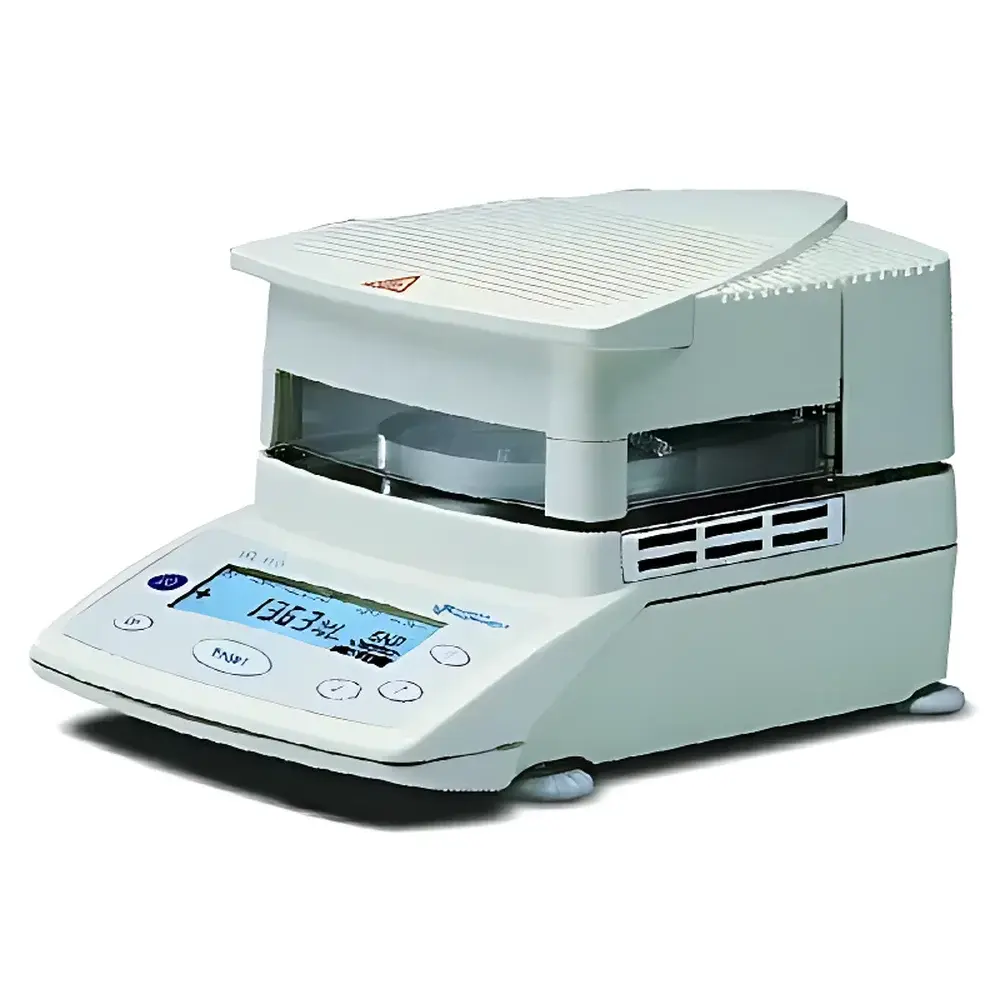
Denver IR-60 Smart Compact Infrared Moisture Analyzer
| Brand | Denver |
|---|---|
| Origin | USA |
| Model | IR-60 |
| Maximum Sample Capacity | 60 g |
| Readability | 1 mg / 0.01% moisture |
| Repeatability | ±0.2% (for 1–5 g initial sample), ±0.05% (for ≥5 g initial sample) |
| Heating Range | 40–210 °C (1 °C increments) |
| Heating Source | Quartz infrared heater with quartz reflector plate |
| Programmable Heating Time | 0.1–99.9 min |
| Stored Methods | 5 user-defined protocols |
| Sample Pan Diameter | 90 mm |
| Calibration Weight | 50 g (E2 class) |
| Interface | RS-232C |
| Dimensions (W×D×H) | 213 × 320 × 181 mm |
| Net Weight | 5.1 kg |
Overview
The Denver IR-60 Smart Compact Infrared Moisture Analyzer is an engineered solution for rapid, gravimetric determination of moisture and volatile content in solid and liquid samples. Based on the principle of infrared thermogravimetry—where a precisely controlled quartz infrared heating element drives off volatiles while an integrated high-resolution analytical balance continuously monitors mass loss—the IR-60 delivers accurate, reproducible results within minutes. Its compact footprint (213 × 320 × 181 mm) and robust mechanical architecture make it suitable for quality control laboratories, R&D environments, and production floor settings where space, reliability, and regulatory traceability are critical. Designed to meet the operational demands of food safety testing, pharmaceutical stability studies, polymer formulation, and environmental sample analysis, the IR-60 complies with core method validation expectations outlined in ASTM D4457 (for moisture in resins), ISO 12099 (for feedstuffs), and USP <921> (Water Determination). The system operates without consumables or carrier gases, minimizing total cost of ownership and procedural complexity.
Key Features
- Quartz infrared heating system with reflective quartz plate ensures uniform thermal distribution and rapid temperature ramping (40–210 °C, adjustable in 1 °C steps)
- Integrated dual-stage sensor architecture: high-stability load cell (1 mg readability) coupled with temperature-compensated thermal monitoring for enhanced mass-loss resolution
- Five programmable drying methods stored onboard—enabling consistent protocol execution across operators and shifts
- Three termination modes: fully automatic (based on mass-change threshold), semi-automatic (user-defined mass-loss step: 1–20 mg per 24 s), and time-controlled (0.1–99.9 min)
- Dust-resistant and shock-dampened mechanical design supports stable operation in non-climate-controlled or vibration-prone lab environments
- E2-class 50 g external calibration weight included for routine performance verification per ISO/IEC 17025 requirements
- RS-232C serial interface enables direct connection to LIMS, ELN, or statistical process control software for automated data export and audit trail generation
Sample Compatibility & Compliance
The IR-60 accommodates a broad range of sample types—including powders, granules, pastes, suspensions, and low-viscosity liquids—within its 90 mm diameter stainless-steel sample pan. Its sealed chamber design minimizes ambient interference during measurement, while the absence of forced-air convection prevents sample displacement or splattering. For regulated industries, the instrument supports GLP/GMP-aligned workflows: all measurements record timestamp, operator ID (via optional keypad input), method name, final moisture %, dry weight, residual mass, and heating profile metadata. Data integrity is preserved through non-volatile memory storage and RS-232 output compatible with FDA 21 CFR Part 11–compliant systems when paired with validated third-party software.
Software & Data Management
While the IR-60 operates autonomously via its front-panel interface, its RS-232C port allows bidirectional communication with host computers running Denver-provided terminal emulation software or custom-developed applications. Raw data streams include real-time mass readings (g), calculated moisture (%) and dry residue (g/kg), along with event markers for heating start/end, stabilization, and auto-shutdown. Exported datasets conform to CSV format for seamless import into Excel, Minitab, or laboratory informatics platforms. Audit-ready reports can be generated with configurable headers, unit preferences, and digital signature fields—facilitating internal review and external inspection readiness.
Applications
- Food & Beverage: moisture profiling of flour, coffee beans, dairy powders, snack foods, and pet food per AOAC 950.46 and AACC 44-19a
- Pharmaceuticals: excipient drying validation, tablet coating uniformity assessment, and raw material release testing aligned with ICH Q5C stability guidelines
- Chemicals & Polymers: water content verification in catalysts, resins, adhesives, and battery electrode slurries
- Environmental: moisture correction in soil, sludge, and biomass samples prior to TOC or calorific value analysis
- Academic Research: kinetic modeling of dehydration processes using time-resolved mass-loss curves
FAQ
What standards does the IR-60 support for method validation?
The IR-60 is designed to support validation per ASTM D4457, ISO 12099, USP <921>, and AOAC 950.46. Full validation documentation templates are available upon request.
Can the IR-60 be calibrated internally?
No—internal calibration is not supported. The instrument requires external calibration using the supplied 50 g E2-class weight at defined intervals per your lab’s SOP and ISO/IEC 17025 requirements.
Is temperature uniformity across the sample pan verified?
Yes. Denver provides a temperature mapping report (per IQ/OQ protocol) demonstrating ≤±2.5 °C variation across the 90 mm pan surface at 105 °C and 150 °C setpoints.
Does the IR-60 comply with FDA 21 CFR Part 11?
The hardware itself is Part 11–capable via secure RS-232 data transmission; full compliance depends on the connected software system’s implementation of electronic signatures, audit trails, and role-based access controls.
What maintenance is required for long-term accuracy?
Annual verification of balance linearity, heater output consistency, and thermal sensor response is recommended. Denver-certified service technicians perform these checks using NIST-traceable standards.
Related Products







