
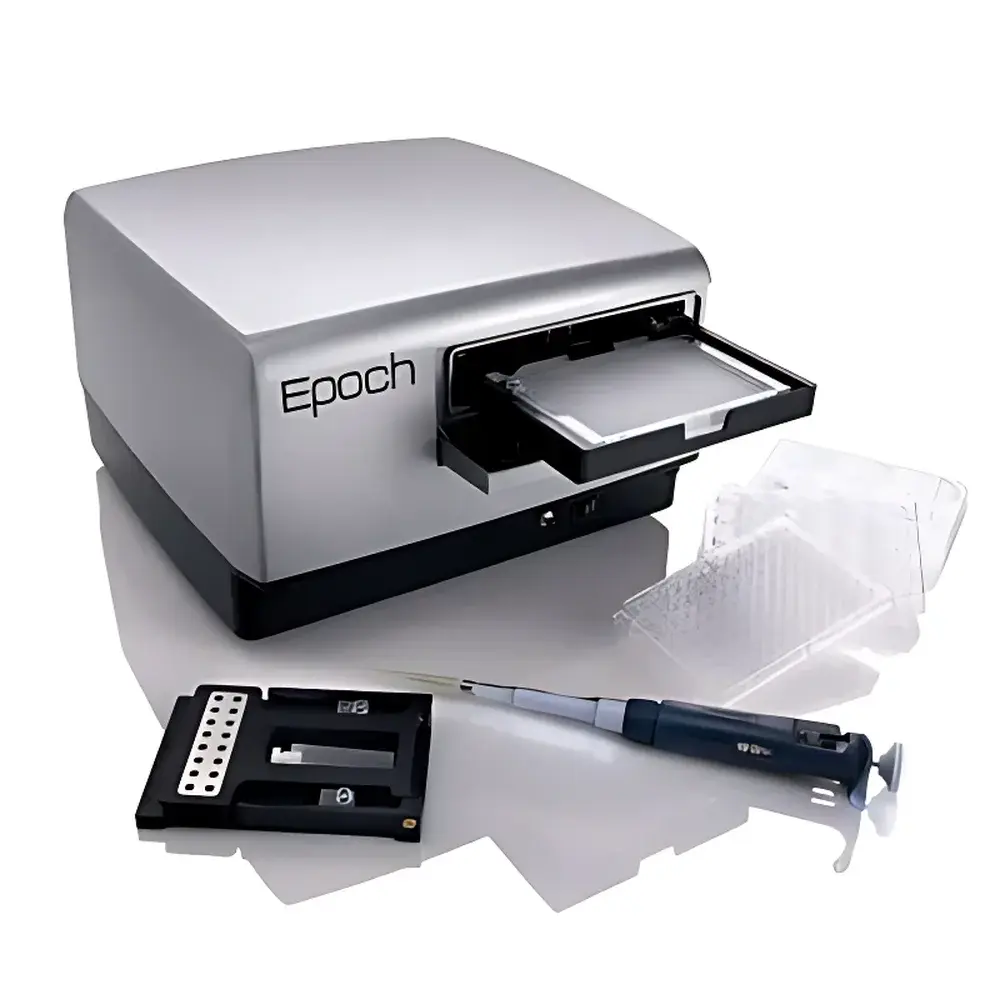
BioTek Epoch Microplate Spectrophotometer
| Brand | BioTek |
|---|---|
| Origin | USA |
| Model | Epoch |
| Wavelength Range | 200–999 nm (1 nm increments) |
| Optical Path Correction | Automatic |
| Detection Modes | Endpoint, Kinetic, Spectral Scan, Well-Scan |
| Compatible Plates | 6-, 12-, 24-, 48-, 96-, 384-well + Take3 Multi-Volume Plate |
| OD Range | 0–4.0 |
| OD Resolution | 0.0001 |
| Wavelength Accuracy | ±2 nm |
| Wavelength Repeatability | ±0.2 nm |
| OD Accuracy | ±1% ±0.01 OD (0–2 OD), ±3% ±0.01 OD (2–2.5 OD) |
| OD Linearity & Reproducibility | ±1% ±0.005 OD (0–2 OD), ±3% ±0.005 OD (2–2.5 OD) |
| Read Times | 49 sec (96-well normal), 38 sec (96-well fast), 15 sec (96-well scan) |
| Dimensions | 30.5 × 31.7 × 19.5 cm |
| Weight | 6.35 kg |
Overview
The BioTek Epoch Microplate Spectrophotometer is a benchtop absorbance reader engineered for precision quantification and kinetic analysis across life science applications. It employs a high-stability xenon flash lamp coupled with a monochromator-based optical system to deliver continuous wavelength selection from 200 nm to 999 nm in 1 nm increments—enabling rigorous UV-Vis characterization of nucleic acids, proteins, enzyme reactions, cell viability assays, and reporter gene expression. Unlike filter-based readers, the monochromator architecture eliminates the need for physical filter wheels, ensuring full spectral flexibility without hardware reconfiguration. Its integrated optical path correction algorithm dynamically compensates for microplate well geometry and meniscus variation—critical for accurate low-volume measurements down to 2 µL using the optional Take3 Multi-Volume Plate. Designed for compliance-driven environments, the Epoch supports audit-ready data capture and meets foundational requirements for GLP and GMP workflows when paired with Gene5 software and appropriate instrument qualification protocols.
Key Features
- Monochromator-based optics with 1 nm wavelength resolution across 200–999 nm range
- Automatic optical path length correction for consistent OD accuracy across variable sample volumes and plate types
- Multi-mode detection: endpoint, kinetic, spectral scanning (full spectrum acquisition per well), and well-scan (spatial profiling within individual wells)
- Support for standard microplates (6–384-well) and specialized formats including the Take3 Multi-Volume Plate for 2 µL microvolume, cuvette, and BioCell measurements
- Xenon flash lamp with >1 billion flashes lifetime—eliminating warm-up time and intensity drift between reads
- Low-noise detector and optimized analog-to-digital signal chain yielding OD resolution of 0.0001 and reproducibility of ±0.005 OD (0–2 OD)
- Compact footprint (30.5 × 31.7 × 19.5 cm) and lightweight design (6.35 kg) for flexible lab integration
Sample Compatibility & Compliance
The Epoch accommodates diverse sample formats without mechanical adaptation: standard polystyrene, glass-bottom, black/clear/white plates, as well as cuvettes and the proprietary BioCell for high-precision reference measurements. The Take3 plate enables simultaneous microvolume (2 µL), cuvette, and BioCell analysis on a single platform—reducing cross-contamination risk and calibration overhead. From a regulatory standpoint, the system supports traceable measurement integrity through Gene5’s secure user access controls, electronic signatures, and configurable audit trails. While not pre-certified for FDA 21 CFR Part 11 out-of-the-box, its architecture aligns with validation frameworks required for ISO/IEC 17025, CLIA, and USP spectrophotometric performance verification. Routine operational qualification (OQ) can be performed using NIST-traceable neutral density filters and holmium oxide reference standards.
Software & Data Management
Gene5 Data Analysis Software serves as the native control and analysis environment for the Epoch. It provides real-time data visualization, customizable protocol templates, built-in nucleic acid/protein concentration calculators (e.g., A260/A280 ratios, Bradford/Lowry/Bicinchoninic acid assays), and kinetic curve fitting (linear, exponential, sigmoidal). All raw absorbance values, metadata (wavelength, integration time, gain setting), and instrument logs are stored in encrypted .g5d project files. Export options include CSV, Excel, PDF reports, and image-based plate heatmaps. For enterprise deployment, Gene5 supports networked instrument sharing, centralized license management, and integration with LIMS via ODBC-compliant database exports—facilitating alignment with laboratory informatics infrastructure.
Applications
- Nucleic acid quantification and purity assessment (A260/A280, A260/A230) in genomic and transcriptomic workflows
- Protein concentration determination using direct UV (A280) or colorimetric assays (BCA, Bradford)
- Enzyme kinetics (e.g., ELISA, phosphatase, kinase, dehydrogenase activity) with up to 30-minute kinetic intervals and 1-second sampling resolution
- Cell-based assays including MTT, XTT, resazurin reduction, and luciferase reporter systems
- Spectral characterization of novel dyes, nanoparticles, and conjugated biomolecules
- Quality control of purified antibodies, recombinant proteins, and oligonucleotides per ICH Q5 guidelines
FAQ
Does the Epoch support kinetic assays with temperature control?
No—the Epoch is a non-incubating absorbance reader. For temperature-regulated kinetic studies, BioTek’s Synergy series (e.g., Synergy H1) is recommended.
Can the Take3 plate be used for both DNA and protein quantification?
Yes—its dual-pathlength design (0.5 mm and 2.0 mm) allows accurate measurement of high-concentration DNA (e.g., plasmid preps) and dilute protein samples without manual dilution.
Is wavelength calibration required before each experiment?
No—factory-calibrated monochromator stability ensures long-term wavelength fidelity; annual verification with holmium oxide is sufficient for most QC labs.
What file formats does Gene5 support for data export?
CSV, XLSX, PDF, PNG, and native .g5d project archives with embedded instrument configuration and raw spectra.
How is optical path correction validated during installation?
Using standardized microplate inserts with known pathlengths and certified OD reference materials per ASTM E275 and ISO 10934-1 protocols.
Related Products



