
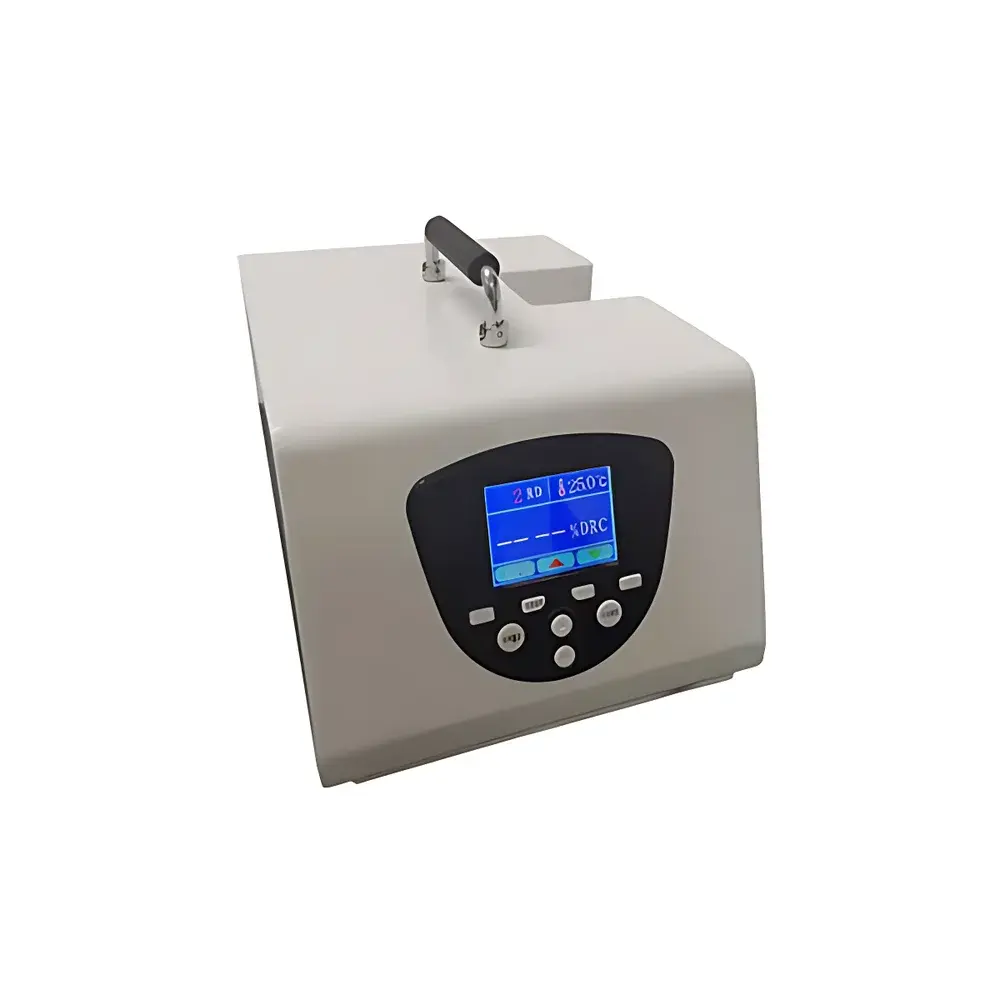
Herexi RH2010SF Microwave-Based Alcohol Concentration Analyzer for Disinfectant Solutions
| [Brand | Herexi |
|---|---|
| Model | RH2010SF |
| Origin | Hunan, China |
| Measuring Principle | Microwave Dielectric Response at Fixed Frequency |
| Alcohol Concentration Range | 50–99% vol/vol |
| Effective Measurement Range | 60–90% vol/vol |
| Resolution | 0.1% vol/vol (alcohol) / 0.1% moisture content |
| Accuracy | ±2% vol/vol (within effective range) |
| Display | TFT-LCD digital readout |
| Compliance | Q/AELE 001–2012 (enterprise standard), JJG 891–1995 (verification regulation for capacitance/resistance-type grain moisture meters), CPAC Type Approval Certificate No. 2014C103-43] |
Overview
The Herexi RH2010SF Microwave-Based Alcohol Concentration Analyzer is a dedicated benchtop instrument engineered for rapid, non-destructive quantification of ethanol concentration in aqueous disinfectant solutions—primarily 75% and 95% isopropyl alcohol (IPA) or ethanol–water mixtures used in pharmaceutical cleanrooms, hospital sterilization units, and quality control laboratories. Unlike refractometric or densitometric methods, the RH2010SF employs fixed-frequency microwave dielectric spectroscopy: it emits a stable, calibrated microwave signal into the sample via a waveguide-coupled oscillator, and measures the phase shift and attenuation induced by the dipole relaxation behavior of water and ethanol molecules under controlled thermal conditions. Because water and ethanol exhibit distinct dielectric loss tangents and permittivity temperature coefficients, the instrument’s embedded microprocessor applies empirically validated correction algorithms to resolve concentration with high reproducibility across the 60–90% v/v operational window. The system operates on the principle that the composite dielectric response of the binary mixture correlates monotonically—and sufficiently linearly—with volume fraction within this range, enabling sub-second measurement without reagents, consumables, or sample dilution.
Key Features
- Single-measurement cycle completed in ≤1 second, supporting high-throughput QC workflows in GMP-regulated environments.
- Integrated waveguide oscillator delivering stable, low-power microwave emission at a fixed frequency optimized for ethanol–water dielectric contrast.
- Automatic post-measurement recovery mode: internal peristaltic transfer system returns unaltered sample to designated collection vessel, minimizing reagent waste and eliminating cross-contamination risk.
- TFT-LCD display with real-time digital readout in % v/v ethanol concentration and optional % moisture content (MC) units, configurable via front-panel interface.
- Thermal stabilization architecture: built-in temperature sensor monitors both ambient and sample thermal state; measurement is suspended if ΔT between sample and instrument cavity exceeds 3 °C, ensuring metrological integrity.
- Pre-calibrated factory alignment traceable to internal reference standards; no user calibration required under routine operation.
Sample Compatibility & Compliance
The RH2010SF is validated for clear, low-viscosity, non-aqueous-alcohol–water solutions with no suspended solids, particulates, or volatile co-solvents (e.g., hydrogen peroxide, quaternary ammonium compounds). It is not suitable for denatured alcohol formulations containing methanol or bitterants, nor for viscous gels or surfactant-stabilized emulsions. While not certified to ISO/IEC 17025, the instrument conforms to Chinese national enterprise standard Q/AELE 001–2012 for moisture analyzers and satisfies verification requirements outlined in JJG 891–1995—originally written for agricultural grain moisture meters but extended via technical equivalence assessment for liquid-phase dielectric instruments. Its type approval (CPAC No. 2014C103-43) confirms compliance with electromagnetic compatibility (EMC) and electrical safety requirements under GB 4793.1–2007. For regulated pharmaceutical use, users must establish in-house validation protocols—including accuracy, repeatability, intermediate precision, and robustness testing—per ICH Q2(R2) guidelines.
Software & Data Management
The RH2010SF operates as a standalone embedded system with no external PC dependency. All measurement data—including timestamp, sample ID (user-entered alphanumeric code), temperature reading, and result—are stored internally in non-volatile memory (capacity: ≥10,000 records). Data export is supported via USB 2.0 port to FAT32-formatted flash drives in CSV format for downstream analysis in Excel or LIMS platforms. Audit trail functionality is limited to chronological record retention; full 21 CFR Part 11 compliance (e.g., electronic signatures, operator-level access control, immutable logs) requires integration with third-party laboratory information management systems (LIMS) or middleware. Firmware updates are delivered via secure USB-based patch files issued by Herexi Technical Support.
Applications
- Routine verification of ethanol concentration in WHO-recommended hand-rub formulations prior to packaging or dispensing.
- In-process monitoring during bulk alcohol blending operations in contract manufacturing organizations (CMOs).
- Stability-indicating testing of alcohol-based disinfectants exposed to elevated temperature or humidity during accelerated aging studies.
- Raw material release testing of incoming IPA or ethanol lots against pharmacopeial specifications (e.g., USP , EP 2.5.12).
- Environmental monitoring program support: rapid field-check of surface disinfectant concentration in ISO Class 5–8 cleanrooms.
FAQ
What is the recommended warm-up time before first use?
The instrument requires a minimum 2-hour power-on stabilization period to achieve thermal equilibrium of internal microwave components and temperature sensors. Subsequent measurements may commence immediately after power cycling if ambient temperature remains constant.
Can the RH2010SF measure denatured alcohol or ethanol blends containing additives?
No. Only pure ethanol–water or isopropanol–water binary solutions are supported. Denaturants, fragrances, thickeners, or surfactants distort the dielectric response and invalidate calibration.
How often must the measurement cup be cleaned, and what cleaning agent is approved?
The quartz-lined sample cup must be wiped dry with lint-free tissue after each measurement. Residual alcohol films should be removed using anhydrous ethanol followed by nitrogen purge; aqueous cleaners or acetone are prohibited.
Is external calibration required, and does Herexi provide certified reference standards?
The unit ships pre-calibrated against NIST-traceable ethanol–water gravimetric standards. Field recalibration is not supported; periodic verification using in-house prepared reference mixtures (±0.5% v/v tolerance) is recommended every 90 days or per internal SOP.
Does the instrument meet FDA or EU regulatory requirements for use in pharmaceutical manufacturing?
It meets general electrical safety and metrological traceability requirements but is not pre-validated for GxP environments. Users bear full responsibility for IQ/OQ/PQ execution, change control documentation, and integration into their quality management system (QMS).





