
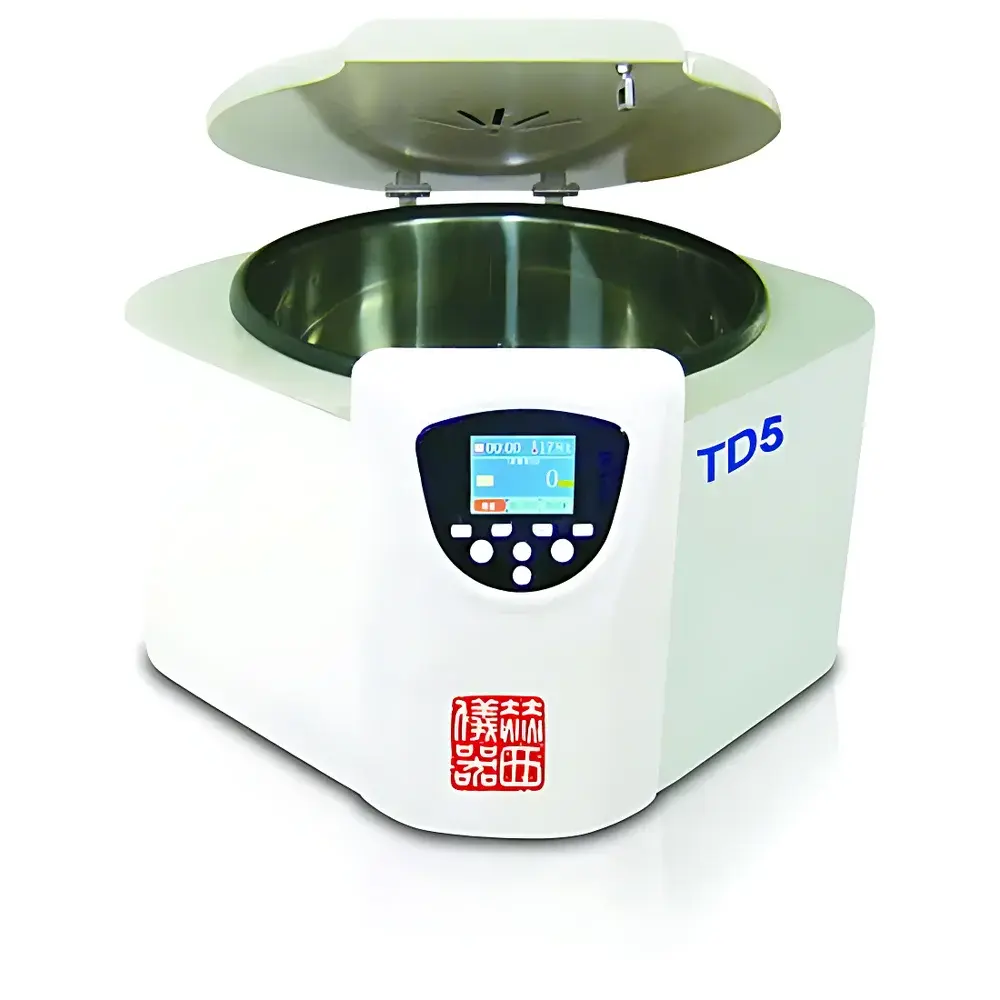
Hesiy TD5 Benchtop Low-Speed Centrifuge with 2×2×96-Well Microplate Rotors
| Brand | Hesiy |
|---|---|
| Origin | Hunan, China |
| Model | MBB-TD5 |
| Instrument Type | Benchtop Centrifuge |
| Max Speed | 5000 rpm |
| Max RCF | 4800 ×g |
| Max Capacity | 4 × 250 mL |
| Dimensions (L×W×H) | 600 × 540 × 360 mm |
| Noise Level | ≤60 dB(A) |
| Power Supply | AC 100–230 V, 50/60 Hz |
| Weight | 35 kg |
| Certifications | CFDA Registered, ISO 9001:2015 & ISO 13485:2016 Certified |
| Rotor Type | Horizontal Swing-Bucket Microplate Rotor (2×2×96-well format) |
| Acceleration/Deceleration | 10-step programmable |
| User Programs | 20 stored protocols |
Overview
The Hesiy TD5 Benchtop Low-Speed Centrifuge is an engineered solution for gentle, high-capacity sedimentation of microplate-based samples in life science and clinical laboratories. Designed specifically for compatibility with standard 96-well microtiter plates—including ELISA, cell culture, PCR, and diagnostic assay plates—the TD5 employs a horizontal swing-bucket rotor configuration that accommodates two stacked 2×2 arrays of 96-well plates (totaling four plates per run). Its operational range—up to 5000 rpm and 4800 ×g—is optimized for low-shear pelleting of cells, platelet-rich plasma (PRP), serum separation, and immunoassay wash steps where sample integrity and minimal resuspension are critical. The centrifuge operates on the principle of sedimentation under controlled gravitational force, with precise regulation of acceleration and deceleration profiles to prevent edge-well disturbance and ensure uniform pellet formation across all wells.
Key Features
- Microplate-optimized horizontal rotor supporting 2×2×96-well configurations (four full plates simultaneously), enabling high-throughput processing without manual plate repositioning.
- Brushless DC motor with microprocessor-based control delivers stable rotational performance, low acoustic emission (≤60 dB[A]), and extended service life—critical for shared-core and GMP-aligned lab environments.
- Dual-mode operation interface: TFT-LCD color display with both capacitive touch and physical keypad support; real-time simultaneous display of setpoints (speed, time, RCF) and actual running parameters.
- Comprehensive safety architecture: triple-stage damping system, imbalance detection with automatic shutdown, overtemperature and undervoltage protection, and interlocked door mechanism with silent electromagnetic latch.
- Biocontainment-compliant design: rotor chamber sealed with RoHS 2015/863-certified silicone gasket to suppress aerosol leakage during centrifugation of infectious or hazardous samples.
- Robust mechanical construction: 304 stainless-steel centrifuge chamber, powder-coated steel housing, and reinforced front panel with triple-layer protective casing meet IEC 61010-2-020 requirements for laboratory equipment safety.
- Wide-input voltage capability (100–230 V, 50/60 Hz) ensures stable operation in multi-country deployment scenarios, including mobile labs and field-deployed diagnostic units.
Sample Compatibility & Compliance
The TD5 accommodates a broad spectrum of microplate formats via interchangeable adapters: standard flat-bottom, U-bottom, and V-bottom 96-well plates; PCR plates (0.2 mL); cell culture plates (6-, 12-, 24-, 48-, and 96-well); and deep-well plates (up to 2.2 mL/well). Optional polyamide fiber adapters support off-standard geometries while maintaining balanced load distribution. All rotors comply with ISO 13485:2016 for medical device manufacturing quality systems and are registered under China’s CFDA (now NMPA) Class II device regulatory framework. The instrument supports GLP/GMP workflows through audit-trail-ready parameter logging (when paired with optional data export module) and adheres to ISO 9001:2015 quality management principles. While not FDA 21 CFR Part 11–validated out-of-box, its firmware architecture permits integration into validated environments via third-party electronic record validation packages.
Software & Data Management
The TD5 embeds a non-volatile memory system capable of storing up to 20 user-defined centrifugation protocols, each retaining speed, time, RCF, acceleration/deceleration ramp rates, and hold conditions. Upon power-up, the unit defaults to the last-executed program—reducing setup time and operator variability. Parameter changes are permitted mid-run without stopping rotation, enabling dynamic optimization during method development. Data output is accessible via USB port (optional cable) for CSV-formatted runtime logs, including start/stop timestamps, achieved RCF, total run duration, and fault event codes. Firmware updates are performed locally via USB stick, ensuring traceability and version control in regulated settings.
Applications
This centrifuge serves core functions across multiple regulated and research domains: ELISA plate washing and substrate removal; post-PCR cleanup prior to sequencing; separation of peripheral blood mononuclear cells (PBMCs) from whole blood in 96-well format; high-throughput serum/plasma harvesting for biobanking; microbial pellet collection in antimicrobial susceptibility testing (AST); and preparation of standardized cell monolayers for drug screening assays. Its low-noise operation and compact footprint make it suitable for installation in biosafety cabinets, cleanrooms (ISO Class 7–8), and point-of-care diagnostic platforms requiring CLIA-waived instrumentation.
FAQ
What microplate formats are natively supported by the 2×2×96-well rotor?
The rotor accepts ANSI/SBS-compliant 96-well plates with standard footprint (127.76 × 85.48 mm), including flat-bottom, U-bottom, and V-bottom designs. Deep-well plates require optional polyamide adapters.
Does the TD5 meet international electrical safety standards?
Yes—it conforms to IEC 61010-1 (Ed. 3.1) for laboratory equipment and carries CE marking under the Low Voltage Directive (2014/35/EU) and EMC Directive (2014/30/EU).
Can the centrifuge be integrated into LIMS or ELN systems?
Direct API integration is not provided, but timestamped CSV logs exported via USB can be parsed by common LIMS/ELN platforms for audit trail linkage.
Is rotor calibration traceable to national standards?
Factory calibration uses NIST-traceable tachometers and gravimetric RCF verification; users may perform periodic verification using certified reference rotors or external speed sensors.
What maintenance intervals are recommended for routine operation?
Daily visual inspection of rotor seating and gasket integrity; monthly cleaning of chamber and air vents; annual preventive maintenance (PM) including bearing assessment and motor current profiling—per Hesiy Service Manual Rev. 4.2.



