
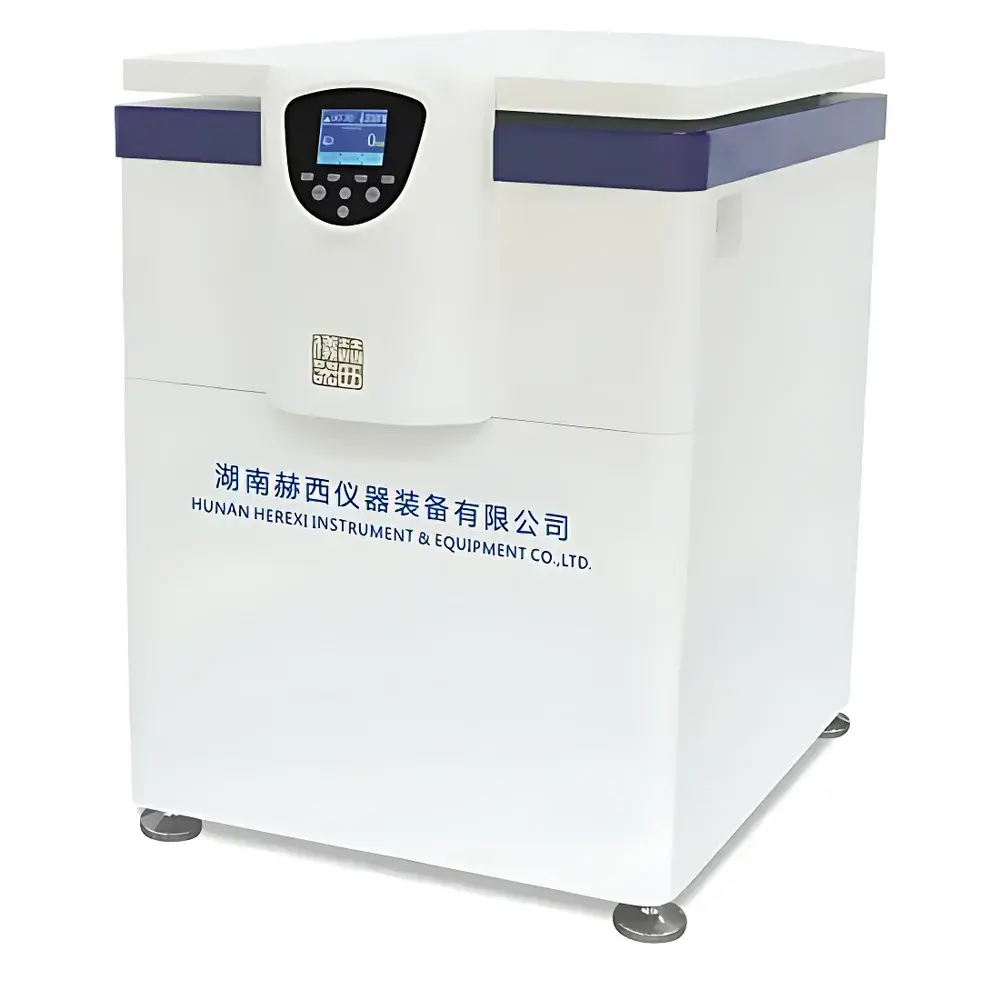
Herxi LT6Y Crude Oil Water Content Determination Centrifuge
| Brand | Herxi |
|---|---|
| Origin | Hunan, China |
| Model | LT6Y |
| Instrument Type | Floor-standing Low-speed Centrifuge |
| Max Speed | 3000 rpm |
| Max RCF | 2294 ×g |
| Max Capacity | 4 × 100 mL |
| Temperature Range | Ambient to 70 °C |
| Temp. Accuracy | ±2 °C |
| Speed Accuracy | ±50 rpm |
| Timer Range | 1 min – 99 h 59 min |
| Noise Level | ≤65 dB(A) |
| Dimensions (W×D×H) | 600 × 490 × 760 mm |
| Weight | 70 kg |
| Drive System | Microprocessor-controlled High-torque Brushless DC Frequency Conversion Motor |
| Safety Features | Overspeed Protection, Imbalance Detection & Auto Shutdown, Electromechanical Door Lock, Dual Shock Absorption System |
| Display Options | PLC LCD or LED Digital Display |
| Compliance | GB/T 6533–2012 |
Overview
The Herxi LT6Y Crude Oil Water Content Determination Centrifuge is a purpose-engineered floor-standing low-speed centrifuge designed specifically for quantitative separation of water and sediment from crude oil samples in accordance with GB/T 6533–2012 (“Determination of Water and Sediment in Crude Oil by Centrifuge Method”). This standard supersedes GB/T 6533–1986 and aligns methodologically with internationally recognized practices for hydrocarbon fluid analysis, including ASTM D96 and ISO 9030. The instrument operates on the principle of differential sedimentation under controlled centrifugal force, enabling rapid phase separation of immiscible components—primarily free water, emulsified water, and solid particulates—from viscous crude matrices. Its thermal regulation capability (ambient to 70 °C) supports standardized sample conditioning prior to centrifugation, ensuring reproducible interfacial separation critical for accurate gravimetric quantification. Engineered for routine QC/QA workflows in upstream petroleum laboratories, refinery quality control departments, and independent testing facilities, the LT6Y delivers robust performance without requiring cryogenic cooling or ultra-high rotational speeds.
Key Features
- Microprocessor-controlled brushless DC frequency conversion motor delivering high torque, smooth acceleration/deceleration profiles, and operational stability at up to 3000 rpm—with speed accuracy maintained within ±50 rpm.
- Integrated heating system with uniform thermal distribution across the rotor chamber; temperature controllable from ambient to 70 °C with precision of ±2 °C—essential for viscosity reduction and consistent phase separation per GB/T 6533–2012.
- Heavy-duty all-steel frame construction with dual shock absorption and automatic dynamic balancing; eliminates visual vibration during operation and ensures mechanical integrity over extended duty cycles.
- Electromechanical door lock mechanism compliant with IEC 61010-1 safety requirements; prevents accidental lid opening during rotation and integrates with real-time imbalance detection and automatic shutdown protocols.
- Flexible display interface offering either PLC-based LCD or LED digital readout; enables simultaneous monitoring and real-time adjustment of speed, temperature, time, and run status—even during active centrifugation.
- Comprehensive safety architecture including overspeed protection, rotor recognition logic (via fixed rotor configuration), and acoustic noise suppression (<65 dB[A]) suitable for shared laboratory environments.
Sample Compatibility & Compliance
The LT6Y accommodates standardized centrifuge tubes and glass sample containers used in petroleum testing—including 10 mL, 25 mL, 50 mL, and 100 mL formats—mounted in its fixed-angle or horizontal swing-out rotors (configurable per application). It supports both batch processing (e.g., 4 × 100 mL) and high-throughput configurations (e.g., 24 × 10 mL), making it adaptable to ASTM D96-style small-volume screening or GB/T 6533–2012’s recommended 100 mL test aliquots. All operational parameters—including timer resolution (1-minute increments), dwell time flexibility (1 min to 99 h 59 min), and continuous/short-pulse modes—are traceable and auditable, supporting GLP-compliant documentation requirements. While not inherently 21 CFR Part 11-enabled, its deterministic control logic and non-volatile parameter storage facilitate integration into validated laboratory information management systems (LIMS).
Software & Data Management
The LT6Y operates via embedded firmware without external PC dependency; however, its parameter logging functionality records run history—including date/time stamp, setpoints, actual RCF, final temperature, and fault codes—in non-volatile memory. Optional RS-232 or USB-to-serial interfaces (available upon request) enable export of session logs for inclusion in electronic lab notebooks (ELN) or LIMS uploads. All user-modifiable settings are password-protected to prevent unauthorized changes, and factory defaults can be restored via service mode—supporting audit readiness in regulated environments where procedural consistency is mandated.
Applications
- Determination of total water content and bottom sediment in crude oil per GB/T 6533–2012, ASTM D96, and ISO 9030.
- Preparative separation of water-in-oil emulsions prior to Karl Fischer titration or GC analysis.
- Stability assessment of produced fluids during enhanced oil recovery (EOR) pilot studies.
- Quality verification of pipeline-delivered crude batches prior to refining intake.
- Research-scale investigation of demulsifier efficacy under controlled thermal and mechanical stress conditions.
FAQ
Does the LT6Y comply with international standards beyond GB/T 6533–2012?
Yes—the centrifugation methodology and operational envelope align with ASTM D96 and ISO 9030 for water and sediment determination; however, formal certification to those standards requires third-party validation per local regulatory authority requirements.
Can the LT6Y be used for non-petroleum samples such as biodiesel or lubricants?
It may be applied empirically for similar immiscible liquid–solid separations, but method validation—including recovery studies and limit-of-quantitation confirmation—is required prior to use in regulated reporting contexts.
Is rotor calibration traceable to national metrology institutes?
Rotor geometry and mass are factory-characterized; users should perform periodic RCF verification using an accredited tachometer and certified reference weights per ISO/IEC 17025 guidelines.
What maintenance is required for long-term reliability?
No routine motor servicing is needed due to brushless design; however, biannual inspection of door latch integrity, gasket condition, and rotor corrosion resistance is recommended—especially in high-salinity or H₂S-exposed operational settings.



