
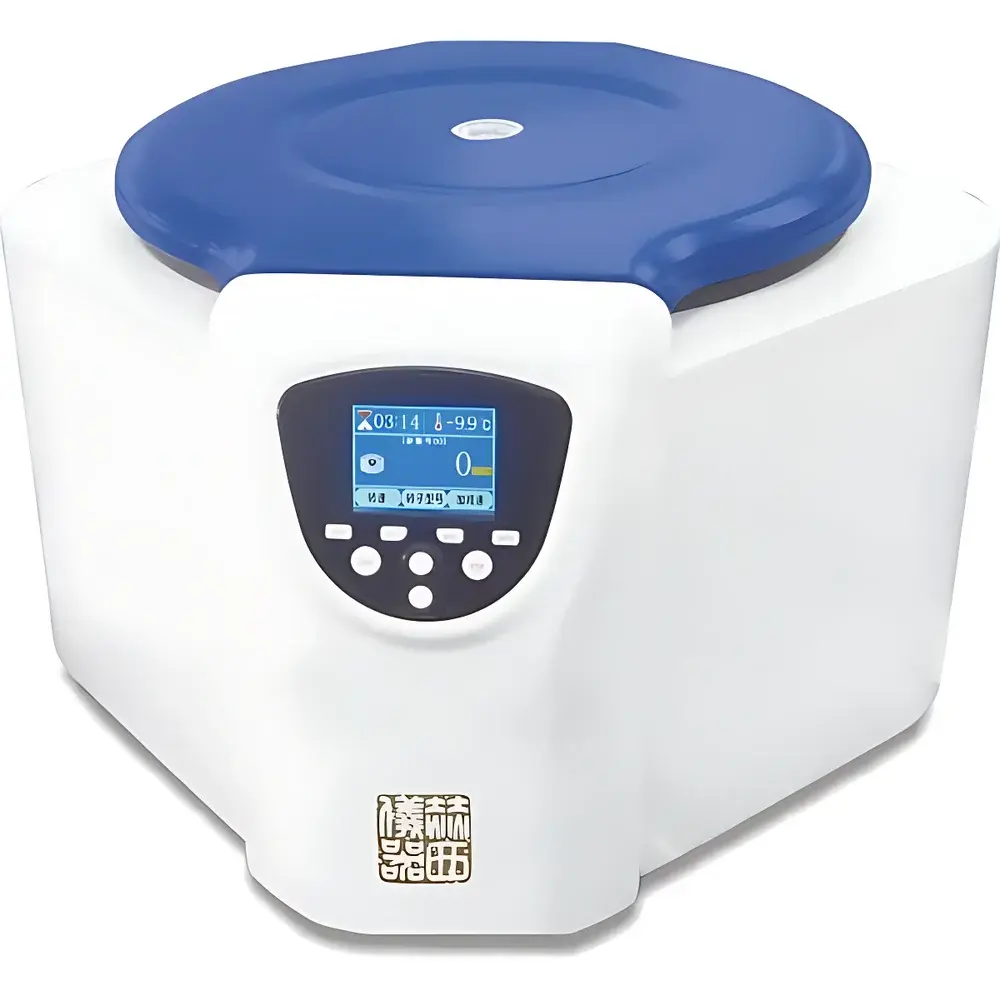
Hesix TD5 Benchtop Low-Speed Centrifuge
| Brand | Hesix |
|---|---|
| Origin | Hunan, China |
| Model | TD5 |
| Instrument Type | Benchtop Centrifuge |
| Maximum Speed | 5000 rpm |
| Maximum RCF | 4800 ×g |
| Maximum Capacity | 4 × 250 mL |
| Dimensions (L×W×H) | 600 × 540 × 360 mm |
| Weight | 35 kg |
| Power Supply | AC 220 V, 50 Hz |
| Noise Level | ≤60 dB(A) |
| Timer Range | 1 min–99 h 59 min / Continuous / Short Spin |
| Acceleration/Deceleration | 10-step control |
| Stored Programs | 20 user-defined protocols |
| Compliance | ISO 9001:2015, ISO 13485:2016, CFDA registered |
| Rotor Material | Forged aluminum (angle rotors), polyamide fiber adapters available |
| Safety | Airtight biocontainment angle rotor with RoHS-compliant silicone sealing ring, 304 stainless steel chamber, triple-layer steel protection housing, brushless DC motor with electronic imbalance detection, over-speed/over-temperature/under-voltage/over-voltage protection, soft-lock motorized door latch |
Overview
The Hesix TD5 Benchtop Low-Speed Centrifuge is an engineered solution for routine sedimentation, pelleting, and phase separation of biological and chemical samples under moderate centrifugal forces. Designed for laboratories requiring reliable, low-maintenance operation at speeds up to 5000 rpm and relative centrifugal forces (RCF) up to 4800 ×g, the TD5 employs a brushless DC motor coupled with microprocessor-based control architecture to ensure high reproducibility and mechanical stability. Its operational envelope targets applications involving whole blood fractionation, cell harvesting, precipitate recovery, and macromolecular isolation—particularly where thermal sensitivity, aerosol containment, and sample integrity are critical. The system adheres to core principles of safe centrifugation: rotor dynamics balance verification, real-time acceleration/deceleration profiling, and fail-safe interlock mechanisms compliant with IEC 61010-2-020 (safety requirements for laboratory centrifuges).
Key Features
- Brushless DC motor with high-torque output and integrated drive module (Infineon-based), delivering consistent rotational performance with noise levels ≤60 dB(A) — suitable for shared or noise-sensitive lab environments.
- Dual-mode interface: 5.7-inch TFT-LCD color display with both capacitive touch and physical keypads; supports on-the-fly parameter modification during active runs without interrupting spin cycles.
- Comprehensive safety architecture: triple-stage damping system, electronic imbalance detection with automatic shutdown, over-speed/over-temperature/under-voltage/over-voltage monitoring, and a motorized soft-lock door latch that engages automatically upon lid closure.
- Airtight angle rotor sealed with EU RoHS 2015/863-compliant silicone gasket to prevent aerosol leakage during biosample processing — validated for BSL-2 compatible workflows.
- Corrosion-resistant 304 stainless steel centrifuge chamber and reinforced steel housing with three-layer protective casing meet structural durability standards for long-term use in QC, clinical, and academic settings.
- Wide-range programmability: 20 user-storable protocols, 10-step acceleration/deceleration ramp control, and auto-recall of last-used method at power-on.
Sample Compatibility & Compliance
The TD5 accommodates diverse tube formats via interchangeable rotors and adapters—including standard conical tubes (5–250 mL), vacuum blood collection tubes (2–5 mL), PCR plates, deep-well plates, and 96-well microtiter plates (enzyme-linked immunosorbent assay configuration). Its maximum capacity of 4 × 250 mL enables scalable batch processing while maintaining rotor balance across heterogeneous loads. All rotors are precision-balanced and certified for use within specified speed and RCF limits per ISO 21501-4. The device holds CFDA registration and manufacturing certification, and complies with ISO 9001:2015 (quality management) and ISO 13485:2016 (medical device quality systems), supporting GLP/GMP-aligned documentation practices.
Software & Data Management
While the TD5 operates as a standalone instrument without external PC dependency, its embedded firmware supports full audit trail functionality for time-stamped parameter logging, run history storage (last 100 cycles), and error event recording. All displayed parameters—including setpoint speed, actual RCF, elapsed time, remaining time, and temperature status (if equipped with optional sensor)—are simultaneously visible and modifiable. Language localization includes English, Chinese, Russian, and Portuguese interfaces, facilitating multi-regional deployment. Though not FDA 21 CFR Part 11–enabled out-of-box, the system’s deterministic control logic and non-volatile memory architecture allow integration into validated environments when paired with third-party LIMS or ELN platforms.
Applications
The TD5 serves as a primary separation tool in clinical diagnostics (e.g., serum/plasma preparation from whole blood), pharmaceutical QA/QC (e.g., excipient suspension clarification), agricultural research (e.g., soil extract centrifugation), food safety testing (e.g., pathogen pellet concentration), and academic life sciences (e.g., bacterial cell harvesting, organelle pre-enrichment prior to ultracentrifugation). Its low-speed profile minimizes shear-induced denaturation of fragile complexes such as ribonucleoprotein particles or extracellular vesicles, making it suitable for preparative workflows preceding downstream analysis by electrophoresis, chromatography, or mass spectrometry.
FAQ
What is the maximum RCF achievable with the TD5 using the 4 × 100 mL horizontal rotor?
The 4 × 100 mL horizontal rotor achieves a maximum RCF of 4800 ×g at 5000 rpm.
Does the TD5 support continuous operation mode?
Yes — the timer includes a dedicated “continuous” setting for indefinite spinning until manually stopped.
Is the rotor autoclavable?
Angle rotors made of forged aluminum are autoclavable at 121 °C for 20 minutes; horizontal rotors and adapters require validation per manufacturer guidelines before sterilization.
Can the TD5 be operated on unstable voltage supplies?
Standard units operate at AC 220 V, 50 Hz; optional wide-input variants (100–230 V) are available for regions with fluctuating grid conditions.
How many language options does the touchscreen interface support?
Four: English, Simplified Chinese, Russian, and Portuguese — selected via system settings menu.



