
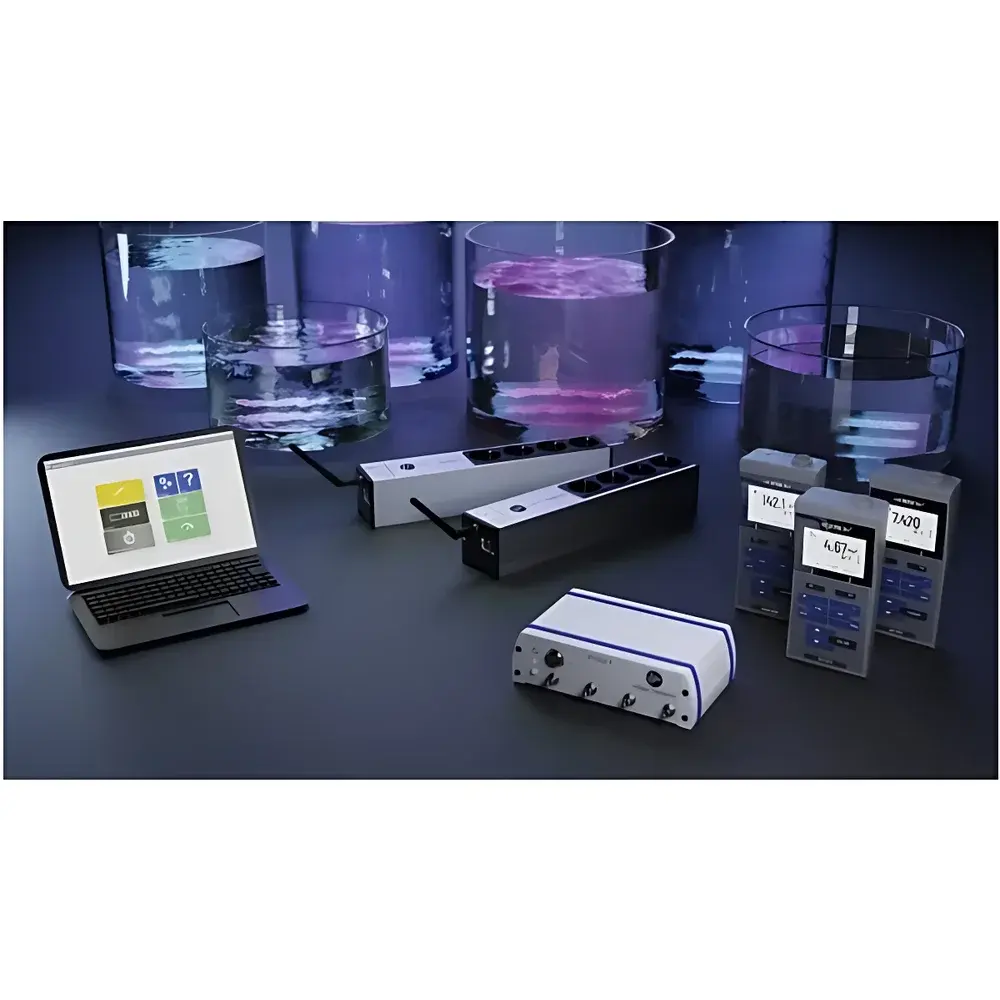
OmniCTRL Water Environment Automated Control System
| Origin | Imported |
|---|---|
| Manufacturer Type | Authorized Distributor |
| Model | OmniCTRL Water Environment Automated Control System |
| Pricing | Available Upon Request |
Overview
The OmniCTRL Water Environment Automated Control System is an integrated, PC-based platform engineered for precise, real-time monitoring and bidirectional regulation of critical aquatic environmental parameters—including temperature, dissolved oxygen (DO), pH/CO₂, and salinity—in controlled laboratory aquaria, mesocosms, and multi-tank experimental setups. Built upon a modular architecture, the system implements closed-loop feedback control using industry-standard electrochemical and optical sensors coupled with programmable actuation hardware (e.g., peristaltic pumps, solenoid valves, and heating/cooling modules). Its operational principle relies on continuous sensor data acquisition, dynamic threshold comparison against user-defined setpoints or time-series protocols, and deterministic output signal generation to drive peripheral actuators via Ethernet, Bluetooth 5.0 (Class 1), or USB interfaces. Designed specifically for marine, estuarine, and freshwater physiological and ecotoxicological research, the system supports long-term stability under GLP-aligned experimental conditions and enables reproducible simulation of natural diel cycles, climate change stressors (e.g., ocean acidification, hypoxia, thermal variability), and multivariate exposure scenarios.
Key Features
- Unified Windows 10/11-native software interface with intuitive drag-and-drop protocol builder and real-time parameter visualization
- Simultaneous control of up to 16 independent tanks or zones via scalable hardware expansion (PowerX4 industrial quad-socket controller with integrated power telemetry)
- Programmable dual-directional regulation (e.g., both heating and cooling; DO enrichment and degassing; acid/base titration) with configurable hysteresis and ramp rates
- Automatic temperature, salinity, and pressure compensation applied in real time to all relevant sensor readings (e.g., DO partial pressure correction per ISO 5814:2012)
- Time-synchronized data logging at user-selectable intervals (1 s to 60 min), with timestamped CSV export compatible with Excel, R, and Python-based analysis pipelines
- Embedded script editor supporting custom logic (e.g., conditional triggers, cascaded parameter dependencies, sinusoidal waveform generation for circadian rhythm emulation)
- Diagnostic monitoring of connected actuator electrical parameters (voltage, current, power draw) for predictive maintenance and experimental fidelity verification
Sample Compatibility & Compliance
The OmniCTRL system accommodates diverse aquatic model systems—from cnidarian symbiosis studies (e.g., Exaiptasia pallida) and bivalve larval development (Crassostrea rivularis) to teleost physiology (e.g., Salvelinus fontinalis, Morone saxatilis) and phytoplankton culture (Pseudo-nitzschia australis). Sensor modules comply with ASTM D888-20 (DO measurement), ASTM D1293-21 (pH), and ISO 7888:2019 (electrical conductivity/salinity). The software architecture supports audit trail functionality and user-access-level management, facilitating alignment with FDA 21 CFR Part 11 requirements for electronic records where configured with validated IT infrastructure. All hardware components meet IEC 61000-6-3 (EMC) and IEC 60529 IP20 specifications for laboratory use.
Software & Data Management
OmniCTRL software provides native integration between sensing and actuation layers without third-party middleware. It features a dual-pane workspace: left-side protocol editor with hierarchical step sequencing (time-based, event-triggered, or sensor-threshold-driven); right-side live dashboard with overlay-capable trend plots, numeric readouts, and status indicators. All graphs support axis scaling, annotation, and export in PNG, SVG, or EMF formats. Raw datasets are stored locally in UTF-8 encoded CSV files with ISO 8601 timestamps and SI-compliant units (°C, mg·L⁻¹ O₂, pH unit, PSU, kPa CO₂). Versioned protocol files (.ocp) retain full metadata—including operator ID, calibration history references, and hardware configuration snapshots—ensuring experimental traceability across longitudinal studies.
Applications
This system is routinely deployed in peer-reviewed climate change biology research investigating interactive stressor effects (e.g., OA + hypoxia + warming), as evidenced by its use in studies published in Aquatic Toxicology, Journal of Experimental Marine Biology and Ecology, and Science of The Total Environment. Typical applications include: automated seawater carbonate chemistry manipulation for calcifier experiments; dynamic DO clamping during respirometry; salinity ramping assays for osmoregulatory phenotyping; and multi-parameter synchronization in cross-treatment factorial designs. Its modularity allows seamless integration with external equipment such as mass spectrometers (for δ¹³C-DIC tracking), fluorometers (for chlorophyll or ROS detection), and high-speed cameras (for behavioral endpoints).
FAQ
Is the OmniCTRL system compatible with non-Windows operating systems?
No—software operation is restricted to x64 editions of Windows 10 (version 20H2 or later) and Windows 11 (version 21H2 or later) due to low-level hardware driver dependencies and real-time scheduling requirements.
Can I integrate third-party sensors or actuators?
Yes—via RS-485, Modbus RTU, or analog 0–10 V / 4–20 mA inputs/outputs using optional interface modules; however, factory-calibrated sensor performance guarantees apply only to OEM-configured hardware bundles.
Does the system support remote access or cloud-based data backup?
Local network remote desktop access is supported; cloud synchronization is not natively implemented but can be enabled via user-configured secure FTP or SMB shares compliant with institutional IT policies.
What validation documentation is provided for regulatory submissions?
A comprehensive IQ/OQ protocol package—including sensor calibration certificates (NIST-traceable), system response latency reports, and software verification test logs—is available upon request for GxP-regulated environments.
How frequently must sensors be recalibrated during extended deployments?
Dissolved oxygen and pH sensors require daily two-point calibration under high-precision protocols; salinity and temperature modules typically maintain ±0.02 PSU and ±0.05 °C accuracy over 7-day intervals when operated within specified environmental envelopes.
Related Products







