
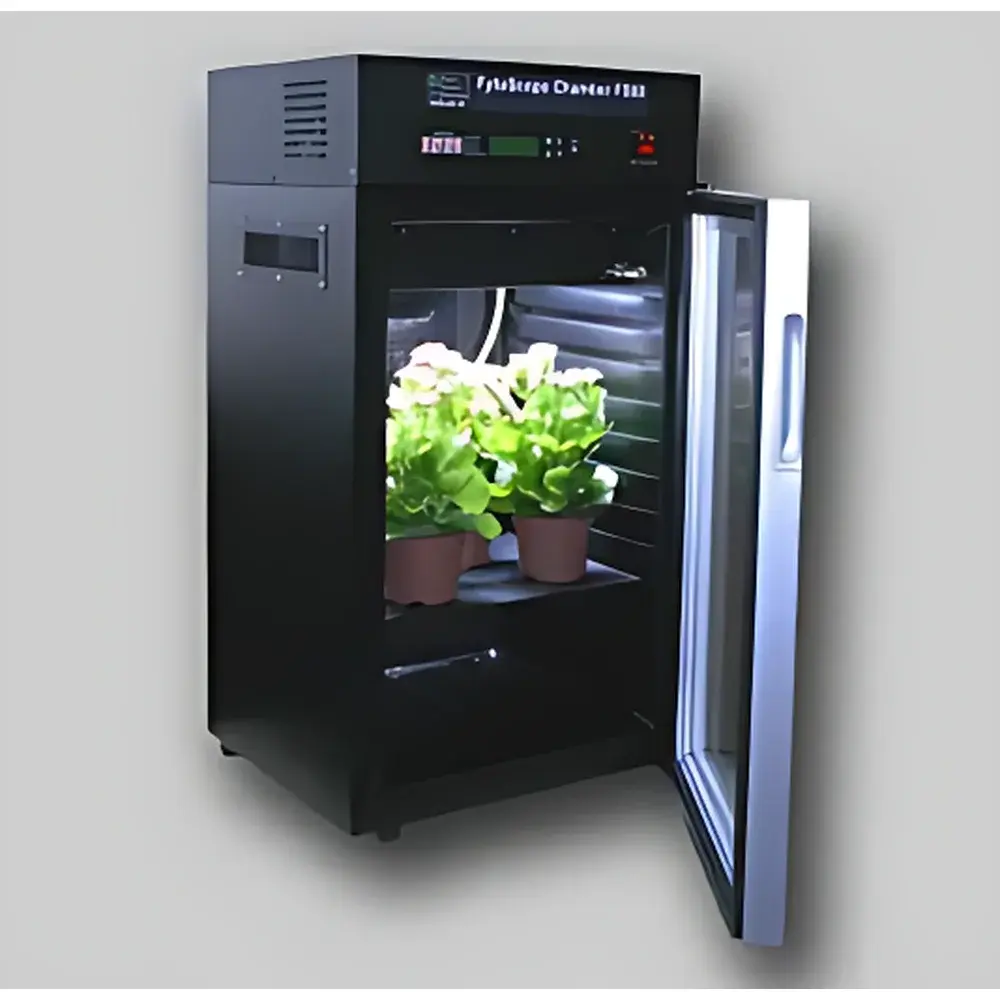
Fytoscopes FS Series Controlled-Environment Plant Growth Chambers
| Origin | Europe |
|---|---|
| Manufacturer Type | Authorized Distributor |
| Product Category | Imported |
| Model | Fytoscopes FS Series |
| Pricing | Available Upon Request |
Overview
The Fytoscopes FS Series Controlled-Environment Plant Growth Chambers are precision-engineered environmental simulation systems designed for reproducible, long-term plant phenotyping, stress physiology, and ecophysiological research. Built on a modular architecture, each chamber integrates high-fidelity LED lighting, dynamic temperature and humidity control, and optional chlorophyll fluorescence monitoring to replicate diurnal cycles, seasonal transitions, or climate-change-relevant scenarios with sub-hour temporal resolution. Unlike conventional growth cabinets, the FS Series employs photobiologically optimized light spectra—calibrated in photosynthetic photon flux density (PPFD, µmol·m⁻²·s⁻¹) at standardized measurement distances—and low-thermal-load solid-state illumination to eliminate radiant heating artifacts that confound stomatal conductance, transpiration, and thermal imaging studies. The system operates on a closed-loop control principle: integrated sensors continuously feed back real-time temperature, relative humidity (RH), and PPFD data to an embedded microcontroller, which dynamically adjusts actuator outputs to maintain setpoint stability within ±0.3°C (temperature), ±3% RH, and ±2% PPFD across the homogenous irradiation zone.
Key Features
- Modular LED lighting platforms: WIR (White + Far-Red) and RGBIR (Red 627 nm + Green 530 nm + Blue 470 nm + Far-Red) spectral configurations, all with independent intensity control per channel
- Precision environmental control: Temperature range from 0°C to 55°C (model-dependent); RH regulation from 30% to 90% (FS3400 standard); programmable ramp rates for gradual acclimation protocols
- Chlorophyll fluorescence module (standard on FS3400, optional on FS130/FS250/FS360): non-invasive measurement of steady-state fluorescence (Ft) and quantum yield of PSII (Qy), compliant with OJIP protocol conventions
- Touchscreen HMI with color display (FS3400) or 4-button keypad + LCD (FS130/FS250/FS360): intuitive navigation, real-time parameter overlay, and graphical trend visualization
- Data logging & traceability: Internal storage for ≥100 user-defined programs; timestamped environmental logs exportable via USB in CSV format; audit-ready for GLP-compliant labs
- Expandable functionality: Optional ultrasonic humidification (standard on FS3400), CO2 mixing system (0–2000 ppm, ±10 ppm accuracy), cloud-simulation software, and orbital shaker integration for cyanobacterial or algal suspension cultures
Sample Compatibility & Compliance
The FS Series accommodates diverse biological samples—including Arabidopsis thaliana, rice, maize, wheat, mosses, lichens, microalgae (e.g., Chlamydomonas reinhardtii), and cyanobacteria (e.g., Synechocystis sp. PCC 6803)—within defined spatial constraints. All models meet IEC 61000-6-3 (EMC emission) and IEC 61000-6-2 (immunity) standards. The FS3400 chamber complies with ISO 17025 requirements for environmental monitoring instrumentation when used with validated calibration procedures. Optional CO2 and humidity modules support adherence to ASTM E1823-22 (standard terminology for plant stress testing) and OECD TG 208 (terrestrial plant toxicity tests). Firmware supports 21 CFR Part 11-compliant electronic signatures and audit trails when paired with certified third-party LIMS integration.
Software & Data Management
Each chamber runs proprietary firmware (v4.2+) enabling multi-parameter scheduling: users define time-series profiles for light intensity, spectral composition, temperature setpoints, RH targets, and photoperiod duration—including dawn/dusk ramping, sinusoidal fluctuations, and stepwise stress imposition. Environmental logs record sensor values at user-selectable intervals (1 s to 60 min), stored internally with millisecond timestamps. Data export is restricted to ASCII-based CSV files to ensure interoperability with R, Python (pandas), MATLAB, and commercial statistical packages (e.g., JMP, GraphPad Prism). No cloud connectivity or remote access is implemented by default—data sovereignty and network isolation are preserved per institutional IT security policies. Firmware updates are delivered via signed USB firmware images, requiring physical authentication prior to installation.
Applications
- Controlled-environment phenotyping under standardized light spectra and thermal regimes for QTL mapping and GWAS validation
- Quantitative assessment of abiotic stress responses—including drought, heat, cold, high-light, and elevated CO2—using concurrent fluorescence yield and morphometric endpoints
- Functional validation of CRISPR/Cas9-edited alleles under ecologically relevant diel cycles
- Algal biomass optimization via spectral tuning of photosystem excitation balance (e.g., red:blue ratio modulation)
- Long-term acclimation experiments simulating projected IPCC AR6 climate scenarios (e.g., RCP 4.5/8.5 temperature-humidity trajectories)
- Pre-clinical screening of phytochemical production in medicinal plants under controlled elicitor regimens
FAQ
What spectral configurations are available, and how are PPFD values calibrated?
All LED modules are factory-calibrated using NIST-traceable spectroradiometers at 30 cm (FS130/FS250/FS360) or 50–150 cm (FS3400) distances. WIR modules offer tunable white CCT (2700K–6500K) plus 730 nm far-red; RGBIR enables independent control of four narrowband peaks aligned with chlorophyll a/b and phytochrome absorption maxima.
Can the system maintain uniform PPFD across large canopy areas?
Yes—the FS3400 achieves ≤±5% spatial uniformity over its 110 × 80 cm homogenous zone (measured per ASTM E308-22 Annex A3); smaller models specify uniformity at ≥90% of nominal PPFD across central 80% of irradiated area.
Is the chlorophyll fluorescence module compatible with pulse-amplitude modulation (PAM) protocols?
No—it measures only steady-state Ft and calculates Qy = (Fm′−Ft)/Fm′ using built-in saturating pulses; it does not support kinetic OJIP or multiphase flash sequences. For full PAM analysis, external devices (e.g., Walz IMAGING-PAM) are recommended.
How is temperature stability maintained during high-intensity illumination?
Active thermoelectric cooling (TEC) and dual-stage compressor refrigeration (R134a) operate in parallel with PID-controlled airflow (250 L/h minimum), decoupling radiant load from air temperature. Thermal shielding between LEDs and chamber interior minimizes conductive heating.
Are firmware updates and technical support provided post-purchase?
Yes—customers receive lifetime firmware updates and remote diagnostic support via secure SSH tunneling; on-site service is available through authorized regional partners in EEA, North America, and APAC regions.
Related Products






