
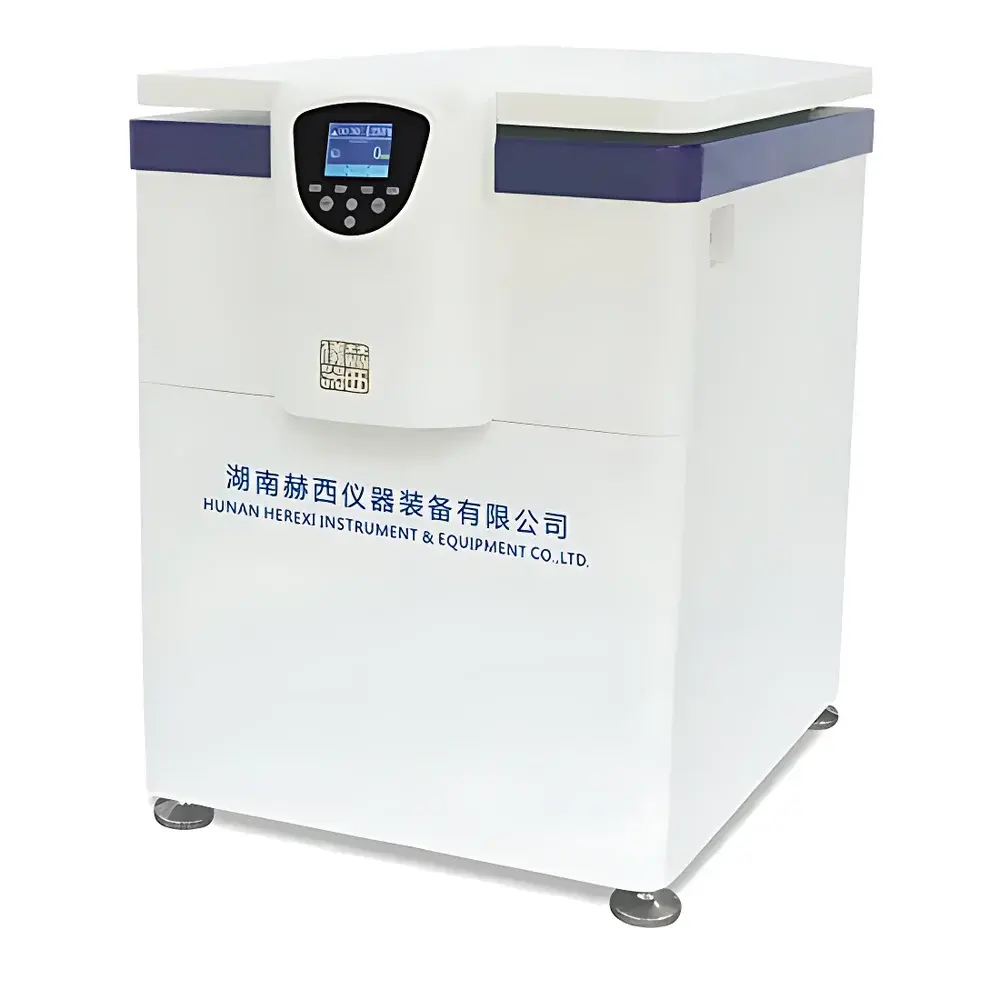
Hershey DD5M Automated Cap-Removal Centrifuge
| Brand | Hershey |
|---|---|
| Origin | Hunan, China |
| Model | DD5M |
| Instrument Type | Floor-Standing Centrifuge |
| Speed Range | Up to 4000 rpm |
| Max RCF | 3580 ×g |
| Capacity | 124–148 vacuum blood collection tubes (75 mm / 100 mm) |
| Acceleration/Deceleration | 10-step programmable |
| Noise Level | ≤65 dB(A) |
| Dimensions (L×W×H) | 710×560×770 mm |
| Weight | 75 kg |
| Certifications | CFDA Registered & Manufactured, ISO 9001:2015, ISO 13485:2016 |
| Display | TFT-LCD with bilingual (EN/CN) interface |
| Drive System | High-torque AC/DC brushless inverter motor |
| Safety | Triple-damping suspension, imbalance detection, overspeed/overtemperature/under-voltage/over-voltage protection, 304 stainless steel rotor chamber, electro-mechanical auto-lock door |
Overview
The Hershey DD5M Automated Cap-Removal Centrifuge is a floor-standing, microprocessor-controlled centrifugation system engineered for high-throughput clinical and diagnostic laboratories requiring automated, reproducible separation of whole blood into serum or plasma. Unlike conventional centrifuges, the DD5M integrates synchronized cap removal and centrifugation in a single workflow—eliminating manual decapping steps that introduce variability, biohazard exposure, and processing delays. Its operation follows standardized gravitational sedimentation principles under controlled angular acceleration and deceleration profiles, optimized for integrity preservation of labile analytes (e.g., cortisol, lactate dehydrogenase, free DNA) during phase separation. Designed specifically for vacuum blood collection tubes (75 mm and 100 mm lengths), the system achieves ≥97% cap removal success rate across heterogeneous tube batches, ensuring consistent sample preparation prior to downstream immunoassay, clinical chemistry, or coagulation testing.
Key Features
- Integrated cap-removal mechanism with adaptive grip geometry—compatible with standard EDTA, heparin, citrate, and serum separator tubes (SSTs) without adapter modification.
- High-torque brushless inverter motor delivering stable rotational control from 0 to 4000 rpm with ±50 rpm speed accuracy; 10-step programmable acceleration and deceleration profiles prevent red blood cell resuspension and serum turbidity.
- TFT-LCD touchscreen interface with dual input mode (touch + physical keys); real-time display of setpoint vs. actual rpm, RCF, elapsed time, temperature (if equipped), and dynamic curves (speed ramp, centrifugation integral, thermal profile).
- Triple-stage damping system combining rubber-isolated base mounts, counterbalanced rotor shaft suspension, and proprietary composite shock absorbers—reducing vibration transmission to <0.05 mm/s RMS at full load.
- Full safety architecture: automatic door interlock with electromagnetic latch, 304 stainless steel centrifuge chamber, three-layer reinforced steel front panel, and comprehensive fault diagnostics (imbalance >2 g, rotor overspeed, ambient temperature >40°C, supply voltage deviation >±10%).
- 20 user-programmable protocols with parameter recall, editable rotor-specific settings, and non-volatile memory retention—even after power interruption.
Sample Compatibility & Compliance
The DD5M accommodates both 124-position (standard) and 148-position (high-capacity) horizontal rotors, supporting all major vacuum tube formats compliant with CLSI GP45-A5 and ISO 6710:2017 specifications. Tube compatibility includes 5–10 mL monovette-style tubes with rubber stoppers, plastic or glass bodies, and gel barrier separators. The device meets essential requirements of IEC 61010-1:2010 (Safety of Laboratory Equipment) and carries CFDA registration (Class II medical device, registration number available upon request). Quality management adheres to ISO 13485:2016 for in vitro diagnostic manufacturing, and documentation supports GLP-compliant audit trails when integrated with LIS/HIS via optional RS232 or USB data export.
Software & Data Management
While the DD5M operates as a standalone instrument, its embedded firmware enables traceable operation through timestamped parameter logging (start/stop time, rotor ID, speed, duration, error codes). All 20 stored programs include metadata fields for operator ID, sample batch ID, and QC reference numbers—facilitating retrospective review per ISO 15189:2022 clause 5.9.2. Data export is supported via USB flash drive in CSV format, compatible with common LIMS platforms (e.g., Sunquest, Cerner CoPath, EPIC Beacon). No proprietary software installation is required; exported files contain no encryption or DRM restrictions. Firmware updates are delivered via signed .bin files verified by SHA-256 checksum to ensure integrity.
Applications
- Routine serum/plasma isolation in hospital core labs and reference laboratories performing CBC, electrolyte panels, liver/kidney function tests, and therapeutic drug monitoring.
- Pre-analytical automation for biobanking operations handling large-volume donor or longitudinal cohort samples.
- Point-of-care deployment in mobile health units where footprint efficiency, low acoustic emission (<65 dB), and rapid cycle time (<12 min for full 148-tube run) are critical.
- QC/QA workflows requiring strict adherence to centrifugation SOPs defined in CLIA, CAP, or JCI-accredited environments.
- Research applications involving exosome enrichment, platelet-poor plasma (PPP) preparation, or microbiological supernatant harvesting—where residual cellular contamination must remain below ISO 15189-defined thresholds.
FAQ
What vacuum tube lengths does the DD5M support?
The DD5M accepts both 75 mm and 100 mm vacuum blood collection tubes without hardware modification.
Is rotor balancing required before each run?
No—integrated imbalance detection automatically halts operation if mass asymmetry exceeds 2 g; however, symmetrical tube loading per manufacturer’s layout diagram is recommended for optimal RCF uniformity.
Can the DD5M be validated for 21 CFR Part 11 compliance?
The base unit does not include electronic signature or audit trail features required for full Part 11 compliance; however, exported CSV logs may serve as raw data inputs for externally managed validation frameworks.
Does the centrifuge require external cooling?
No—the DD5M is a non-refrigerated model; ambient temperature operation is specified between 10–32°C per ISO 13485 environmental controls.
What maintenance intervals are recommended?
Rotor inspection every 6 months or 500 runs (whichever occurs first); drive belt replacement every 2 years; full calibration verification annually using NIST-traceable tachometer and RCF meter.



