
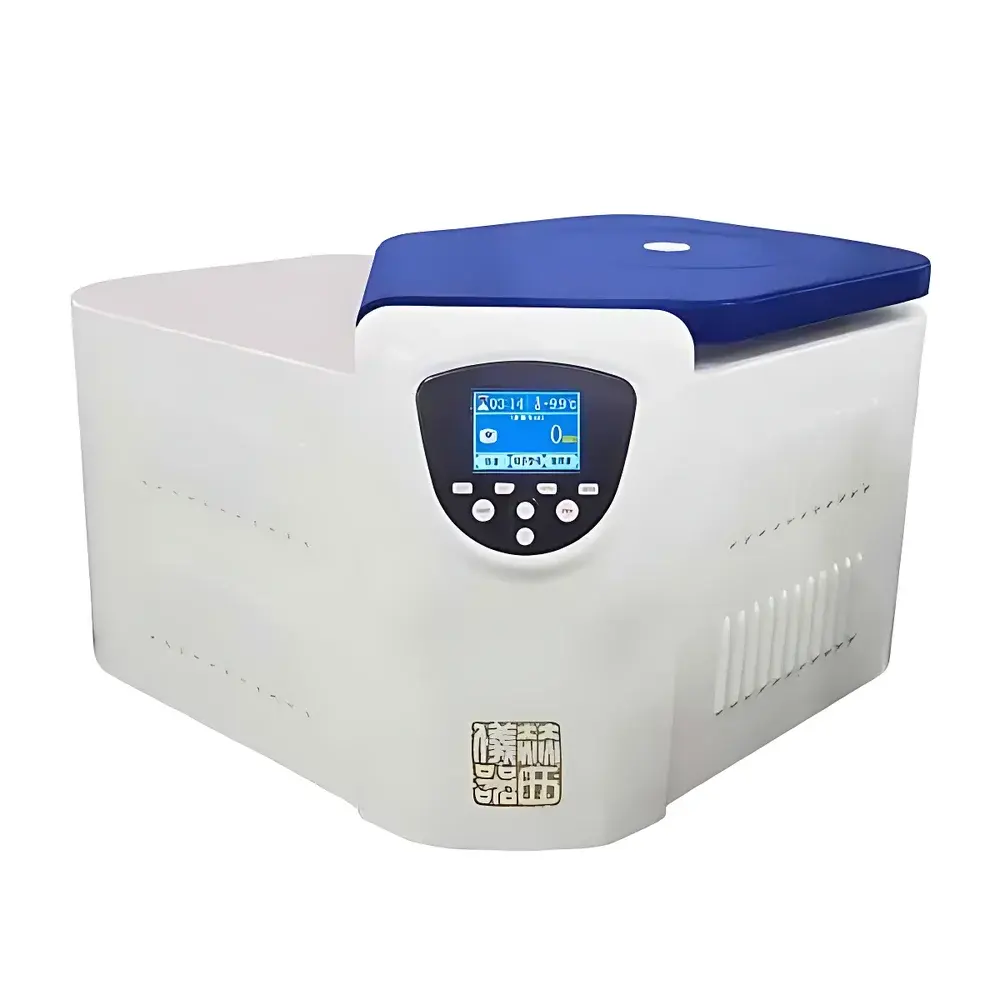
Hettich HR/T16M Benchtop High-Speed Refrigerated Centrifuge
| Brand | Hettich |
|---|---|
| Origin | Hunan, China |
| Manufacturer Type | Authorized Distributor |
| Product Category | Domestic |
| Model | Hettich HR/T16M |
| Instrument Type | Benchtop Centrifuge |
| Speed Range | High-Speed (10,000–30,000 rpm) |
| Function | General-Purpose Refrigerated Centrifugation |
| Configuration | Fixed-Angle Rotor System |
| Max Capacity | 4 × 100 mL |
| Max Speed | 16,000 rpm |
| Max RCF | 19,600 × g |
| Dimensions | 710 × 630 × 350 mm |
| Refrigeration | R404a refrigerant with imported non-CFC compressor |
| Temp Range | −20 °C to +40 °C |
| Temp Accuracy | ±1 °C |
| Acceleration/Deceleration | 10-step programmable |
| Noise Level | ≤65 dB(A) |
| Power Supply | AC 220 V, 50 Hz |
| Total Power | 1.5 kW |
| Weight | 73 kg |
| Certifications | CFDA Registered & Manufactured, ISO 9001:2015, ISO 13485:2016 |
Overview
The Hettich HR/T16M is a benchtop high-speed refrigerated centrifuge engineered for precision separation in demanding life science and clinical laboratory environments. It operates on the principle of sedimentation under controlled gravitational force (RCF), enabling efficient isolation of subcellular components—including nuclei, mitochondria, microsomes, and ribosomes—as well as macromolecules such as nucleic acids, proteins, and viral particles. Its robust design integrates a high-torque brushless DC/AC inverter motor, ensuring stable rotational dynamics at speeds up to 16,000 rpm and generating a maximum relative centrifugal force of 19,600 × g. The unit maintains sample integrity through precise temperature regulation between −20 °C and +40 °C, supported by an imported R404a refrigeration system compliant with international environmental standards (EU F-Gas Regulation No. 517/2014). Unlike air-cooled systems, this active refrigeration architecture allows real-time temperature adjustment during operation and supports pre-cool functionality—critical for heat-sensitive biological samples.
Key Features
- Microprocessor-controlled operation with dual-mode interface: TFT-LCD color display with both capacitive touch and physical keypad inputs
- Real-time parameter monitoring: simultaneous display of setpoints (speed, time, temperature, acceleration/deceleration rate) and actual running values
- Programmable ramp control: 10 acceleration and 10 deceleration profiles for optimized pelleting and gradient preservation
- 20 user-defined protocol storage with auto-recall of last-used program upon startup
- Biocontainment-compliant fixed-angle rotor: silicone rubber O-ring sealing per EU RoHS Directive 2015/863, minimizing aerosol leakage during high-speed runs
- Triple-layer safety construction: 304 austenitic stainless steel centrifuge chamber, powder-coated steel housing, and reinforced front panel with impact-resistant polymer overlay
- Intelligent door lock mechanism: electromagnetic latching activated automatically upon lid closure; interlocked with rotor detection and imbalance sensors
- Comprehensive safety suite: overspeed, overtemperature, imbalance, voltage fluctuation (under/over-voltage), and refrigeration fault detection with audible and visual alerts
Sample Compatibility & Compliance
The HR/T16M accommodates standard conical tubes (1.5–2.0 mL), PCR strips, deep-well plates (96- and 384-well), and custom adapters for MTP formats—all compatible with aerospace-grade aluminum angle rotors. Its cavity geometry supports routine use of 4 × 100 mL bottles or equivalent volume configurations. All mechanical and thermal performance parameters conform to ISO 13485:2016 requirements for medical device manufacturing quality management systems. Regulatory documentation includes CFDA registration (Class II medical device) and production license verification. While not FDA 510(k)-cleared, its design principles align with IEC 61010-1 (Safety Requirements for Electrical Equipment for Measurement, Control, and Laboratory Use) and EN 61326-1 (EMC compliance for laboratory instrumentation). Temperature uniformity across the rotor chamber meets ISO/IEC 17025 traceability guidelines when validated using calibrated NIST-traceable probes.
Software & Data Management
The embedded control firmware supports audit-ready data logging with timestamped records of all operational events—including start/stop times, parameter changes, alarm triggers, and refrigeration status. Though no external PC software is bundled, raw log files can be exported via USB port in CSV format for integration into LIMS or ELN platforms. The system implements basic electronic signature readiness: operator ID entry is supported (via alphanumeric keypad), and critical parameter modifications require confirmation—laying groundwork for GLP/GMP-aligned workflows. Full 21 CFR Part 11 compliance requires third-party validation packages; however, the architecture permits secure user-level access control and immutable event logging when deployed in validated environments.
Applications
- Nucleic acid purification workflows: plasmid DNA, genomic DNA, RNA isolation from blood, tissue homogenates, and cultured cells
- Protein biochemistry: clarification of lysates, fractionation of membrane-bound proteins, and preparation of cytosolic extracts
- Clinical diagnostics: serum/plasma separation, PBMC isolation, pathogen concentration from environmental water samples
- Vaccines & biologics: removal of cell debris post-fermentation, virus harvesting, and adjuvant formulation support
- Food safety testing: pathogen enrichment (e.g., Salmonella, Listeria) and mycotoxin extraction from grain matrices
- Environmental analysis: particulate matter recovery from wastewater, soil eluates, and airborne filter extracts
FAQ
What is the minimum temperature achievable during operation?
The unit achieves and maintains −20 °C throughout the centrifuge chamber while spinning at rated speed, provided ambient conditions remain below 25 °C and humidity is ≤60% RH.
Can the HR/T16M accommodate swinging-bucket rotors?
No—it is configured exclusively for fixed-angle rotor systems. Swinging-bucket compatibility is limited to higher-tier models in the HR/T series.
Is rotor calibration required before first use?
Yes. Each rotor must undergo initial balancing verification and RCF calculation validation using the manufacturer-provided calibration certificate and serial-matched tachometer readings.
Does the system support remote monitoring or network connectivity?
Not natively. Ethernet or Wi-Fi modules are not integrated; connectivity requires external IoT gateways interfacing via RS-232 or USB CDC protocols.
How often should the refrigeration system be serviced?
Annual preventive maintenance is recommended, including refrigerant pressure check, condenser coil cleaning, and compressor oil inspection—per ISO 13485 maintenance log requirements.



