
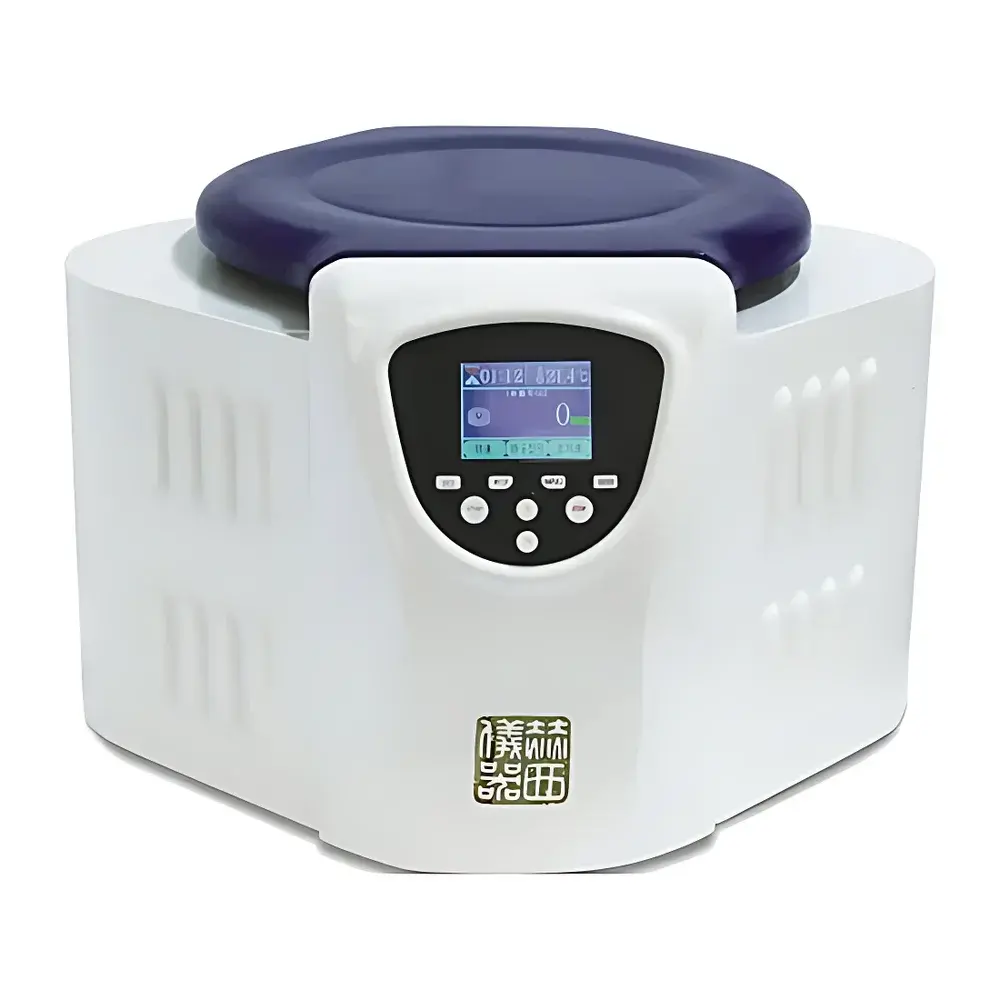
HEREXI H/T12MM Blood Typing Card Centrifuge
| Brand | HEREXI |
|---|---|
| Origin | Hunan, China |
| Model | H/T12MM |
| Centrifuge Type | Benchtop Low-Speed Centrifuge |
| Maximum Capacity | 12 microtubes or 12 blood typing cards (6- or 8-column gel cards) |
| Max Speed | 4000 rpm |
| Max RCF | 2200 ×g |
| Dimensions (L×W×H) | 500 × 450 × 280 mm |
| Weight | 35 kg |
| Power Supply | 220 V, 50 Hz |
| Rated Power | 200 W |
| Rotor Types | SERO rotor (for RBC washing and serology), HLS rotor (for lymphocyte separation), Blood Typing Card rotor (for 6-/8-column microgel cards and 24-well formats) |
| Control System | Microprocessor-based with automatic imbalance detection |
| Compliance | Designed for GLP-compliant clinical laboratories performing immunohematology testing per CLSI EP12-A2 and ISO 15189 requirements |
Overview
The HEREXI H/T12MM Blood Typing Card Centrifuge is a purpose-engineered benchtop centrifuge optimized for immunohematology applications, particularly microcolumn gel card-based assays. It operates on the principle of controlled low-speed sedimentation to separate red blood cells (RBCs), white blood cells (WBCs), platelets, and serum/plasma within standardized gel matrix cards—enabling precise interpretation of agglutination patterns in ABO/Rh typing, antibody screening, identification, and crossmatching. Unlike general-purpose centrifuges, the H/T12MM integrates dedicated rotor geometry, programmable acceleration/deceleration profiles, and card-specific braking algorithms to prevent gel column disruption while ensuring reproducible pellet formation and clear band resolution. Its design aligns with internationally accepted microcolumn gel technology workflows, supporting both manual and semi-automated blood bank operations under routine clinical laboratory conditions.
Key Features
- Microprocessor-controlled operation with 7 pre-programmed protocols tailored for immunohematology workflows—including RBC washing, lymphocyte isolation, platelet removal, and gel card centrifugation.
- Dedicated blood typing card rotor accommodating 6-column, 8-column, and 24-well microgel formats—ensuring uniform radial force distribution across all card positions.
- Automatic imbalance detection and real-time rotor monitoring to prevent mechanical stress during high-cycle usage typical in blood bank settings.
- Adjustable deceleration profiles to minimize disturbance of settled RBC layers in gel columns—critical for accurate interpretation of weak agglutination reactions.
- Compact footprint (500 × 450 × 280 mm) and quiet operation (<65 dB(A)) suitable for laminar flow hoods, blood bank workstations, and point-of-care testing environments.
- Compliance-ready architecture: supports audit trails for parameter changes, user log-in tracking, and time-stamped run records—facilitating adherence to CLIA, CAP, and ISO 15189 documentation requirements.
Sample Compatibility & Compliance
The H/T12MM is validated for use with commercially available microcolumn gel cards (e.g., ID-Micro Typing System, Ortho BioVue, DiaMed-ID) and standard 12 × 75 mm or 13 × 100 mm tubes used in RBC washing and serologic testing. It meets mechanical safety standards per IEC 61010-1:2010 and electromagnetic compatibility requirements per IEC 61326-1:2020. The device is intended for in vitro diagnostic use in clinical laboratories accredited under ISO 15189 and operating under Good Laboratory Practice (GLP) frameworks. All rotor configurations are calibrated per ISO 21501-4 for consistent RCF delivery; no recalibration is required between card types when using the designated blood typing rotor.
Software & Data Management
The centrifuge features an embedded microcontroller with non-volatile memory storing up to 100 run logs, including date/time stamp, selected program, actual speed, RCF, duration, and error codes. While it does not support external PC connectivity or LIMS integration, its internal logging system satisfies minimum traceability requirements for FDA 21 CFR Part 11–aligned environments when paired with laboratory SOPs governing data review and retention. Each protocol includes factory-set parameters aligned with manufacturer recommendations for leading gel card systems—ensuring method equivalence without user adjustment.
Applications
- Blood group determination (ABO, RhD, Kell, Duffy, Kidd systems) using microcolumn gel cards.
- Antibody screening and identification via indirect antiglobulin test (IAT) in gel media.
- Immediate-spin and IAT crossmatches with integrated RBC washing capability (SERO rotor).
- Lymphocyte isolation from peripheral blood mononuclear cells (PBMCs) using density gradient-compatible protocols (HLS rotor).
- Platelet depletion prior to RBC antigen testing or plasma preparation.
- Serum/plasma separation from whole blood samples prior to ELISA or molecular testing.
- Red cell phenotyping and rare antigen detection requiring high-resolution gel band analysis.
FAQ
What gel card formats are compatible with the H/T12MM?
The dedicated blood typing card rotor supports 6-column, 8-column, and 24-well microgel cards from major manufacturers including DiaMed, Ortho Clinical Diagnostics, and Grifols.
Does the H/T12MM comply with CLSI EP12-A2 guidelines for gel card centrifugation?
Yes—the device delivers repeatable RCF profiles (±2% tolerance) and controlled braking consistent with CLSI-recommended centrifugation conditions for microcolumn gel immunohematology assays.
Can the same rotor be used for both RBC washing and gel card processing?
No—separate rotors are provided: the SERO rotor for tube-based RBC washing and serology, and the dedicated blood typing card rotor for gel cards. Mixing rotors compromises assay integrity.
Is calibration required before first use or after maintenance?
Factory calibration is performed prior to shipment; users must verify rotor balance and perform routine visual inspection per manufacturer’s maintenance schedule—no field recalibration is necessary.
What safety certifications does the H/T12MM hold?
It conforms to IEC 61010-1:2010 (Safety Requirements for Electrical Equipment for Measurement, Control, and Laboratory Use) and IEC 61326-1:2020 (EMC for Laboratory Equipment).



