
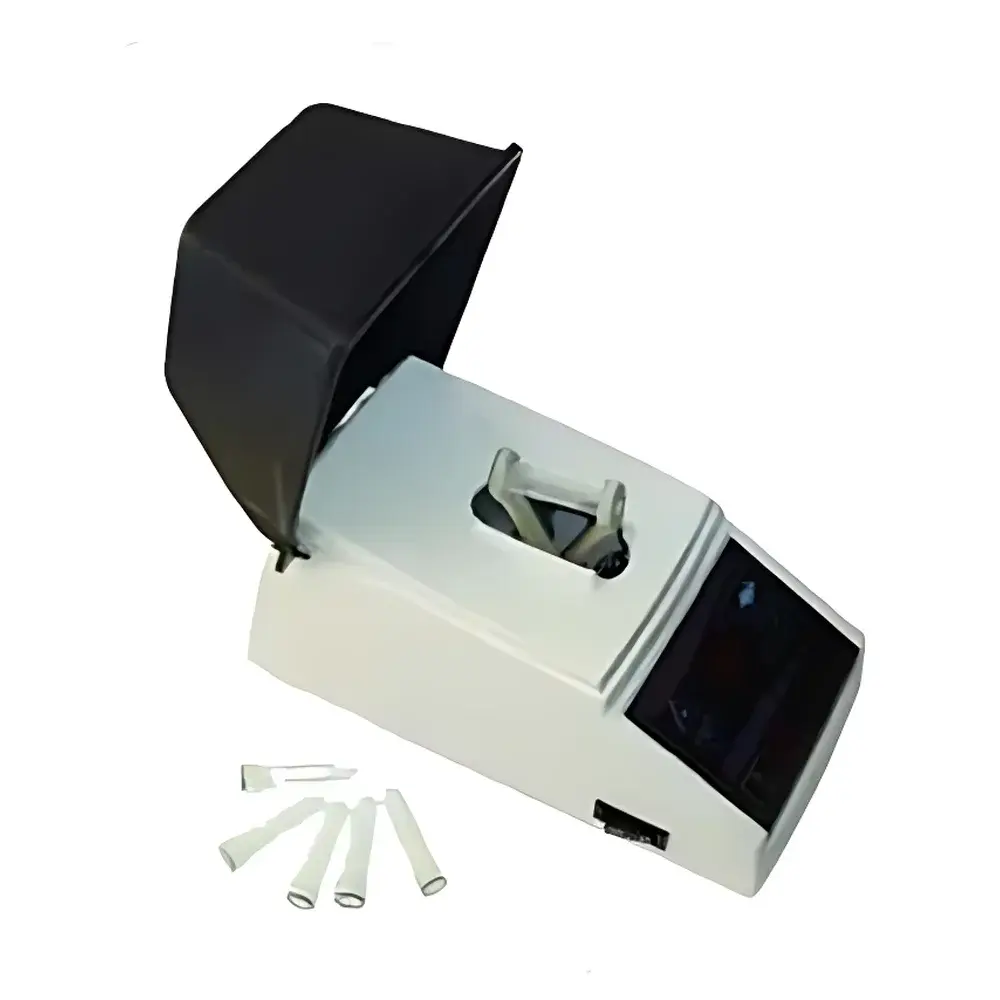
Biospec MiniBeadbeater-1 Bead Mill Homogenizer
| Brand | Biospec |
|---|---|
| Origin | USA |
| Model | MiniBeadbeater-1 |
| Instrument Type | Bead Mill Homogenizer |
| Sample Compatibility | Cryogenic and ambient-temperature samples |
| Maximum Batch Volume | 2 mL |
| Feed Particle Size | < 5 mm |
| Final Particle Size | < 0.01 mm |
| Processing Capacity | Up to 400 mg tissue/cells/plant material per run (in 100 µL–1 mL volume) |
| Oscillation Speeds | 2500, 4200, 4600, 4800 rpm |
| Timer Range | 0–5 min, adjustable in 10-s increments |
| Optional Consumables | Glass, stainless steel, and ceramic beads (0.1 mm, 0.5 mm, 1.0 mm, 3.0 mm diameter) |
Overview
The Biospec MiniBeadbeater-1 is a compact, high-energy bead mill homogenizer engineered for rapid, reproducible mechanical lysis of biological samples under controlled conditions. It operates on the principle of horizontal reciprocating motion—driving a stainless-steel grinding chamber containing sample and beads at precisely regulated frequencies—generating intense shear, impact, and collision forces sufficient to disrupt tough cellular matrices, including yeast cell walls, bacterial spores, plant tissues, and frozen animal tissues. Unlike rotor-stator or ultrasonic systems, the MiniBeadbeater-1 delivers consistent energy input without significant heat accumulation when used with pre-chilled tubes or cryogenic adapters, making it especially suitable for nucleic acid and protein extraction workflows where biomolecular integrity is critical. Its benchtop footprint and single-tube operation support traceable, low-cross-contamination processing in regulated environments.
Key Features
- Four fixed oscillation speeds (2500, 4200, 4600, and 4800 rpm) optimized for differential lysis efficiency across sample types—from soft mammalian cells to rigid fungal hyphae.
- Precision digital timer with 10-second resolution (0–5 minutes), enabling strict protocol adherence and inter-laboratory method transferability.
- Robust all-metal housing and balanced drive mechanism ensure long-term mechanical stability and minimal vibration transmission to adjacent instrumentation.
- Cryogenic compatibility: validated operation with dry ice or liquid nitrogen-cooled sample tubes, supporting RNA stabilization and protease inhibition during homogenization.
- No moving parts in contact with samples—only disposable tubes and inert beads—eliminating carryover risk and simplifying cleaning validation.
Sample Compatibility & Compliance
The MiniBeadbeater-1 accommodates a broad spectrum of sample formats, including fresh, frozen, lyophilized, and formalin-fixed tissues; microbial pellets; soil suspensions; and environmental biofilms. It supports GLP- and GMP-aligned workflows through its deterministic operating parameters and absence of software-based control surfaces that require 21 CFR Part 11 compliance. While the device itself does not include electronic audit trails, its manual timer and fixed-speed architecture facilitate straightforward SOP documentation and instrument qualification (IQ/OQ). Compatible consumables—including USP Class VI-certified polypropylene tubes and ISO 9001-manufactured ceramic/glass beads—meet common requirements for clinical research and pharmaceutical development laboratories.
Software & Data Management
The MiniBeadbeater-1 is a hardware-only platform with no embedded firmware, touchscreen interface, or data logging capability. This design prioritizes operational simplicity, regulatory transparency, and maintenance-free reliability. All process parameters (speed selection, duration setting) are manually entered and visually confirmed via analog/digital indicators. Users integrate the instrument into broader data ecosystems by recording settings in electronic lab notebooks (ELNs) or LIMS platforms alongside downstream analytical results (e.g., qPCR Ct values, SDS-PAGE band intensity, or LC-MS peptide counts). This approach aligns with FDA guidance on legacy equipment qualification and avoids complexities associated with software validation.
Applications
- High-yield genomic DNA and total RNA isolation from Gram-positive bacteria, actinomycetes, and lignified plant tissues.
- Preparation of subcellular fractions (e.g., mitochondria, nuclei) requiring gentle yet complete membrane disruption.
- Routine quality control of biopharmaceutical raw materials, including mycoplasma detection sample prep and host-cell protein extraction.
- Environmental microbiology: direct lysis of filter-captured waterborne microbes for metagenomic library construction.
- Forensic sample processing—bone, hair shafts, and degraded tissue—where chemical lysis alone yields insufficient nucleic acid recovery.
FAQ
Can the MiniBeadbeater-1 be used with liquid nitrogen?
Yes—when equipped with optional cryo-adapters and pre-chilled 2-mL tubes, it maintains sample temperatures below –70°C during operation, minimizing enzymatic degradation.
What bead sizes are recommended for mammalian cell lysis?
0.1 mm glass or zirconia beads provide optimal balance between lysis efficiency and nucleic acid shearing for suspension cultures and soft tissues.
Is calibration required prior to use?
No routine calibration is specified by Biospec; however, users should verify speed accuracy annually using a non-contact tachometer as part of preventive maintenance.
Does the instrument meet CE or UL safety standards?
Yes—the MiniBeadbeater-1 carries UL 61010-1 certification for laboratory electrical equipment and complies with IEC 61000-6-3 electromagnetic compatibility requirements.
Can multiple tubes be processed simultaneously?
No—the MiniBeadbeater-1 is configured for single-tube operation only; for parallel processing, consider the MiniBeadbeater-96 or BioSpec’s BeadRuptor series.



