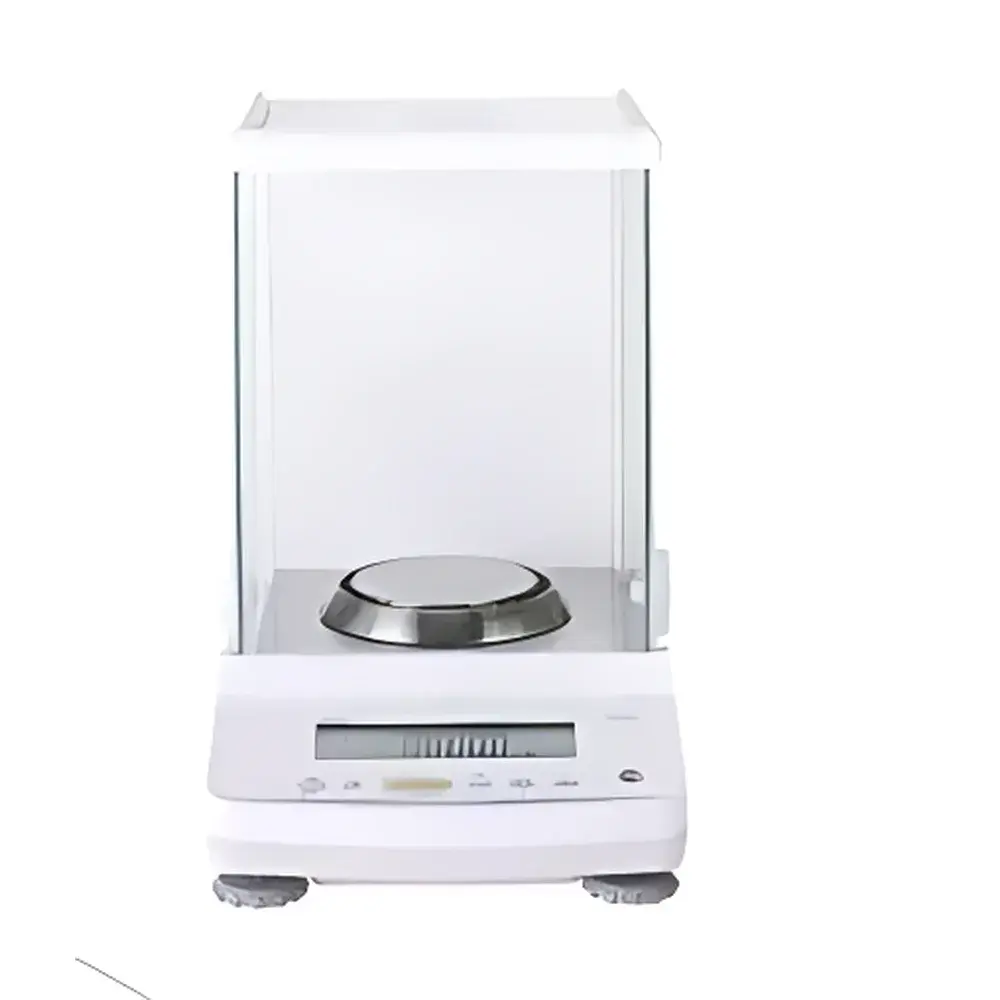
Shimadzu ATX/ATY Series Precision Analytical Balances
| Brand | Shimadzu |
|---|---|
| Origin | Japan |
| Model Series | ATX & ATY |
| Measurement Principle | Electromagnetic Force Compensation (EMFC) |
| Max Capacity | 220 g (ATX224/ATY224) to 62 g (ATY64) |
| Minimum Readability | 0.1 mg |
| Repeatability | ±0.1 mg |
| Linearity Error | ±0.2 mg |
| Stabilization Time | ≤2.5 s |
| Pan Size | 91 mm diameter |
| Calibration | Internal Auto-Calibration with External Weights |
| Compliance | ISO/IEC 17025, ASTM E898, USP <41>, GLP/GMP-ready |
| Interface | RS-232, USB (optional), Direct Windows Data Transfer (No Driver Required) |
| Environmental Adaptation | Adjustable Filter Settings (Stability/Response Trade-off) |
| Sensor Architecture | Monolithic UniBloc Dual-Lever EMFC Sensor |
Overview
Shimadzu ATX and ATY Series analytical balances are high-performance laboratory instruments engineered for precision mass measurement in regulated research, quality control, and pharmaceutical development environments. Based on electromagnetic force compensation (EMFC) technology, these balances deliver traceable, reproducible results under dynamic ambient conditions. The core sensing element — Shimadzu’s proprietary UniBloc monolithic dual-lever sensor — eliminates mechanical hysteresis and dramatically reduces susceptibility to air currents, vibration, and thermal drift. With readability down to 0.1 mg across all models (e.g., ATX224: 220 g capacity; ATY64: 62 g capacity), these balances meet the stringent repeatability (±0.1 mg) and linearity (±0.2 mg) requirements defined in USP and ISO 9001-compliant workflows. Their sub-3-second stabilization time enables rapid sequential weighing without compromise to accuracy — critical for high-throughput sample preparation, formulation verification, and reference standard handling.
Key Features
- UniBloc Monolithic Sensor: Single-piece, dual-lever electromagnetic transducer architecture ensures long-term stability, minimal creep, and immunity to environmental turbulence — a foundational design for GLP/GMP compliance.
- Driver-Free Data Integration: “Direct View Window” functionality enables real-time data streaming to Microsoft Excel, LabWare LIMS, or custom Python-based acquisition scripts via standard USB or RS-232 — no proprietary drivers or middleware required.
- Adaptive Filtering Engine: User-selectable response modes (Standard, Fast, Ultra-Fast) dynamically adjust digital filtering coefficients to optimize stability vs. speed trade-offs — essential when weighing low-mass powders or volatile solvents.
- Intuitive Touch-Activated Calibration: Internal auto-calibration initiated via front-panel key press; external weight loading verified by visual prompt and audible feedback — fully documented in audit trail logs per FDA 21 CFR Part 11.
- Ergonomic Draft Shield Design: Tool-free door removal, low-friction linear rails, and optimized chamber geometry reduce operator fatigue during extended sessions while maintaining Class I weighing performance (ISO 17025 Annex C).
- Self-Diagnostic System: Continuous internal monitoring of sensor output, temperature gradient, power supply ripple, and mechanical integrity — faults logged with timestamped event codes for root-cause analysis.
Sample Compatibility & Compliance
The ATX/ATY series supports diverse sample forms including powders, crystals, lyophilized vials, microcentrifuge tubes, and calibration weights. All models comply with international metrological standards: JIS B 7721 (Japan), OIML R76-1 (Class I), and ASTM E898 for analytical balance verification. Built-in applications — such as piece counting, percentage weighing, density determination (with optional density kit), and unit conversion — are validated against ISO 8655-6 and referenced in internal SOPs. Full electronic records — including calibration history, user logins, parameter changes, and raw weighing events — are stored with tamper-evident timestamps, satisfying ALCOA+ data integrity principles required by FDA, EMA, and PMDA inspections.
Software & Data Management
No dedicated software installation is required for basic operation or data export. However, optional Shimadzu Balance Manager (SBM) software provides advanced features: customizable report templates (PDF/CSV/XLSX), multi-balance fleet monitoring, electronic signature workflows, and automated backup to network drives or cloud storage (AWS S3, Azure Blob). All communication protocols support TLS 1.2 encryption where applicable. Audit trails are immutable and exportable in .csv format with SHA-256 hash verification — compliant with 21 CFR Part 11 Subpart B §11.10(a) and Annex 11 of EU GMP Guidelines.
Applications
- Pharmaceutical QC testing: Active pharmaceutical ingredient (API) assay, excipient blending verification, and dissolution tablet weight checks per USP .
- Academic and industrial research: Gravimetric preparation of standard solutions, catalyst loading quantification, and thermogravimetric analysis (TGA) sample tare validation.
- Materials science: Density measurement of polymers and ceramics using Archimedean principle (with optional sinker kit).
- Environmental labs: Precise weighing of filter media pre- and post-sampling for PM2.5/PM10 gravimetric analysis (EPA Method 201A).
- Clinical diagnostics: Calibration of pipette verification standards and reagent kit component reconciliation.
FAQ
What regulatory standards does this balance support?
It complies with ISO/IEC 17025:2017 (Clause 6.4.3), USP , ASTM E898-22, and OIML R76-1 Class I. Full traceability to NIST SRMs is maintained through factory calibration certificates.
Is 21 CFR Part 11 compliance built-in?
Yes — electronic signatures, audit trail logging, user access levels, and data immutability are enabled by default; no hardware add-ons required.
Can the balance interface with LIMS without third-party middleware?
Yes — native ASCII protocol over RS-232 or USB CDC allows direct integration with LabWare, STARLIMS, and Thermo Fisher SampleManager via configurable delimiter and trigger settings.
How often must external calibration be performed?
Per ISO/IEC 17025, frequency depends on risk assessment — typically daily pre-use verification with certified weights, plus full calibration every 1–3 months based on usage intensity and environmental stability.
Is the UniBloc sensor repairable in the field?
No — it is a sealed monolithic assembly; replacement requires factory service and full recalibration with accredited mass standards.