EcoTech PhenoTron-XYZ High-Throughput Plant Phenotyping Imaging System
| Brand | EcoTech |
|---|---|
| Origin | Beijing, China |
| Model | PhenoTron-XYZ |
| Configuration | Modular Sensor Platform |
| Control Interface | Embedded Linux + Touchscreen GUI + PC-based SpectrAPP & FluorVision Software |
| XYZ Positioning Accuracy | ±1 mm |
| Visual Localization Precision | <2 cm |
| Standard Scan Area | 180 × 80 cm (customizable) |
| Z-Axis Travel | 30 cm |
| Thermal Imaging Resolution | 640 × 512 |
| RGB Imaging Resolution | 20 MP |
| Hyperspectral Range Options | 400–1000 nm (VIS-NIR), 900–1700 nm (SWIR) |
| SWIR Channels | 220 bands, SNR ≥ 1000:1 |
| Chlorophyll Fluorescence Imaging | 5 MP, 70 fps, full Kautsky & fluorescence quenching protocol support |
| Data Compliance | Export-ready for ASTM E2912 (plant imaging metadata), ISO 21748 (uncertainty in plant phenotyping), GLP-aligned audit trail in SpectrAPP v4.2 |
Overview
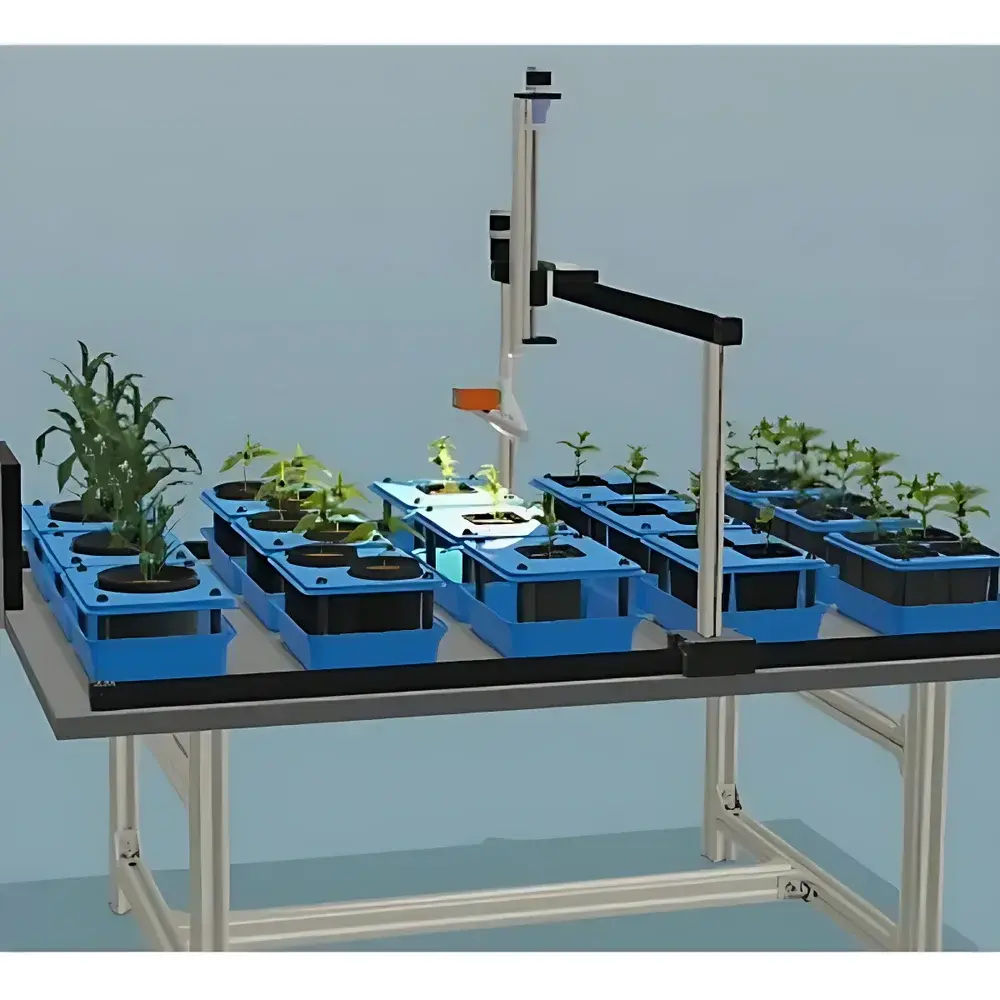
The EcoTech PhenoTron-XYZ is an engineered high-throughput plant phenotyping imaging system designed for controlled-environment laboratories and greenhouse facilities requiring non-invasive, multi-modal, quantitative trait analysis across large populations of seedlings, tissue-cultured plants, or mature crops. It operates on a modular sensor fusion architecture, integrating synchronized acquisition from hyperspectral, chlorophyll fluorescence, thermal infrared, and visible-light imaging modalities—each calibrated to traceable physical standards. The system employs Couette-style XYZ gantry motion control with sub-millimeter repeatability, enabling precise spatial registration of multi-sensor data cubes (x, y, λ, T, F). Its core measurement principles include reflectance-based spectral index derivation (e.g., NDVI, PSRI, CCI), photochemical yield quantification via pulse-amplitude modulated (PAM) chlorophyll fluorescence kinetics, and radiometrically calibrated thermal emissivity mapping under controlled illumination conditions. Unlike single-modality platforms, the PhenoTron-XYZ maintains strict geometric and temporal co-registration across all sensors—critical for longitudinal studies where pixel-level correspondence between spectral signature, fluorescence decay dynamics, and stomatal conductance proxies (via leaf temperature gradients) must be preserved across timepoints.
Key Features
- Modular sensor integration: Interchangeable high-sensitivity imaging heads—including VIS-NIR (400–1000 nm, >400 bands) and SWIR (900–1700 nm, 220 bands) hyperspectral cameras, UV-MCF multi-channel fluorescence imager, FluorTron® PAM-based chlorophyll fluorescence module (Fo/Fm, Y(II), NPQ, Rfd), and dual-lens Thermo-RGB unit (20 MP RGB + 640×512 microbolometer)
- Precision XYZ gantry: Industrial-grade linear motion system with 1 mm positional accuracy, programmable scan paths, and position memory for repeatable ROI targeting across experimental cycles
- Machine vision-guided auto-localization: Real-time plant detection and centroid tracking using calibrated wide-field stereo vision; enables one-click registration and autonomous scanning without manual coordinate input
- Thermo-RGB fusion analytics: Pixel-aligned thermal/visible image overlay with background-subtracted emissivity correction, enabling robust ROI-based temperature statistics (min/max/mean/ΔT), morphometric extraction (length, width, convex hull area, circularity), and HSI–thermal correlation matrices
- iPOT-compatible digital phenotyping: Optional integration with EcoTech’s iPOT蒸渗仪-based cultivation pots for concurrent monitoring of substrate moisture (capacitance), weight change (±0.1 g), leaf temperature (IR contactless), sap flow (thermal dissipation), and gas exchange proxies
- Fully embedded control architecture: Linux-based onboard controller with touchscreen GUI; supports remote operation via Wi-Fi or Ethernet; dual-control mode (local touch + remote PC) with synchronized logging
Sample Compatibility & Compliance
The PhenoTron-XYZ accommodates standard growth trays (e.g., 128-well plates, 96-well microplates), pot arrays (up to 15 cm diameter), hydroponic racks, and aeroponic mist chambers. Sample height range is adjustable from 5–120 cm via Z-axis translation. All optical modules meet IEC 62471 photobiological safety requirements for Class 1 LED excitation sources. Hyperspectral calibration follows NIST-traceable reflectance standards (Spectralon® 99% white, blackbody reference for SWIR). Thermal imaging adheres to ISO 18434-1 for infrared thermography in biological applications. Data export formats comply with MIAPPE 1.1 (Minimum Information About a Plant Phenotyping Experiment) and support FAIR principles (Findable, Accessible, Interoperable, Reusable). Audit trails, user access logs, and parameter versioning in SpectrAPP satisfy GLP documentation requirements per OECD Series on Principles of Good Laboratory Practice.
Software & Data Management
SpectrAPP v4.2 serves as the unified acquisition and analysis environment, supporting protocol-driven batch imaging, spectral library matching, and automated ROI segmentation using deep-learning-assisted thresholding (U-Net backbone, pre-trained on >50k annotated plant images). FluorVision provides dedicated fluorescence kinetic modeling—fitting OJIP transients, calculating quantum yield parameters (Fv/Fm, Y(NO), Y(NPQ)), and generating spatial heatmaps of photochemical efficiency. Both applications generate HDF5-formatted output files containing raw sensor data, metadata (time stamp, illumination intensity, ambient RH/T, gantry coordinates), and derived indices—structured for direct ingestion into R (phenofit), Python (scikit-learn, xarray), or MATLAB workflows. All software modules enforce 21 CFR Part 11-compliant electronic signatures, role-based permissions, and immutable audit logs for regulatory submissions.
Applications
- High-resolution screening of genetic diversity panels under abiotic stress (drought, salinity, heat, nutrient deficiency)
- Time-series quantification of photosynthetic acclimation during diurnal cycles or light-shift experiments
- Non-destructive assessment of early-stage biotic stress responses (pathogen inoculation, herbivory) via fluorescence red-edge shifts and thermal anomalies
- Validation of remote sensing indices (e.g., PRI, NIRv, ΔPRI) at canopy and leaf scales for satellite/airborne sensor calibration
- Phenotypic characterization of CRISPR-edited lines targeting stomatal density, cuticle wax composition, or chloroplast development
- Multi-omics integration: Correlating hyperspectral fingerprints with transcriptomic (RNA-seq) or metabolomic (LC-MS) datasets using canonical correlation analysis (CCA)
- Seed vigor and germination uniformity assessment via dynamic chlorophyll fluorescence induction curves
FAQ
Does the PhenoTron-XYZ support fully automated unattended operation over multi-day experiments?
Yes. Scheduled protocols can execute overnight or across weekends, including automatic tray indexing, multi-sensor sequential acquisition, thermal drift compensation, and error-recovery routines (e.g., re-scan upon motion timeout).
Can spectral data be exported in ENVI or BIL format for third-party processing?
Yes. SpectrAPP exports calibrated radiance cubes in ENVI-compatible BIL format with full header metadata (wavelength array, FWHM, GPS timestamp, gantry pose).
Is calibration validation documented per ISO/IEC 17025 requirements?
Calibration certificates for all optical and thermal sensors are provided annually by EcoTech’s CNAS-accredited metrology lab (ISO/IEC 17025:2017 certified), including uncertainty budgets and traceability statements.
How is data integrity ensured during wireless transmission from the gantry to the host PC?
All wireless transfers use TLS 1.3-encrypted MQTT streams with SHA-256 checksum verification; packet loss triggers automatic retransmission of corrupted frames.
Are software updates delivered with version-controlled release notes and backward compatibility guarantees?
Yes. Each SpectrAPP/FluorVision release includes a validated changelog, regression test reports, and guaranteed backward compatibility for HDF5 file schemas across three major versions.
Related Products