
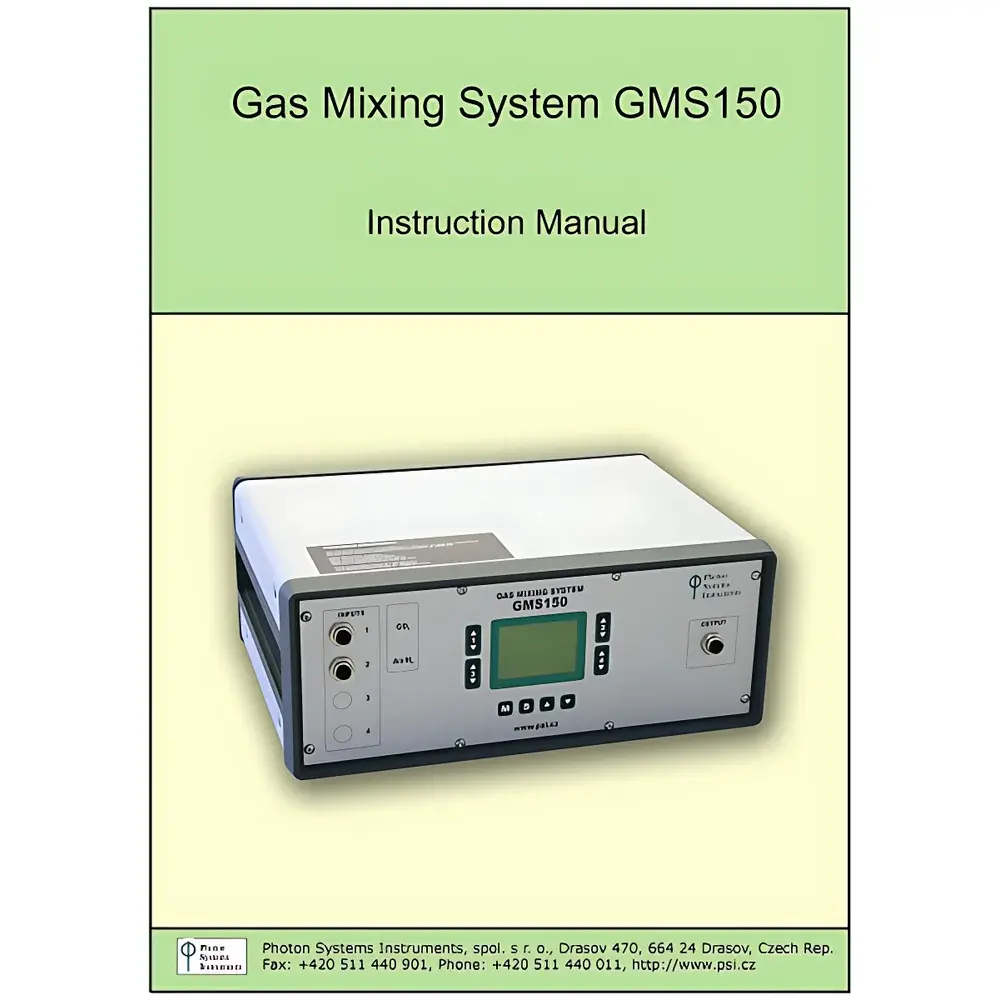
GMS150 High-Precision Gas Mixing and Regulation System
| Origin | Europe |
|---|---|
| Manufacturer Type | Authorized Distributor |
| Product Origin | Imported |
| Model | GMS150 |
| Price Range | USD 7,000 – 14,000 |
Overview
The GMS150 High-Precision Gas Mixing and Regulation System is an engineered solution for laboratory-scale dynamic gas composition control, designed specifically for physiological and metabolic studies requiring reproducible, trace-level gas concentration modulation. Based on thermal mass flow measurement and closed-loop proportional-integral (PI) control architecture, the system delivers real-time, stable blending of up to four independent gas streams—enabling precise generation of custom atmospheres with defined partial pressures of CO₂, O₂, N₂, CH₄, CO, NH₃, or dry synthetic air. Its core functionality centers on maintaining stoichiometric consistency across variable flow regimes while minimizing drift, hysteresis, and cross-sensitivity to ambient temperature, pressure, and orientation—critical for long-term photobioreactor experiments, diel-cycle simulations, and carbon-concentrating mechanism (CCM) investigations in microalgae and cyanobacteria.
Key Features
- Thermal mass flow sensors and controllers compliant with ISO 14644-1 Class 5 cleanroom-grade calibration protocols, traceable to NIST standards
- Dual-standard configuration: GMS150 (high-precision mode, 0.02–1000 mL/min range) and GMS150-MICRO (high-flow mode, 0.2–5000 mL/min range), both supporting up to 4-channel expansion
- Parker Prestolok® quick-connect fittings (6 mm OD) with fluorocarbon (FKM) seals, rated for continuous operation at 3–5 bar input pressure and compatible with non-corrosive, non-explosive, dry gases
- Integrated 8×21 character LCD display with real-time flow readout per channel, status indicators, and system diagnostics—including preheat progress, stability alerts, and error codes
- Robust thermal management architecture ensuring <±0.1% full-scale stability (at 1 mL/min N₂ reference) and <2 s settling time after setpoint change
- Temperature compensation algorithms validated across 15–50 °C ambient range; pressure sensitivity <0.1%/bar (N₂ reference); orientation insensitivity ≤0.2% FS at 90° tilt (1 bar)
Sample Compatibility & Compliance
The GMS150 is qualified for use with dry, particle-free, chemically inert gases including compressed air, nitrogen, oxygen, carbon dioxide, methane, carbon monoxide, and ammonia. It is not rated for humidified, corrosive (e.g., Cl₂, H₂S, SO₂), or flammable mixtures above LEL thresholds. All wetted materials—including flow bodies, valves, and seals—are constructed from 316 stainless steel and FKM elastomers, meeting USP Class VI biocompatibility requirements. The system supports GLP-compliant experimental workflows through deterministic flow repeatability (±0.5% FS for GMS150; ±0.5% of reading >20 mL/min for GMS150-MICRO) and built-in audit-ready operational logs when integrated with external data acquisition platforms. While not intrinsically certified for hazardous locations, it complies with IEC 61010-1 safety standards for laboratory electrical equipment.
Software & Data Management
The GMS150 operates autonomously via its embedded microcontroller but supports analog (0–5 V / 4–20 mA) and digital (RS-232, optional RS-485 or USB-CDC) interfaces for integration into larger experimental ecosystems. When paired with systems such as the FMT150 Algal Cultivation and Online Monitoring Platform or FytoScope LED Growth Chambers, it enables synchronized diel gas modulation—e.g., cycling CO₂ between 0.04% (ambient) and 5% over 12-h light/dark periods while logging timestamped flow values at 1 Hz resolution. Optional firmware upgrades provide CSV export capability and support for SCPI command sets, facilitating compatibility with LabVIEW, Python-based automation frameworks, and LIMS environments requiring 21 CFR Part 11–compliant electronic records (when deployed with validated third-party data servers).
Applications
- Controlled-environment simulation of atmospheric CO₂ gradients (0.04–100%) for studying photosynthetic acclimation, CCM induction, and Rubisco kinetics in Chlamydomonas reinhardtii, Synechocystis sp. PCC 6803, and Cyanothece sp. ATCC 51142
- Multi-gas stress assays—e.g., co-exposure to sublethal NH₃ and elevated CO₂—to quantify detoxification capacity and nitrogen assimilation efficiency in microalgal bioremediation strains
- Dynamic O₂/CO₂ dual-control in photoautotrophic fermenters to decouple respiratory and photosynthetic electron transport under varying redox conditions
- Gas-phase calibration of dissolved gas sensors (e.g., optical O₂ probes, IR-based CO₂ analyzers) using certified reference mixtures generated on-demand
- Integration with custom-built photobioreactors and climate-controlled growth chambers where pneumatic interlocks and fail-safe purge sequences are required
FAQ
What gases are supported—and which are excluded?
The GMS150 supports dry, non-corrosive, non-explosive gases including N₂, O₂, CO₂, CH₄, CO, NH₃, and synthetic air. It excludes humidified gases, halogens, sulfur compounds, silanes, and any mixture exceeding 100% LEL for flammability.
Can the GMS150 be used in GMP-regulated bioprocess development?
While not a GMP-certified instrument per se, its metrological traceability, deterministic repeatability, and analog/digital interface capabilities allow integration into validated workflows when combined with appropriate documentation, IQ/OQ protocols, and audit-trail-enabled data loggers.
How does the GMS150-MICRO differ from the standard GMS150 in practice?
GMS150-MICRO offers higher maximum flow rates (up to 5000 mL/min) and broader low-end linearity above 0.2 mL/min, making it suitable for large-volume photobioreactors; the standard GMS150 provides superior accuracy below 3 mL/min, ideal for microcosm-scale studies and sensor calibration.
Is external gas drying required?
Yes. Inlet gases must be dew-point controlled to ≤−40 °C and filtered to ≤0.01 µm to prevent condensation-induced sensor drift and valve clogging. A dedicated desiccant + particulate filtration stage upstream of the GMS150 is strongly recommended.
Does the system include gas cylinders or regulators?
No. Users must supply externally regulated, pressure-stabilized gas sources meeting the 3–5 bar inlet requirement. Parker, Swagelok, and SMC-compatible regulators and manifolds are commonly deployed in conjunction with this system.



