
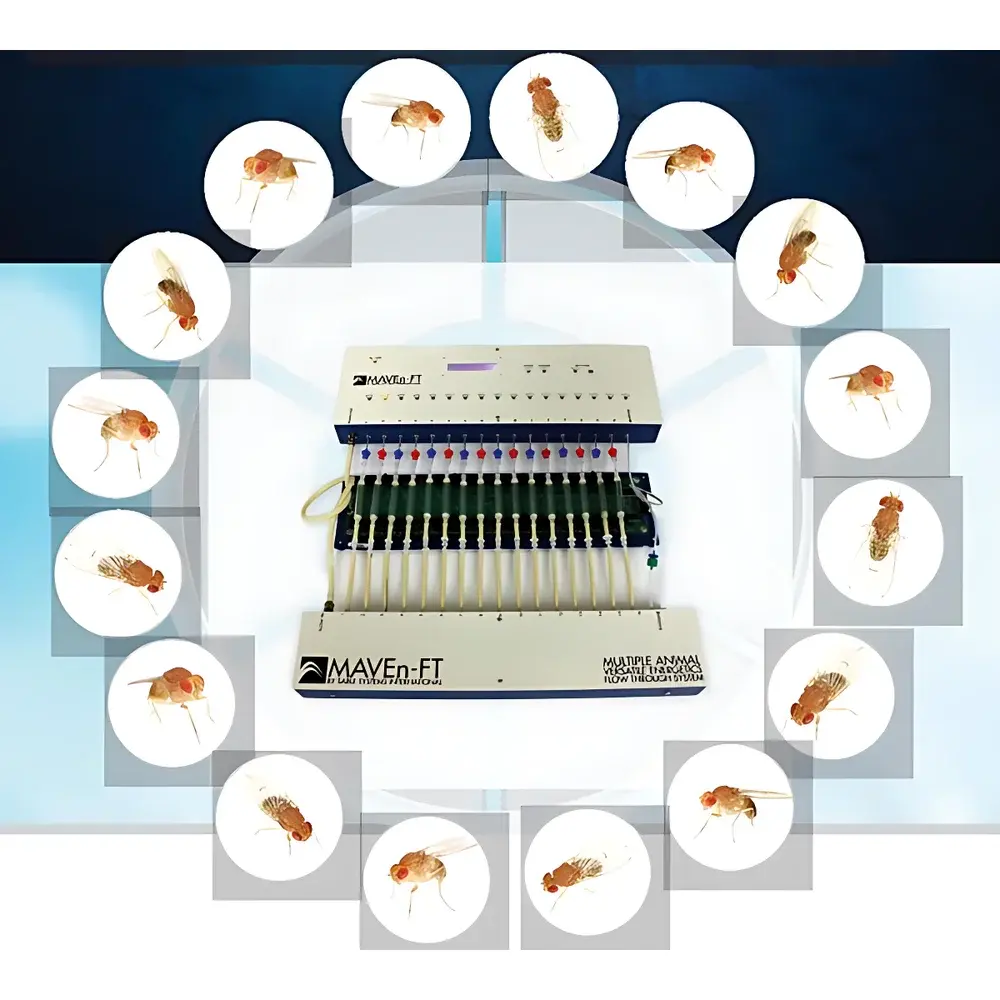
Sable Systems MAVEn™ High-Throughput 16-Channel Drosophila Metabolic Monitoring System
| Brand | Sable |
|---|---|
| Origin | USA |
| Model | MAVEn™ High-Throughput 16-Channel |
| Flow Rate Range | 5–200 mL/min (mass flow controlled, ±2% accuracy) |
| Measurement Interval per Fly | 15 s (programmable from 15 s to 3 h) |
| O₂ Analyzer | Dual-channel fuel-cell sensor, 0–100% range, ±0.1% accuracy (2–100% O₂), 0.0001% resolution, <0.01%/h drift |
| CO₂ Analyzer | 0–3000 ppm, <1% accuracy, 0.01 ppm resolution |
| H₂O Analyzer | 0–60 mmol/mol, ±1% accuracy |
| Pressure Sensor | 1 Pa resolution, ±0.05% FS accuracy |
| Temperature Sensor | 0–50 °C, ±0.25 °C accuracy, 0.01 °C resolution |
| Illuminance Control | 0.1–5000 lux |
| Analog Inputs | 6 channels, 16-bit, −5 to +5 V |
| Data Output | CSV via SD card (up to 32 GB), RS-232, 0–5 V BNC analog outputs |
| Dimensions (O₂ Unit) | 43.2 × 35.6 × 20.3 cm |
| Weight (O₂ Unit) | 6.4 kg |
| Operating Temp | 5–45 °C, non-condensing |
Overview
The Sable Systems MAVEn™ High-Throughput 16-Channel Drosophila Metabolic Monitoring System is an engineered platform for quantitative, real-time respirometry of Drosophila melanogaster and other micro-invertebrates. It operates on the principle of open-flow indirect calorimetry, measuring dynamic changes in O₂ consumption (VO₂) and CO₂ production (VCO₂) across up to 16 independent, continuously ventilated measurement chambers. Unlike traditional closed- or stop-flow systems—where accumulating CO₂ and declining O₂ introduce physiological artifacts such as hypoxia and hypercapnia—the MAVEn™ maintains true physiological fidelity through precisely regulated, laminar airflow (5–200 mL/min) across each chamber. This architecture enables high-fidelity metabolic phenotyping under ecologically relevant conditions, supporting longitudinal studies of energy homeostasis, mitochondrial function, and stress response kinetics. Designed for integration into GLP-compliant and hypothesis-driven translational research workflows, the system delivers time-synchronized, timestamped metabolic data with traceable calibration pathways and hardware-level environmental control.
Key Features
- 16-channel parallel monitoring with fully open, mass-flow-controlled ventilation per chamber—eliminating gas accumulation artifacts and enabling true steady-state respirometry.
- Ultra-rapid per-fly measurement cycle: configurable down to 15 seconds, optimized for high-throughput screening without compromising signal-to-noise ratio.
- Dual-channel, differential fuel-cell O₂ analyzer with integrated temperature and pressure compensation; 0.0001% O₂ resolution, <0.01% O₂/h baseline drift, and PID-regulated sensor thermostating for long-term stability.
- High-sensitivity NDIR-based CO₂/H₂O co-analyzer (0–3000 ppm CO₂, 0–60 mmol/mol H₂O) calibrated for sub-microliter respiratory volumes typical of Drosophila.
- Programmable environmental control: ambient temperature (0–50 °C, ±0.25 °C), barometric pressure (1 Pa resolution), and illuminance (0.1–5000 lux) synchronized with metabolic acquisition.
- Modular expandability via standardized analog (−5 to +5 V, 16-bit) and digital (RS-232) I/O—enabling seamless integration with FLIC feeding monitors, AD-2 locomotor tracking, and third-party gas analyzers.
- Onboard SD-card logging (up to 32 GB) with ISO 8601 timestamped CSV output—ensuring audit-ready data provenance without host PC dependency.
Sample Compatibility & Compliance
The MAVEn™ system is validated for use with adult Drosophila melanogaster (both sexes, multiple genetic backgrounds), larval stages (L3), and other small arthropods including mosquitoes (Aedes, Anopheles) and acarids. Chamber geometry and flow dynamics are empirically optimized to minimize boundary-layer effects and ensure representative gas exchange sampling across body masses ranging from 0.1 to 2.0 mg. All sensors and electronics comply with IEC 61000-4 electromagnetic compatibility standards. The system supports ALARA (As Low As Reasonably Achievable) experimental design by minimizing handling stress through automated chamber cycling and passive immobilization protocols. Data acquisition meets FDA 21 CFR Part 11 requirements for electronic records when deployed with validated timestamping and user-access controls on connected workstations. Calibration certificates traceable to NIST standards are provided for O₂, CO₂, pressure, and temperature modules.
Software & Data Management
Data acquisition is managed via Sable Systems’ proprietary ExpeData™ software (Windows-compatible), which provides real-time visualization of VO₂, VCO₂, RQ, and environmental parameters across all 16 channels. The software implements adaptive noise filtering (0–40 s digital smoothing, 0.2 s increments), automatic baseline subtraction, and multi-point calibration workflows compliant with ASTM E2777-11 (Standard Practice for Respirometric Instrument Calibration). Raw CSV files contain unprocessed sensor voltages, calculated gas concentrations, and metadata headers—including chamber ID, timestamp (UTC), flow rate, temperature, pressure, and user-defined experimental annotations. Exported datasets are structured for direct ingestion into Python (Pandas, SciPy), R (respirometry, dplyr), or MATLAB for advanced modeling (e.g., dynamic energy budget modeling, circadian rhythm analysis, or machine-learning–based metabolic clustering). Audit trails record operator login, parameter changes, and calibration events—supporting GLP/GMP documentation requirements.
Applications
The MAVEn™ platform serves as a core infrastructure tool in academic and pharmaceutical research investigating metabolic dysregulation in disease models. It is routinely applied to: (1) characterizing insulin/TOR signaling mutants in Drosophila for diabetes and aging studies; (2) quantifying mitochondrial uncoupling in Parkinson’s and Alzheimer’s disease models; (3) evaluating drug-induced metabolic shifts (e.g., metformin, rapamycin, or novel kinase inhibitors); (4) assessing thermoregulatory plasticity across thermal gradients; (5) mapping genotype–metabolotype associations in genome-wide association studies (GWAS); and (6) validating CRISPR/Cas9-edited metabolic enzyme knockouts. Its capacity for longitudinal, low-stress monitoring makes it especially suitable for circadian metabolism studies, dietary restriction interventions, and toxicological screening where repeated measurements over days or weeks are required.
FAQ
What is the minimum measurable metabolic rate for a single Drosophila using MAVEn™?
The system resolves O₂ fluxes down to 0.005 µL O₂/min (at 25 °C, 101.3 kPa) with signal stability maintained over multi-hour acquisitions.
Can the MAVEn™ be used with larvae or pupae?
Yes—chamber inserts and flow profiles are adaptable for L3 larvae; pupal assays require custom humidity control and are supported via optional H₂O-saturated air modules.
Is remote monitoring supported?
ExpeData™ supports networked acquisition and live dashboard viewing across local area networks; cloud synchronization requires institutional IT validation for HIPAA/FDA compliance.
How often must the O₂ sensor be recalibrated?
Factory calibration remains stable for ≥6 months under continuous operation; field verification with certified zero-air and span gas (20.9% O₂ in N₂) is recommended before critical experiments.
Does the system meet ISO/IEC 17025 requirements for accredited testing labs?
While the instrument itself is not ISO/IEC 17025-certified, its metrological traceability, documented uncertainty budgets, and calibration SOPs enable laboratories to establish in-house accreditation for respirometric testing scopes.




