
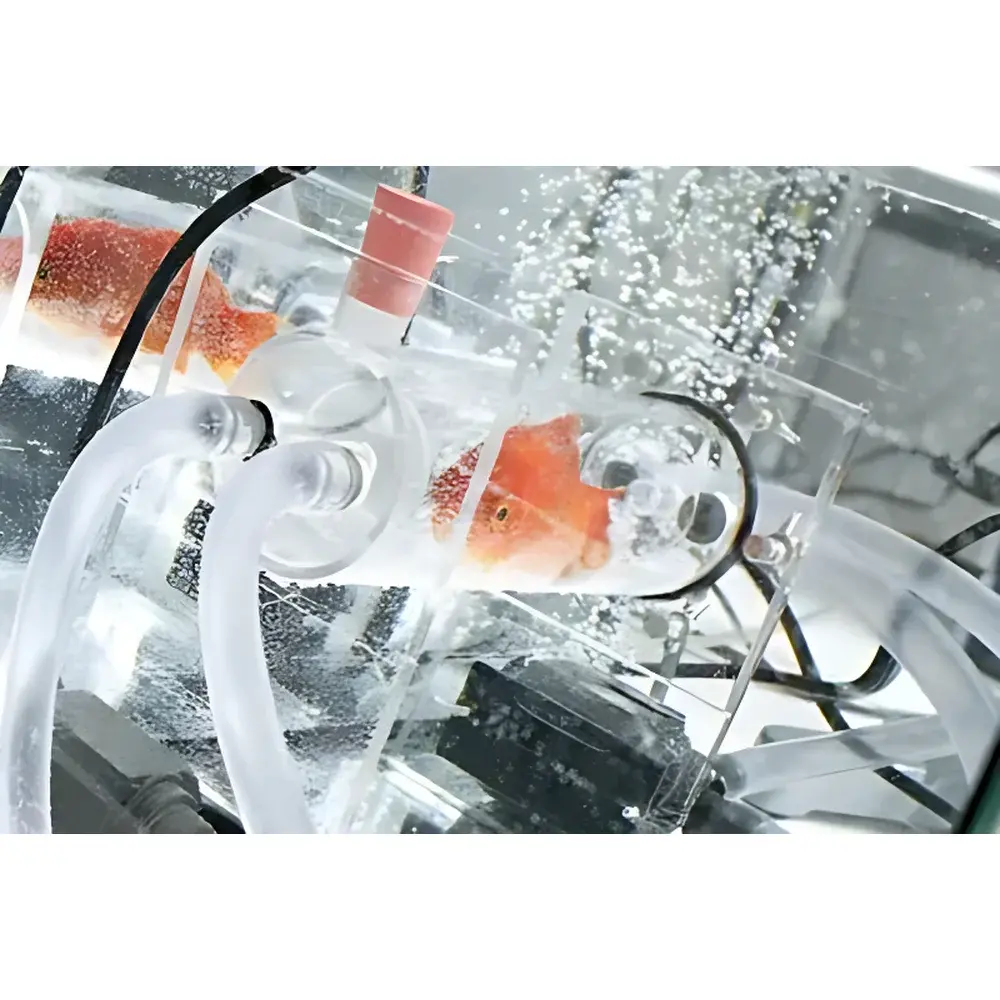
Aalborg-Copenhagen DAQ Aquatic Respirometry System for Fish and Aquatic Organisms
| Origin | Denmark |
|---|---|
| Manufacturer Type | Authorized Distributor |
| Origin Category | Imported |
| Model | DAQ |
| Pricing | Upon Request |
| Compliance | Designed for GLP-compliant respirometric studies in aquatic ecophysiology and toxicology |
Overview
The Aalborg-Copenhagen DAQ Aquatic Respirometry System is a rigorously validated, research-grade platform engineered for high-temporal-resolution measurement of oxygen consumption (ṀO₂) in live aquatic organisms—including teleost fish, crustaceans, bivalves, zooplankton, fish embryos, and phytoplankton. Developed jointly by Aalborg University and the University of Copenhagen, it implements an intermittent-flow respirometry principle that reconciles the precision of closed-system measurements with the physiological sustainability of open-system designs. Unlike continuous-flow systems—prone to low signal-to-noise ratios during low-metabolic states—or static closed chambers—limited by oxygen depletion and CO₂ accumulation—the DAQ system executes autonomous, cyclical measurement phases: (1) closed-phase O₂ decline recording, (2) controlled water exchange to restore baseline [O₂], and (3) equilibration prior to the next cycle. Each full cycle completes within 10 minutes, enabling multi-day, unattended monitoring while preserving animal welfare and metabolic integrity. Dissolved oxygen (DO) kinetics are modeled as linear decay over time; ṀO₂ (mg O₂·kg⁻¹·h⁻¹) is computed from the slope of the DO vs. time regression, normalized to chamber volume and organism mass. The system supports both liquid-phase and gas-phase O₂ quantification, making it applicable to dual-phase respiratory studies (e.g., air-breathing fish or emergent macroinvertebrates).
Key Features
- Intermittent-flow architecture with programmable cycle timing (measurement, exchange, wait), ensuring metabolic fidelity across extended durations (72+ hours)
- Modular channel scalability: 1-, 4-, or 8-channel configurations for parallel respirometry across individuals, life stages, or treatment groups
- Dual-sensor compatibility: Select between galvanic oxygen electrodes (cost-optimized, ±1% accuracy, t₉₀ < 20 s) or fluorescence-based optical O₂ sensors (sub-ppb detection limit, t₉₀ < 1 s, zero oxygen consumption, immune to electromagnetic interference)
- Integrated environmental control: Independent modules for temperature (±0.2 °C stability, −20 °C to +60 °C range), pH/pCO₂ (0–14 pH, 0.01 resolution, CapCTRL software-driven CO₂ sparging), and dissolved O₂ regulation (via solenoid-valve-controlled O₂/N₂ injection)
- Multi-parameter co-monitoring: Simultaneous acquisition of DO, temperature, pH, CO₂, NH₃ (optional ion-selective electrode), and behavioral metrics when coupled with synchronized video tracking
- Chamber flexibility: Static chambers (borosilicate glass or acrylic; diameters 3.3–190 mm), swim tunnels (SW-series; volumes 170 mL–185 L; flow velocities 3–225 cm·s⁻¹), and micro-chambers (11.2–22.2 mm ID) compatible with non-invasive fiber-optic sensing
Sample Compatibility & Compliance
The DAQ system accommodates a broad taxonomic and ontogenetic spectrum: adult salmonids (>50 g), larval zebrafish (≥0.1 mL chamber volume), benthic amphipods, Daphnia magna, oyster embryos, and even microbial consortia in natural water samples. Its design conforms to internationally recognized respirometry standards including ASTM D882 (oxygen demand in aquatic systems), ISO 8692 (freshwater algal growth inhibition), and OECD Test No. 210 (fish early-life stage toxicity). All data acquisition adheres to ALARP (As Low As Reasonably Practicable) principles for animal use, with real-time stress-response detection via abrupt ṀO₂ spikes—enabling immediate intervention or automated protocol suspension. Full audit trails, electronic signatures, and timestamped raw data export comply with FDA 21 CFR Part 11 requirements for regulated ecotoxicological submissions.
Software & Data Management
DAQ Control Suite is a Windows-based application providing real-time visualization of DO, temperature, pH, and calculated ṀO₂ across all channels. It features automated regression analysis (R² ≥ 0.98 threshold enforced), batch processing of multiple trials, and export to .xlsx and ASCII .txt formats with metadata headers (chamber ID, animal mass, calibration timestamps, sensor serial numbers). The software logs all hardware events—including pump actuation, valve switching, and sensor diagnostics—with millisecond precision. Optional integration with EthoVision XT or Noldus Tracking Software enables synchronized behavioral annotation: activity duration, velocity vectors, spatial occupancy heatmaps, and zone-of-interest interaction frequency—all statistically linked to concurrent metabolic output. Raw sensor voltages and derived parameters are stored with 16-bit ADC resolution and 6 × 0–5 V analog outputs for third-party DAQ interfacing.
Applications
This system serves core functions in academic and regulatory laboratories:
- Aquatic ecophysiology: Standard metabolic rate (SMR), active metabolic rate (AMR), and aerobic scope quantification under thermal, hypoxic, or acidified conditions
- Environmental toxicology: Sublethal endpoint assessment per OECD 210 and EPA OPPTS 850.1400, including delayed metabolic recovery post-exposure
- Aquaculture R&D: Feed efficiency optimization via post-prandial oxygen kinetics and thermal performance curves (CTmax estimation)
- Developmental biology: Embryonic and larval ṀO₂ trajectories correlated with morphometric staging and gene expression profiles
- Microbial ecology: Community respiration assays in filtered seawater or sediment porewater, decoupled from phototrophic O₂ production using dark-cycle protocols
FAQ
What is the minimum detectable oxygen consumption rate?
Detection limit depends on sensor type and chamber volume. With the Mini fluorescence probe (15 ppb DO LOD) in a 1 mL micro-chamber, ṀO₂ resolution reaches 0.008 mg O₂·kg⁻¹·h⁻¹ for 10 mg zebrafish larvae.
Can the system operate unattended for 72 hours?
Yes—programmable cycles, fail-safe pump logic, and battery-backed real-time clock ensure uninterrupted operation. Power loss triggers automatic recovery upon restoration.
Is calibration traceable to NIST standards?
All O₂ sensors include factory calibration certificates referenced to NIST-traceable gas mixtures (0%, 20.9%, 100% O₂); field recalibration uses two-point (zero-air/saturated-water) protocol with temperature compensation.
How is biofouling mitigated in long-term experiments?
Fluorescence sensors feature anti-fouling polymer coatings; electrochemical probes include automated cleaning cycles via pulsed voltage reversal; all chambers support UV-C sterilization between runs.
Does the system support custom experimental protocols?
DAQ Control Suite allows user-defined sequence scripting—including variable cycle durations, conditional valve actuation, and external trigger inputs—via Lua-based macro language.
Related Products




