PSI PlantScreen XYZ 3D Robotic Phenotyping Imaging System
| Brand | PSI |
|---|---|
| Origin | Czech Republic |
| Model | PlantScreen XYZ |
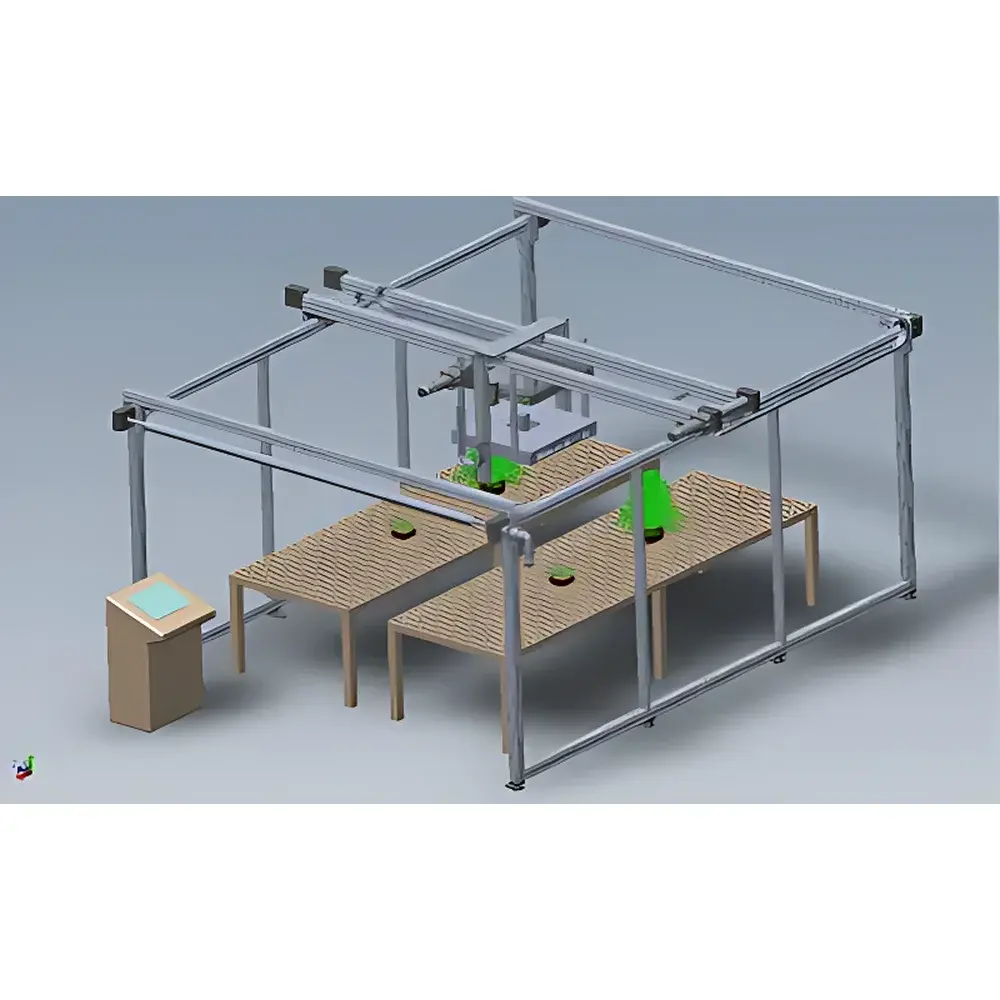
| Imaging Axes | X (0–101 cm, ±1 mm), Y (0–72 cm, ±1 mm), Z (0–49 cm, ±5 mm) |
| Max Payload (Z-axis) | 30 kg |
| Standard Footprint | 200 × 150 × 230 cm |
| Scan Area | 61 × 129 cm |
| Chlorophyll Fluorescence Imaging | 35 × 35 cm FOV, 1.3 MP sensor, 618 nm measuring light, white saturating flash up to 3600 µmol·m⁻²·s⁻¹, 735 nm IR source, 8-position filter wheel |
| RGB Imaging | 2592 × 1944 px (1/2.5″ sensor, 2.2 µm pixel size), timestamped & georeferenced (X/Y/Z) BMP output |
| NIR Imaging (optional) | 1450–1600 nm band, water absorption contrast |
| SWIR/VNIR Hyperspectral (optional) | 400–1000 nm or 1000–2500 nm, 150 × 100 cm FOV |
| Thermal Imaging (optional) | 640 × 480 px, 20–120 °C range, NETD < 50 mK @ 30 °C |
| Software | PSI FluorCam & PlantScreen Control Suite with protocol-driven automation, GLP-compliant metadata logging, audit trail, and export to CSV/HDF5 |
Overview
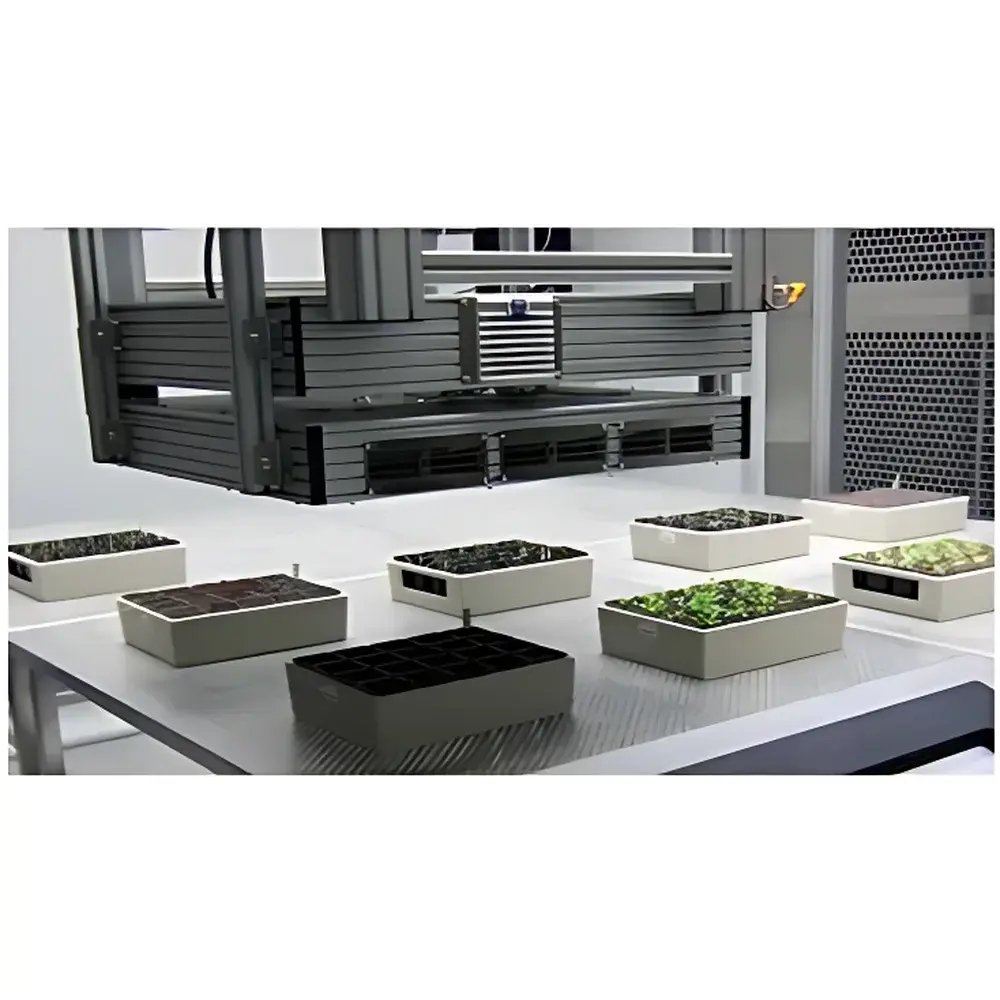
The PSI PlantScreen XYZ 3D Robotic Phenotyping Imaging System is a fully integrated, research-grade platform engineered for non-invasive, high-throughput quantitative phenotyping of intact plants across developmental stages and environmental treatments. Developed by Photon Systems Instruments (PSI), the pioneer in chlorophyll fluorescence imaging instrumentation, the system implements a precision XYZ robotic gantry to position multiple optical sensors—fluorescence, RGB, thermal, NIR, and hyperspectral—above plant canopies with sub-millimeter repeatability. Its core measurement principle relies on spatially resolved biophysical and biochemical signal acquisition: modulated pulse-amplitude modulation (PAM) fluorometry quantifies photosynthetic efficiency via kinetic parameters (e.g., ΦPSII, NPQ, qP); multispectral reflectance enables vegetation index derivation; thermal emission maps stomatal conductance and transpirational cooling; NIR absorption correlates with tissue water content; and high-resolution RGB photogrammetry delivers morphometric descriptors grounded in computational geometry. Designed for controlled-environment phenotyping facilities—including growth chambers, greenhouses, and climate rooms—the PlantScreen XYZ supports longitudinal studies under standardized lighting, temperature, and humidity regimes, ensuring inter-experiment reproducibility required for QTL mapping, mutant screening, and stress physiology validation.
Key Features
- Precision XYZ robotic gantry with programmable positioning (X: 0–101 cm, ±1 mm; Y: 0–72 cm, ±1 mm; Z: 0–49 cm, ±5 mm) and 30 kg payload capacity for multi-sensor head integration
- Simultaneous multimodal imaging: Chlorophyll fluorescence (Fo, Fm, Fv/Fm, ΦPSII, NPQ, Rfd), RGB morphology (leaf area, solidity, eccentricity, roundness, centroid, internode distance, 3D height/width), thermal distribution (640×480 px, <50 mK NETD), NIR water status (1450–1600 nm), and VNIR/SWIR hyperspectral reflectance (400–2500 nm)
- Standardized illumination architecture: LED-based growth chamber with spectral tunability, synchronized with imaging protocols to eliminate confounding photobiological artifacts
- Automated barcode scanning and tray-level metadata tagging for unambiguous sample tracking across time-series experiments
- Hardware-synchronized triggering ensures temporal alignment of fluorescence kinetics, thermal transients, and spectral acquisitions within single measurement cycles
- Modular expansion capability: Optional add-ons include UV-induced fluorescence modules, gas exchange integration ports, and custom lighting arrays compliant with ISO 22028-1 for spectral radiance calibration
Sample Compatibility & Compliance
The PlantScreen XYZ accommodates a broad spectrum of plant architectures—from Arabidopsis thaliana rosettes and rice seedlings to maize vegetative stands and woody perennials—within standard growth trays (up to 49 cm height). Tray dimensions are configurable to match common international standards (e.g., 52 × 37 cm Eurotrays, 60 × 40 cm greenhouse trays). All optical modules comply with IEC 62471 for photobiological safety and EN 61326-1 for electromagnetic compatibility in laboratory environments. Data acquisition adheres to FAIR principles (Findable, Accessible, Interoperable, Reusable), with metadata embedded per MIAPPE v1.1 specifications. The system supports GLP- and GMP-aligned workflows through user-authenticated access control, electronic signatures, and immutable audit trails—fully compatible with FDA 21 CFR Part 11 requirements when deployed with validated software configurations.
Software & Data Management
Control and analysis are executed via PSI’s native PlantScreen Control Suite and FluorCam software—both built on a Qt-based cross-platform framework. The interface enables drag-and-drop protocol design: users define measurement sequences (e.g., dark adaptation → fluorescence induction → thermal snapshot → RGB capture), specify ROI masks, assign sensor activation logic, and set environmental triggers (e.g., initiate imaging upon chamber temperature stabilization). All raw data are stored in HDF5 format with embedded timestamps, coordinate metadata (X/Y/Z), illumination settings, and sensor calibration coefficients. Batch processing pipelines support automated extraction of >100 phenotypic descriptors—including derived indices such as NDVI, PRI, OSAVI, and NPQI—with statistical summaries exported to CSV or R-compatible formats. Integrated Python API allows custom algorithm deployment (e.g., deep learning-based segmentation) without disrupting core acquisition integrity.
Applications
- High-throughput screening of genetic variants for drought tolerance, salinity resilience, or nutrient-use efficiency using combined fluorescence quenching kinetics and NIR water-content mapping
- Longitudinal monitoring of circadian-regulated photosynthetic performance under controlled photoperiods
- Eco-toxicological assessment via chlorophyll fluorescence inhibition (IC50) and morphometric deviation (e.g., reduced leaf expansion rate, altered solidity) following chemical exposure
- Phenotypic validation of CRISPR/Cas9-edited lines through multivariate trait clustering (e.g., ΦPSII + leaf angle + relative growth rate)
- Calibration of remote-sensing vegetation indices using ground-truthed hyperspectral reflectance data from controlled trials
- Thermal phenotype profiling of stomatal mutants under progressive vapor pressure deficit gradients
FAQ
What is the maximum plant height supported by the standard PlantScreen XYZ configuration?
The Z-axis travel range accommodates plants up to 49 cm tall, with optional extended gantry configurations available for taller species.
Does the system support fully automated daily imaging schedules across multi-week experiments?
Yes—protocol-based scheduling, hardware-triggered synchronization, and unattended operation (including power-fail recovery) enable robust longitudinal data collection without manual intervention.
How is calibration traceability maintained for fluorescence and hyperspectral measurements?
Each optical module includes NIST-traceable reference standards: calibrated neutral density filters for irradiance, Spectralon® reflectance tiles for hyperspectral radiometric correction, and certified fluorescent reference materials for PAM gain validation.
Can third-party analysis tools (e.g., R, Python, MATLAB) interface directly with acquired datasets?
All raw and processed outputs are provided in open, well-documented formats (HDF5, CSV, GeoTIFF), with published schema documentation and RESTful API endpoints for programmatic access.
Is the system suitable for use in biosafety level 2 (BSL-2) containment facilities?
The modular mechanical design permits installation within BSL-2 enclosures; all electronics are housed externally, and optical paths are sealed with borosilicate viewports rated for negative-pressure environments.