
UGT Evapotranspirometer System (Custom-Engineered Soil Monolith Monitoring Platform)
| Key | Origin: Germany |
|---|---|
| Manufacturer Type | Authorized Distributor |
| Origin Category | Imported |
| Model | UGT Evapotranspirometer System |
| Pricing | Upon Technical Consultation |
Overview
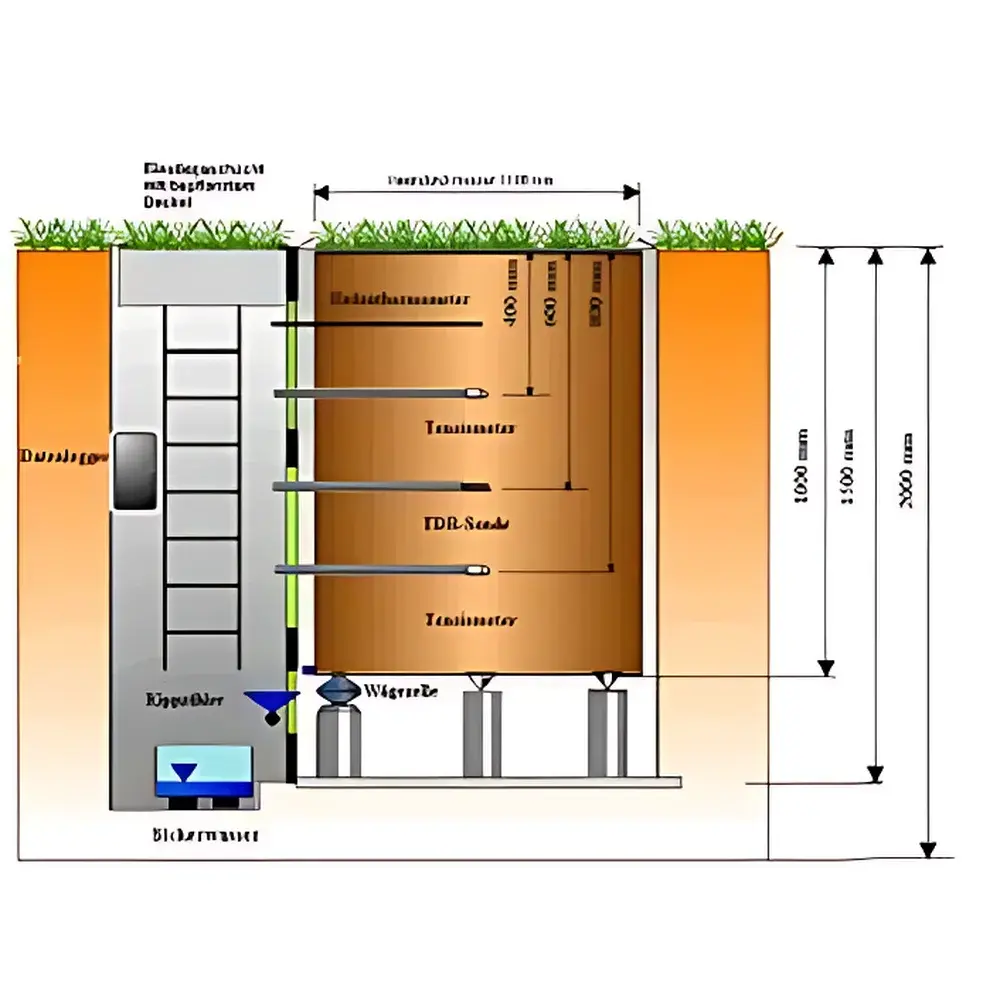
The UGT Evapotranspirometer System is a precision-engineered, field-deployable or laboratory-integrated soil monolith monitoring platform designed for quantitative assessment of hydrological and biogeochemical cycles in terrestrial ecosystems. Based on the fundamental principle of mass balance—specifically, water balance (P + I − ET − D − ΔS = 0) and solute balance (Dep + F − V − L − ΔM = 0)—this system enables high-temporal-resolution measurement of evapotranspiration (ET), infiltration, drainage, soil water storage change (ΔS), leachate volume (D), and associated solute fluxes (L). It operates as a controlled “ecotron” unit: a physically intact soil–plant–atmosphere continuum (SPAC) column, either extracted in situ or reconstructed experimentally, instrumented with calibrated sensors and gravimetric weighing systems. Developed by UGT GmbH (Germany) and distributed exclusively in this region, the platform adheres to ISO 10381-5 (soil sampling—part 5: guidance on monitoring of soil water and solute movement) and supports long-term ecological research compliant with ICLEI and LTER network protocols.
Key Features
- Modular Architecture: Three interoperable configurations—Mini-Lysimeter (benchtop simulation), Hydro-Solute Balance System (field-scale monolith monitoring), and Riparian Groundwater Dynamic Simulator (integrated aquifer–surface water coupling)—allow scalability from controlled lab experiments to complex field ecotones.
- Gravimetric Precision: High-resolution load cells (±0.1 g resolution, 0.01% FS repeatability) continuously record mass changes of soil columns; converted directly to mm-equivalent water depth (1 kg = 1 L·m⁻² = 1 mm) per ISO 21268-3.
- Vacuum-Controlled Infiltration Module: For Mini-Lysimeter units, a membrane filtration assembly with programmable vacuum regulation enables reproducible, pressure-controlled infiltration experiments—ideal for evaluating low-permeability soils, landfill cap performance, or engineered barrier systems.
- Multi-Parameter Sensor Integration: Pre-wired ports support simultaneous deployment of TDR/FDR soil moisture probes, thermocouples (−40 to +85 °C), tensiometers (0 to −100 kPa), and pore-water samplers (ceramic suction lysimeters, 0.2 µm pore size).
- Automated Leachate & Pore-Water Collection: Fractionated sampling valves enable time- or volume-triggered collection of drainage and matrix pore water, compatible with ICP-MS, ion chromatography, and DOC analysis per EPA Method 415.3 and ISO 14851.
Sample Compatibility & Compliance
The system accommodates undisturbed soil monoliths (up to 1 m diameter × 1.5 m depth), repacked experimental columns (sand, loam, clay, biochar-amended, or mine spoil substrates), and vegetated mesocosms (grasses, riparian shrubs, crop species). All structural components comply with DIN EN 12697-12 (bituminous mixtures—test methods for hot mix asphalt—part 12: determination of water sensitivity) and ASTM D5856 (standard test method for measurement of hydraulic conductivity of saturated porous materials using a flexible wall permeameter). Data acquisition and metadata logging meet GLP requirements per OECD Series on Principles of Good Laboratory Practice and are configurable for 21 CFR Part 11-compliant electronic signatures when paired with validated UGT ControlSuite software.
Software & Data Management
UGT ControlSuite v5.2 provides real-time visualization, automated mass-balance validation, and export-ready data streams (CSV, NetCDF, HDF5). Built-in algorithms calculate ET via residual method, compute solute loads (L = Sc × S), and flag outliers using robust iterative reweighting (IRWLS). Raw sensor data are timestamped with GPS-synchronized NTP clocks; audit trails log all user actions, parameter changes, and calibration events. Export modules generate reports aligned with FAO-56 Penman–Monteith reference ET benchmarks and EU Water Framework Directive (WFD) Annex V reporting templates. Data can be ingested into external platforms (e.g., RHESSys, SWAT+, or custom Python-based biogeochemical models) via RESTful API.
Applications
- Long-term monitoring of water and nitrogen budgets in agricultural catchments (e.g., fertilizer use efficiency, nitrate leaching risk under climate scenarios)
- Evaluation of constructed wetland and riverbank filtration systems for wastewater reuse and micropollutant attenuation
- Performance testing of landfill final covers and phytostabilization strategies at post-mining sites
- Quantification of ecohydrological feedbacks in forest understory soils under drought stress or CO₂ enrichment
- Validation of vadose zone transport models (HYDRUS-1D, STANMOD) against observed drainage and solute breakthrough curves
- Regulatory compliance studies supporting EU Nitrates Directive reporting and US EPA NPDES permit renewals
FAQ
What distinguishes UGT’s evapotranspirometer from conventional lysimeters?
It integrates gravimetric weighing, multi-depth sensor arrays, and vacuum-regulated infiltration within a single modular framework—enabling concurrent water *and* solute mass balance without manual intervention.
Can the system operate unattended in remote field locations?
Yes. Solar-powered variants include LTE-M/NB-IoT telemetry, low-power dataloggers (−30 to +60 °C operating range), and battery-backed memory (72 h autonomy during grid outage).
Is soil monolith extraction supported as part of the service package?
UGT-certified field technicians provide full-service monolith coring, transport, and installation—including geotechnical stabilization and root-zone preservation per DIN 4020 standards.
How is calibration traceability maintained?
All load cells are certified to ISO/IEC 17025 by DAkkS-accredited labs; temperature and moisture sensors carry individual calibration certificates (as per ISO/IEC 17025:2017 Annex A.3).
Does the system support dual-isotope (δ²H, δ¹⁸O) water source partitioning studies?
Yes. Integrated pore-water samplers collect isotopically representative samples compatible with cavity ring-down spectroscopy (CRDS) analysis per ISO 19993.







