
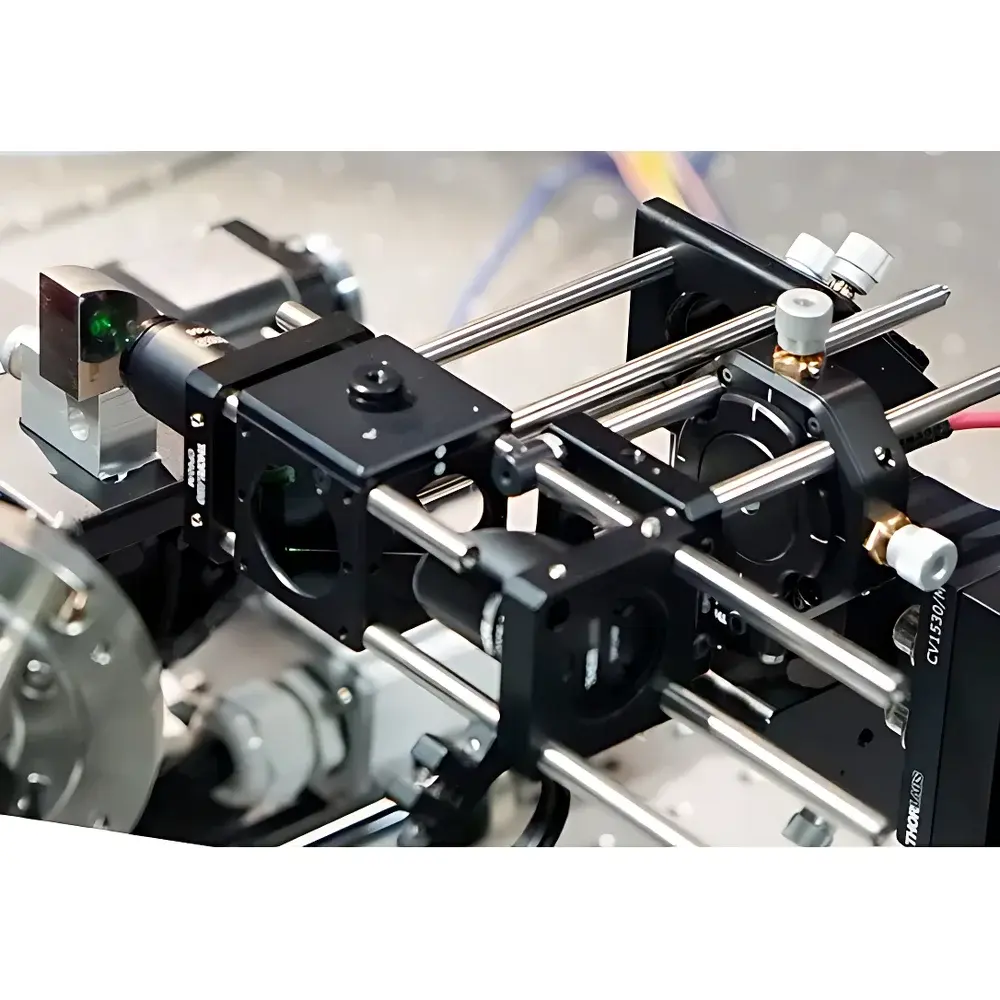
Lightigo DragonFly LIBS Elemental Analysis System
| Brand | Lightigo |
|---|---|
| Origin | Czech Republic |
| Model | DragonFly LIBS |
| Vacuum Chamber Range | 1–1300 mbar |
| Laser Wavelengths | 1064 nm / 532 nm / 266 nm (DPSS, Q-switched) |
| Max Pulse Rate | 100 Hz |
| Spectral Range | 200–1000 nm |
| Spectral Resolution | up to 60,000 λ/Δλ (Echelle + EMCCD) |
| Spatial Mapping Resolution | down to 50 µm |
| Sample Stage | 3-axis motorized (X×Y×Z = 60×80×50 mm), resolution 0.08 µm (fine), 5 µm (standard) |
| Imaging | Dual CMOS microscopes (axial & lateral), 55 fps, 1.5 mm & 80 mm FOV |
| Delay Generator | 8-channel digital, 10 ns time resolution, ±5 ns accuracy |
| Gas Control | Programmable Ar/He purge & active suction |
| Detector Options | iCCD, EMCCD, sCMOS, CMOS |
| Optical Path | Modular Echelle or Czerny-Turner spectrometer |
| Customization | Dual/multi-pulse excitation, multi-channel collection, UV-vacuum module available |
| Dimensions (L×W×H) | 1320 × 850 × 1500 mm |
| Weight | 300 kg |
Overview
The Lightigo DragonFly LIBS Elemental Analysis System is a high-precision, research-grade laser-induced breakdown spectroscopy (LIBS) platform engineered for quantitative and spatially resolved elemental analysis of solid, heterogeneous, and delicate samples without chemical preparation or vacuum sample coating. Based on the fundamental physics of plasma emission spectroscopy—where nanosecond pulsed laser ablation generates transient microplasmas whose atomic/ionic line spectra are captured and deconvoluted—the DragonFly delivers calibrated elemental identification and semi-quantitative concentration mapping across diverse matrices. Unlike conventional benchtop analyzers, it integrates full environmental control (1–1300 mbar tunable vacuum/purge), multi-wavelength excitation capability, and sub-50 µm spatial resolution mapping—enabling robust detection of traditionally challenging elements such as carbon in steel, fluorine in geological silicates, chlorine in concrete, and lithium in battery cathodes. Its architecture reflects CEITEC’s legacy in ultrafast laser diagnostics and spectroscopic metrology, making it suitable for GLP-compliant laboratories requiring trace-level sensitivity, reproducible ablation geometry, and audit-ready data provenance.
Key Features
- Automated 1–1300 mbar vacuum reaction chamber with programmable Ar/He gas purge and active particulate/dust extraction—optimized for spectral line stability and reduced continuum background.
- Triple-wavelength DPSS laser system (1064 nm, 532 nm, 266 nm) with automatic wavelength switching and optional dual-pulse configuration (>100 mJ pulse energy, 100 Hz max repetition rate).
- Modular spectrometer options: High-resolution Echelle (λ/Δλ ≤ 60,000) or broadband Czerny-Turner, compatible with iCCD, EMCCD, sCMOS, and scientific CMOS detectors for flexible signal-to-noise optimization.
- 8-channel digital delay generator with 10 ns timing resolution and multiple trigger modes (single-shot, gated, external sync, burst)—enabling precise plasma evolution gating and time-resolved spectral acquisition.
- Motorized 3-axis precision stage (60 × 80 × 50 mm travel) with dual-resolution positioning (0.08 µm fine step, 5 µm standard), supporting automated raster scanning and depth profiling.
- Dual-view optical microscopy: coaxial CMOS (1.5 mm FOV, 55 fps) for real-time ablation site verification and lateral CMOS (80 mm FOV) for macro-sample navigation—both equipped with independently controllable 4-segment LED ring illumination.
- Adaptive laser focusing optics with motorized lens translation enabling dynamic spot size adjustment from 10 to 150 µm—critical for balancing ablation efficiency and spatial resolution across soft biological tissues and hard alloys.
Sample Compatibility & Compliance
The DragonFly accommodates irregular and fragile samples up to 80 × 80 × 50 mm, including unmounted plant roots, soil cores, metallurgical cross-sections, polymer composites, and thin-film battery electrodes. Standard fixtures include universal clamping mounts and precision holders for pressed pellets (12 × 12 mm, 2 × 30 mm, 1 × 50 mm). Its non-contact, ambient-to-vacuum operability eliminates matrix-dependent charging artifacts common in SEM-EDS and avoids dissolution bias inherent in ICP-MS sample digestion. The system supports method validation per ISO 17025 and ASTM E2926 (Standard Practice for LIBS Analysis), and its software architecture includes full electronic audit trails compliant with FDA 21 CFR Part 11 for regulated environments. All hardware modules—including gas flow controllers, stage encoders, and detector gain settings—are logged with timestamps and user attribution to ensure analytical traceability.
Software & Data Management
Acquisition and analysis are managed via Lightigo’s proprietary DragonFly Control Suite, a modular application built on LabVIEW RT and Python-based spectral processing kernels. It provides real-time plasma emission preview, automated spectral calibration (using NIST-traceable emission lines), multivariate curve resolution (MCR), and PCA-driven elemental correlation mapping. Raw spectra are stored in HDF5 format with embedded metadata (laser energy, delay time, gas pressure, stage coordinates), ensuring FAIR (Findable, Accessible, Interoperable, Reusable) data principles. Batch processing pipelines support quantification via internal standardization or calibration-free CF-LIBS algorithms. Export formats include CSV, TIFF (for hyperspectral cubes), and MGF-compatible spectral libraries. Remote monitoring and scheduled acquisition are supported via secure HTTPS API, enabling integration into centralized LIMS environments.
Applications
- Biological & Environmental Toxicology: Quantitative mapping of AgNPs (21.7 ± 2.3 nm) and Cu²⁺ gradients in Vicia faba root cross-sections at 50 µm resolution—demonstrating differential accumulation across epidermis, cortex, and stele layers under ecologically relevant exposure durations (7 days).
- Clinical & Biomedical Research: Discrimination of malignant vs. benign skin tissue based on Ca/P/K/Mg/Cu/Zn stoichiometric deviations—validated in pilot studies at Brno University of Technology’s Laser Spectroscopy Lab for early-stage melanoma margin assessment.
- Materials Science: In-situ depth profiling of Li distribution in NMC cathodes and Cl segregation at concrete-rebar interfaces—leveraging UV-Vacuum module to resolve overlapping Cl I 134.7 nm and O I 135.6 nm lines otherwise obscured in air.
- Geoscience & Archaeometry: Multi-element stratigraphy of sediment cores and obsidian sourcing via rare-earth element fingerprinting—enabled by high-resolution echelle spectrograph and atmospheric correction algorithms.
- Industrial QC: Rapid screening of alloy composition (C, S, P in stainless steels), coating thickness homogeneity, and contaminant detection in recycled plastics—achieving <10 s per measurement point at ppm-level detection limits.
FAQ
What vacuum levels are required for optimal detection of light elements like C, F, or Li?
For C I (247.8 nm), F I (685.6 nm), and Li I (670.8 nm), operation between 10–100 mbar Ar pressure typically yields maximal signal-to-background ratio and minimal spectral broadening. The DragonFly’s continuous pressure control allows empirical optimization per sample class.
Can the system perform depth profiling on layered materials?
Yes. The 3-axis stage enables sequential ablation at defined Z-intervals (down to 0.1 µm steps), with synchronized spectral acquisition and layer-wise normalization. Depth resolution is limited by laser spot size and plasma shielding effects—not instrument mechanics.
Is dual-pulse LIBS supported out-of-the-box?
Dual-pulse excitation is available as a factory-configured option using two temporally synchronized DPSS lasers. Beam path alignment, delay tuning (sub-ns precision), and energy balancing are fully integrated into the control suite.
How does the system handle spectral interference in complex matrices?
Interference mitigation employs three strategies: (1) vacuum-UV extension to access isolated lines (e.g., Cl I 134.7 nm); (2) time-gated detection to suppress early continuum; and (3) multivariate regression models trained on certified reference materials.
What regulatory documentation is provided for GMP/GLP labs?
Lightigo supplies IQ/OQ documentation templates, detector linearity reports, laser energy stability logs (±1.5% over 8 hrs), and software validation packages aligned with Annex 11 and USP . Full 21 CFR Part 11 compliance requires on-site configuration review and role-based access setup.



