
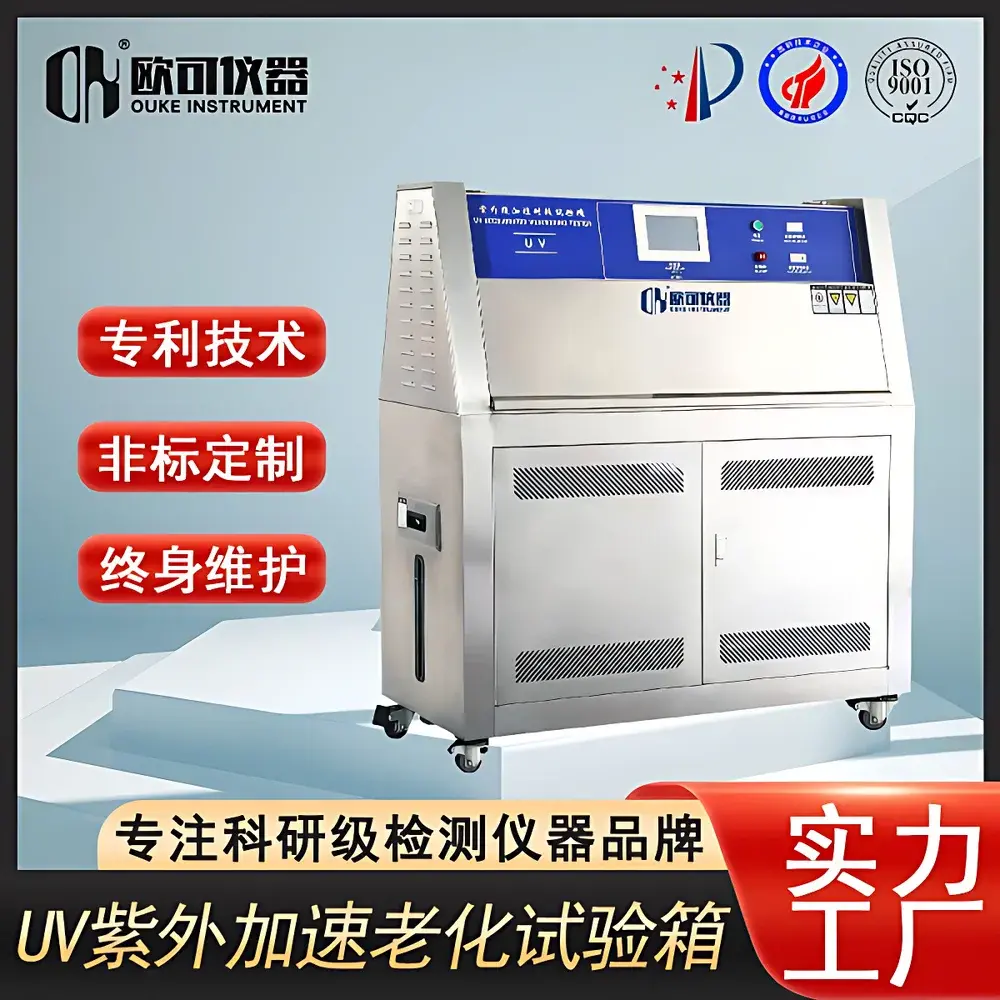
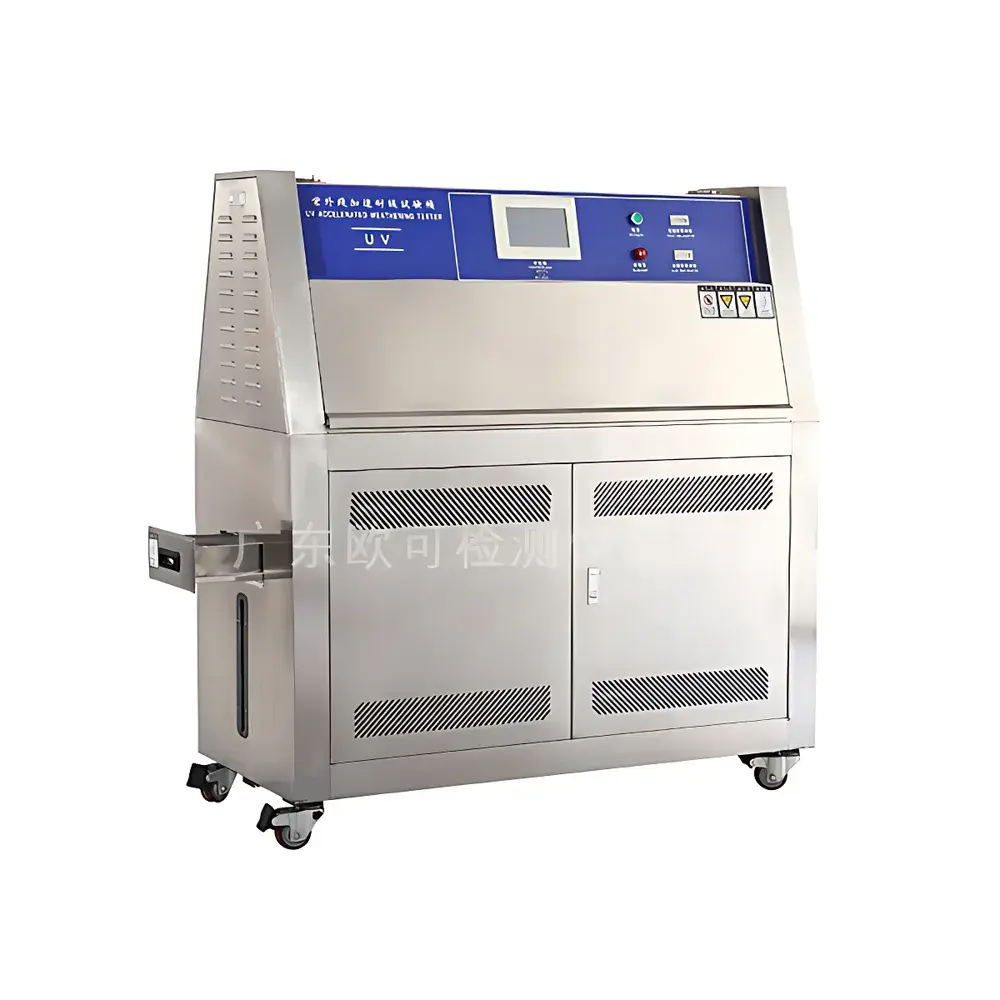
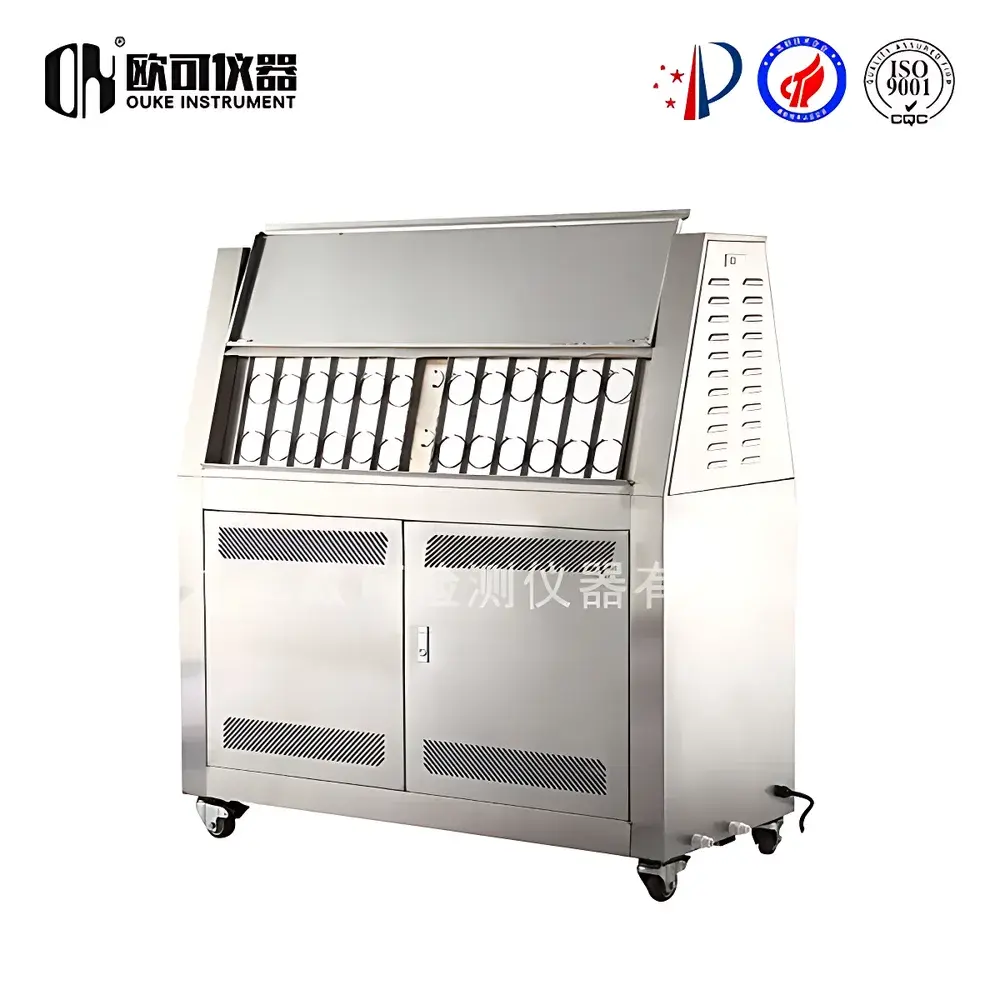
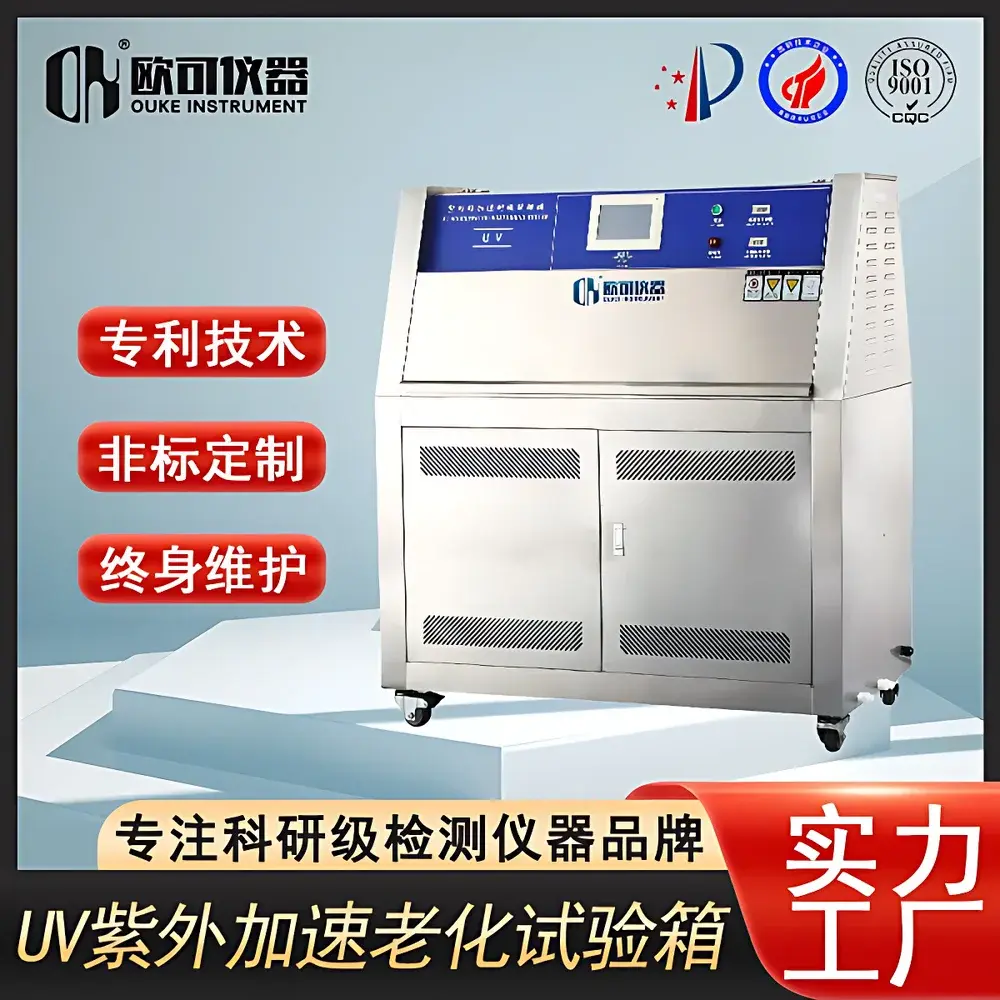
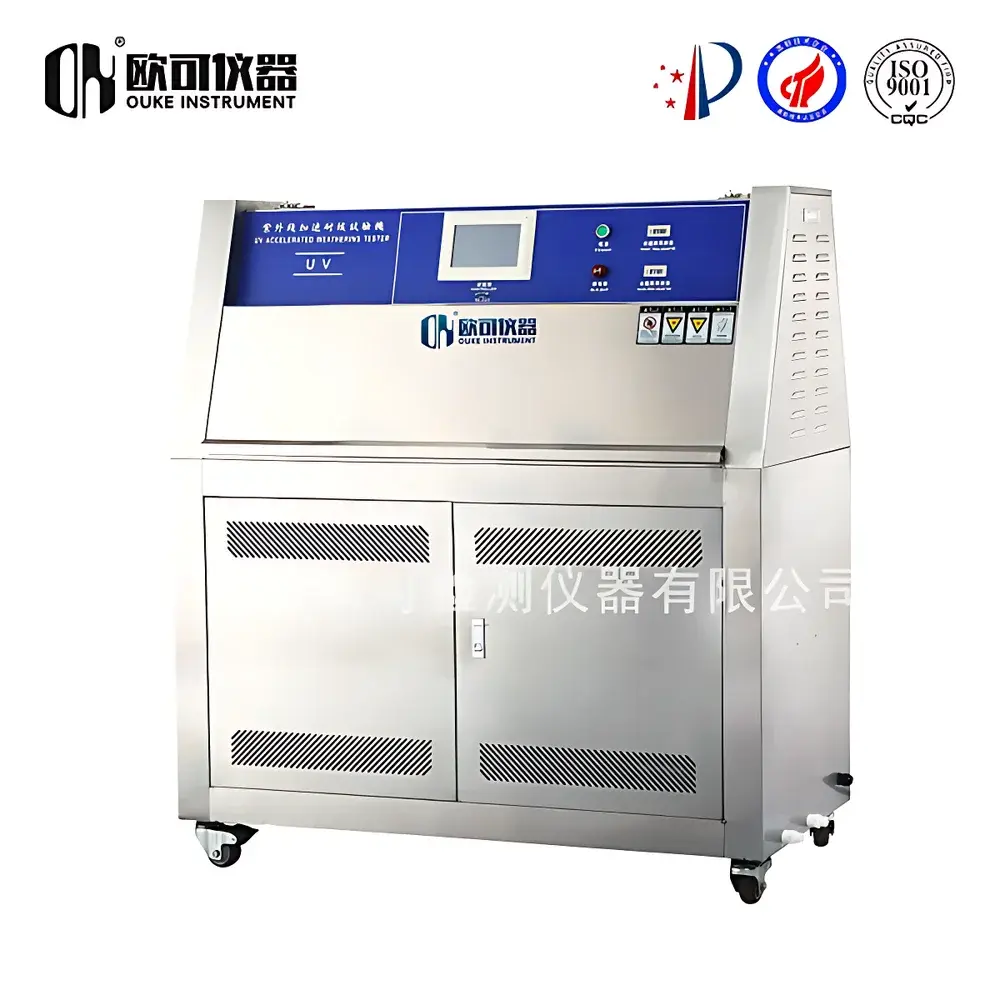
OK UV Aging Test Chamber OK-UV-290.00..0
| Brand | OK Instruments |
|---|---|
| Origin | Guangdong, China |
| Manufacturer Type | Direct Manufacturer |
| Product Origin | Domestic (China) |
| Model | OK-UV-290.00..0 |
| Humidity Range | ≥95% RH (in-chamber actual value) |
| Lamp Power | 40 W per tube |
| Irradiance Range | 0.72 W/m² |
| Exposure Time | 1–9999 h (adjustable) |
| Irradiation Temperature Range | RT to 70 °C |
| UV Wavelength Range | 280–400 nm |
| Chamber Dimensions (L×W×H) | 1170 × 400 × 400 mm |
Overview
The OK UV Aging Test Chamber OK-UV-290.00..0 is a precision-engineered environmental test system designed to simulate and accelerate the photodegradation effects of solar ultraviolet radiation under controlled laboratory conditions. It operates on the principle of fluorescent UV irradiation—specifically leveraging UVA-340 and/or UVB-313 lamp spectra—to replicate the photochemical stress induced by natural sunlight in the 280–400 nm spectral band. Unlike broad-spectrum xenon arc or carbon arc systems, this chamber focuses exclusively on the most damaging short-wavelength UV region, enabling rapid, reproducible evaluation of polymer degradation, pigment fading, surface chalking, gloss loss, and embrittlement. The unit integrates tightly regulated thermal control (RT to 70 °C), high-humidity condensation cycles (≥95% RH), and programmable exposure timing to emulate real-world diurnal weathering mechanisms—including UV exposure, dark condensation (simulating dew formation), and optional thermal cycling—per ASTM G154 and ISO 4892-3 protocols.
Key Features
- Fluorescent UV lamp array with standardized 40 W per tube output, optimized for spectral fidelity in the 280–400 nm range
- Stable irradiance delivery at 0.72 W/m² (typically measured at 340 nm), calibrated to NIST-traceable reference standards
- Programmable exposure duration from 1 hour to 9999 hours, supporting multi-stage test sequences with precise time resolution
- Integrated condensation humidity system achieving ≥95% RH within the test chamber, facilitating realistic moisture-induced degradation pathways
- Uniform irradiation field across the 1170 × 400 × 400 mm test volume, verified via spatial irradiance mapping per IEC 60068-2-5
- Robust stainless-steel interior construction with UV-resistant insulation and corrosion-resistant hardware for long-term operational integrity
- Digital PID temperature controller with ±0.5 °C accuracy over the full RT–70 °C irradiation temperature range
Sample Compatibility & Compliance
The OK-UV-290.00..0 accommodates flat-panel specimens up to 1100 mm in length, including coated substrates, molded plastic parts, textile swatches, automotive trim components, and architectural cladding samples. Its design conforms to the mechanical and operational requirements of ASTM G154 (Standard Practice for Operating Fluorescent Ultraviolet (UV) Lamp Apparatus for Exposure of Non-Metallic Materials) and ISO 4892-3 (Plastics — Methods of Exposure to Laboratory Light Sources — Part 3: Fluorescent UV Lamps). While not certified to UL or CE for safety compliance out-of-the-box, the chamber meets fundamental electrical safety and thermal containment criteria aligned with IEC 61000-6-2/6-4 for industrial equipment. For GLP/GMP-regulated environments, users may implement audit-ready logbook procedures and manual irradiance verification logs; optional irradiance sensor integration supports future traceability enhancements.
Software & Data Management
The chamber features an embedded microprocessor-based controller with intuitive LCD interface for setting and monitoring irradiation time, temperature setpoints, and humidity hold phases. All parameters are logged internally with timestamped records stored in non-volatile memory (retention ≥10 years). Export functionality via USB port enables transfer of CSV-formatted test logs for post-processing in Excel or statistical analysis platforms (e.g., JMP, Minitab). Though no native cloud connectivity or FDA 21 CFR Part 11-compliant electronic signature module is included, the system supports external data acquisition via analog 4–20 mA outputs for irradiance and temperature signals—enabling integration into validated LIMS or SCADA infrastructures when paired with compliant third-party DAQ hardware and SOP-defined validation protocols.
Applications
This UV aging chamber serves critical roles across R&D, QC, and regulatory submission workflows. In coatings development, it quantifies chalk resistance and color shift (ΔE* ab per CIE 1976) of architectural paints after accelerated exposure. For automotive suppliers, it validates UV stability of interior trim materials per SAE J2020 and exterior fascia components under cyclic UV/condensation regimes. Plastic compounders use it to rank stabilizer package efficacy in polyolefins and engineering resins. Textile laboratories apply it to assess ISO 105-B02-compliant colorfastness to artificial daylight UV. Additionally, building product manufacturers rely on its output to support EN 1504-2 conformity assessments for protective coating systems applied to concrete substrates.
FAQ
What UV lamp types are compatible with the OK-UV-290.00..0?
The chamber accepts industry-standard UVA-340 and UVB-313 fluorescent tubes (40 W, T8 format); lamp selection must align with target test standard—UVA-340 for solar simulation fidelity, UVB-313 for aggressive acceleration.
Does the unit include irradiance calibration capability?
It provides manual calibration support via user-supplied NIST-traceable radiometer; closed-loop irradiance feedback control is not integrated but can be added via aftermarket sensor retrofit.
How frequently should UV lamps be replaced?
Per ASTM G154 guidance, UVA-340 lamps require replacement every 1600–2000 hours of operation; UVB-313 lamps degrade faster and should be renewed every 1000–1200 hours to maintain spectral consistency.
Can condensation cycles be disabled for dry-heat-only testing?
Yes—the controller allows independent activation/deactivation of humidity generation, permitting pure UV/thermal exposure profiles without condensation.
Is the chamber suitable for testing metallic substrates with organic coatings?
Yes, provided the metal substrate is non-reflective or masked appropriately; uncoated bare metals are not recommended due to potential catalytic photo-oxidation interference.



