
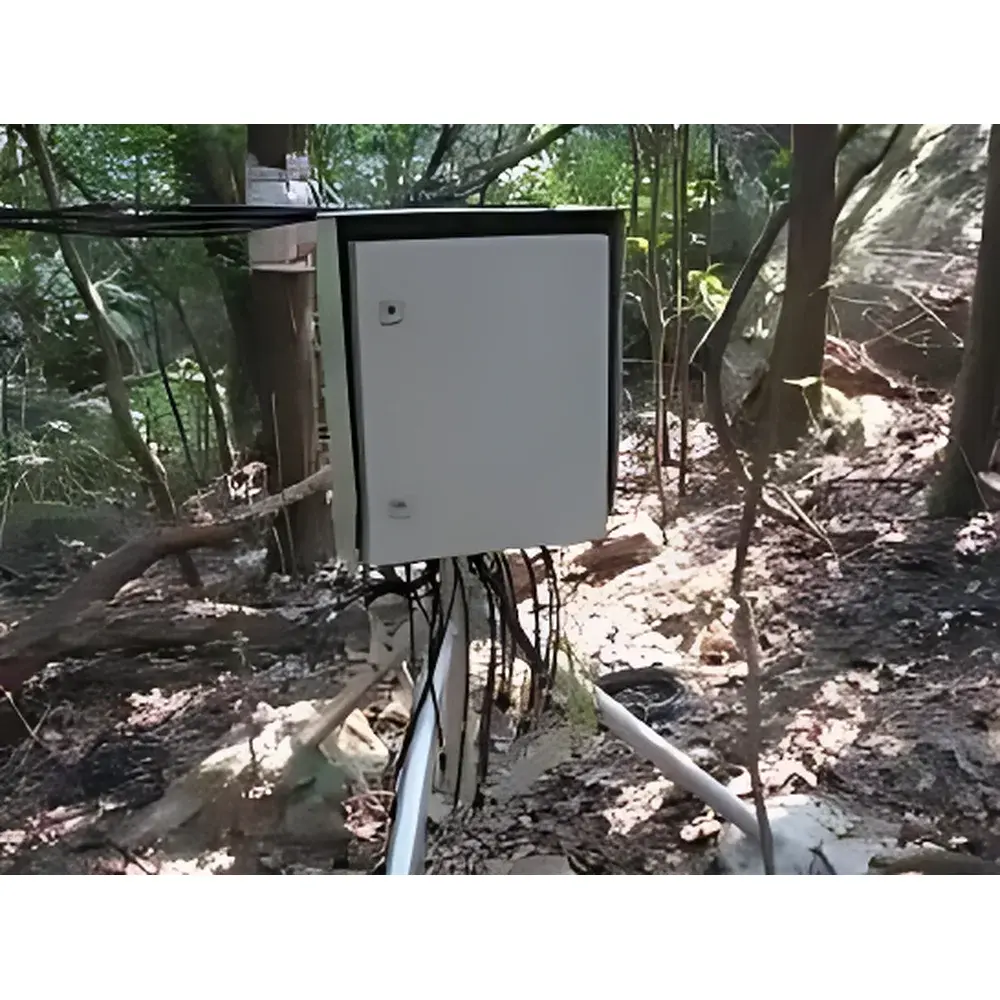
ENVIdata-DT Plant Stem Flow and Leaf Temperature Monitoring System
| Origin | Beijing, China |
|---|---|
| Manufacturer Type | Authorized Distributor |
| Product Origin | Domestic (China) |
| Model | ENVIdata-DT |
| Pricing | Available Upon Request |
Overview
The ENVIdata-DT Plant Stem Flow and Leaf Temperature Monitoring System is a field-deployable, multi-sensor environmental telemetry platform engineered for high-temporal-resolution quantification of plant water use dynamics in agricultural, ecological, and physiological research. It operates on two complementary biophysical principles: thermal dissipation (TDP) and heat balance (SG/SF) for stem flow measurement, and infrared radiometry for non-contact leaf surface temperature acquisition. These measurements—combined with co-located precipitation, soil moisture, and irrigation flow data—enable rigorous calculation of field-scale water balance, transpiration rates, and crop water stress indices. The system is designed for long-term unattended operation in remote outdoor environments, supporting both real-time monitoring and post-hoc hydrological modeling under variable climatic conditions.
Key Features
- Modular architecture integrating dual-stem-flow sensor modalities: TDP-series needle probes (for woody stems ≥70 mm diameter) and SG/SF-series wrap-around sensors (for herbaceous or juvenile stems 2.1–175 mm diameter), each requiring no calibration or invasive tissue penetration.
- Dual-tier data acquisition: DT80 (up to 15 analog + 12 digital channels) and DT85 (up to 48 analog + 12 digital channels) loggers featuring 18-bit ADC resolution, 25 Hz maximum sampling rate, and programmable output types including mean, min/max, cumulative totalize, and vector-averaged values.
- Robust environmental resilience: Operating temperature range of −45 °C to +70 °C; humidity tolerance up to 85% RH (non-condensing); IP65-rated enclosure; integrated surge and overvoltage protection on all sensor inputs.
- Flexible power management: Dual-output adjustable voltage regulator supplies precise excitation voltages (2.3–7.5 V DC) to heterogeneous sensor arrays while enabling duty-cycled sleep modes to extend battery life in solar-powered deployments.
- Multi-protocol connectivity: RS232, USB 2.0, and Ethernet interfaces support local configuration and remote data retrieval via FTP, Modbus TCP, SDI-12 networks, and HTTP-based web interface with embedded 2×16-character LCD display and tactile keypad.
- ENVIdata Internet telemetry software enables secure, dynamic DNS-based remote access without static IP requirements—delivering raw time-series data, trend plots, and configurable email/SMS alerts directly to desktop or mobile devices.
Sample Compatibility & Compliance
The system accommodates a broad spectrum of plant morphotypes across ecological and agronomic contexts: from small-diameter herbaceous stems (e.g., maize, soybean, grapevine shoots) using SF-G (≥5 cm) or DSGA3 (2.7–4.0 mm) probes, to mature hardwood trunks (e.g., oak, eucalyptus) via TDP-80 (≥180 mm). All sensors comply with ISO 17025 traceable calibration practices during manufacturing. Data integrity meets GLP/GMP-aligned audit trail requirements through timestamped metadata logging, firmware-level clock accuracy (±1 min/year at 0–40 °C), and non-volatile memory retention (10 million points in 128 MB internal storage). Sensor outputs are compatible with ASTM E1960 (infrared thermometry), ISO 11274 (soil hydraulic properties), and FAO-56 reference evapotranspiration frameworks.
Software & Data Management
ENVIdata Internet provides browser-accessible visualization and export functionality without proprietary client installation. Raw sensor data—including differential thermocouple voltages (µV), heater supply voltages (V), and pulse counts from rain gauges or flow meters—are stored in standardized CSV/JSON formats with UTC timestamps and channel-specific metadata headers. The software supports automated FTP push to institutional servers, scheduled email reports with embedded graphs, and threshold-triggered notifications for critical parameters (e.g., leaf temperature >35 °C indicating acute water stress). All logger configurations—including sampling intervals (10 ms to multi-day), alarm hysteresis, and memory partitioning—are programmable via intuitive web GUI or command-line script upload. Data provenance is preserved through immutable firmware logs and optional SD card redundancy.
Applications
- Irrigation scheduling optimization in precision viticulture, orchard management, and row-crop systems by correlating real-time stem flow decline with soil matric potential thresholds.
- Quantifying diurnal and seasonal transpiration patterns in forest ecophysiology studies, particularly for drought-response phenotyping across genotypes.
- Validating land-surface model parameterizations in hydrological catchment studies where plant water uptake represents a dominant flux term.
- Assessing stomatal conductance proxies via leaf-to-air temperature differentials (dTleaf-air) under controlled deficit irrigation trials.
- Long-term monitoring of riparian zone water use in restoration ecology projects, integrating stem flow with groundwater level and streamflow data.
FAQ
What stem diameter ranges does the system support?
The SG/SF wrap-around probes cover 2.1–175 mm; TDP needle probes are optimized for stems ≥70 mm (TDP-30), ≥120 mm (TDP-50), or ≥180 mm (TDP-80).
Is calibration required for the stem flow sensors?
No—SG/SF series probes operate on heat balance principles and require no site-specific calibration; TDP probes are factory-calibrated and retain stability across seasonal temperature gradients.
Can the system operate autonomously for extended periods?
Yes—configured with solar charging, low-power sleep cycles, and 128 MB internal memory, deployments exceeding 12 months are routinely achieved in temperate and arid climates.
Which environmental standards does the infrared leaf temperature sensor meet?
It conforms to IEC 60751 Class B tolerances for Pt100 reference, with stated accuracy of ±0.2 °C over −10 to +65 °C per ISO 17025-accredited validation reports.
How is data security handled during remote transmission?
FTP transfers use authenticated credentials; web interface sessions enforce TLS 1.2+ encryption; no data is stored on cloud servers unless explicitly configured by the user.




