
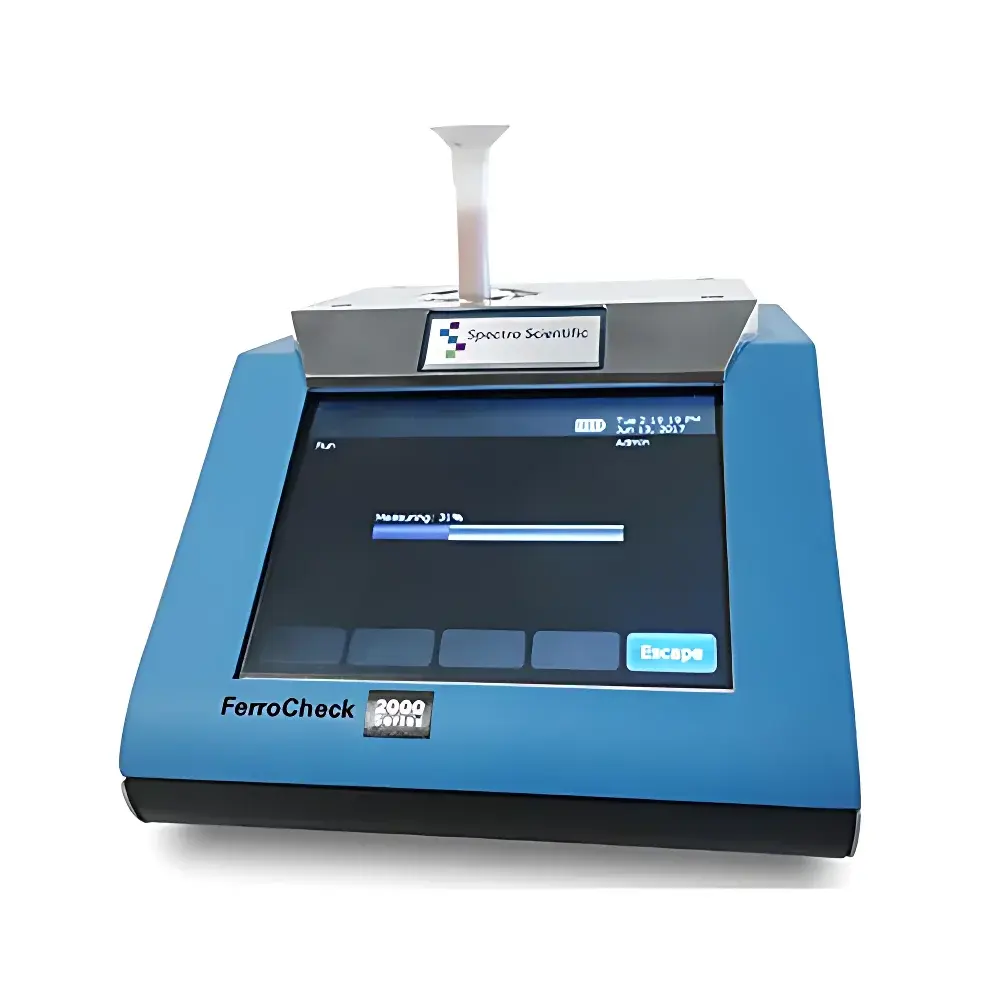
Spectro Scientific FerroCheck 2000 Portable Ferrography Analyzer
| Brand | Spectro Scientific |
|---|---|
| Origin | USA |
| Model | FerroCheck 2000 |
| Type | Portable Instrument |
| Detection Principle | Magnetic Susceptibility-Based Quantitative Ferrous Particle Measurement |
| Measurement Range | 0–10,000 ppm |
| Repeatability | <5 ppm |
| Particle Size Sensitivity | Nanoscale to Millimeter-Scale Ferromagnetic Particles |
| Analysis Time | <30 seconds per sample |
| Power Supply | Rechargeable Lithium-Ion Battery |
| Data Storage | Internal Non-Volatile Memory with USB Export Capability |
| Sample Requirement | No Pre-treatment or Organic Solvents Required |
| Compliance | Designed for ASTM D7684 (Standard Test Method for Quantitative Measurement of Wear Debris in Used Lubricants by Ferrography), ISO 4406, and GLP/GMP-Ready Data Traceability |
Overview
The Spectro Scientific FerroCheck 2000 is a field-deployable, quantitative ferrographic analyzer engineered for rapid, on-site measurement of ferromagnetic wear debris concentration in lubricating oils and hydraulic fluids. It operates on the principle of magnetic susceptibility detection: as an undiluted oil sample flows through a precision-calibrated magnetic sensing zone, ferromagnetic particles—including elemental iron, steel, and alloy fragments—induce measurable changes in coil inductance proportional to their total mass concentration. Unlike qualitative ferrography methods that rely on microscopic particle morphology assessment, the FerroCheck 2000 delivers traceable, linear ppm-level quantification without sample dilution, solvent extraction, or centrifugation. This makes it uniquely suited for condition-based maintenance programs where real-time insight into mechanical wear severity—particularly from gear teeth, rolling element bearings, and hydraulic pump components—is required to prevent catastrophic failure.
Key Features
- Quantitative ferrous debris measurement across a dynamic range of 0–10,000 ppm with repeatability better than ±5 ppm under controlled ambient conditions.
- Real-time analysis completed in under 30 seconds per sample—enabling high-throughput screening during routine equipment walkdowns or mobile lab deployments.
- Integrated lithium-ion battery provides >8 hours of continuous operation, supporting extended field use without AC infrastructure.
- Capacitive touchscreen interface with intuitive icon-driven workflow; no specialized training or interpretation expertise required for basic operation.
- Onboard non-volatile memory stores up to 1,000 test records with timestamp, operator ID, and sample identification fields—fully compliant with audit-ready data integrity requirements.
- USB 2.0 interface enables secure export of CSV-formatted datasets for integration with CMMS, LIMS, or enterprise asset management platforms.
Sample Compatibility & Compliance
The FerroCheck 2000 accepts undiluted samples of mineral-based, synthetic, and semi-synthetic lubricants—including turbine oils, gear oils, engine oils, and hydraulic fluids—without modification or pre-filtration. It is insensitive to base oil chemistry, additive packages, or viscosity variations within ISO VG 32–680 ranges. The instrument meets the functional performance criteria outlined in ASTM D7684 for quantitative ferrous debris analysis and supports alignment with ISO 4406 (fluid cleanliness coding) and ISO 17359 (condition monitoring and diagnostics standards). Its embedded data logging architecture includes operator authentication, tamper-evident timestamps, and immutable record retention—facilitating compliance with GLP and GMP documentation practices and enabling readiness for FDA 21 CFR Part 11–governed environments where electronic records are subject to regulatory review.
Software & Data Management
Data acquisition and reporting are managed via the embedded firmware platform, which enforces structured entry of sample metadata (e.g., equipment ID, sampling date, location, lubricant type). All measurements are automatically tagged with calibration verification status and sensor health indicators. Exported datasets include raw inductance values, calculated ppm concentrations, and diagnostic flags for out-of-range readings or flow anomalies. Optional SpectroLink desktop software (v3.2+) provides trend visualization, statistical process control (SPC) charting, alarm threshold configuration, and automated report generation aligned with ISO 55001 asset management frameworks. Audit trails record all user actions—including calibration events, parameter edits, and data deletions—with cryptographic hashing to ensure forensic traceability.
Applications
- Routine wear monitoring of wind turbine gearboxes, where early detection of macro-particle spikes (>100 µm) correlates strongly with pitting or spalling progression.
- Preventive maintenance of marine propulsion systems, where ferrous debris accumulation in main engine lube oil signals liner wear or bearing degradation.
- Condition assessment of hydraulic systems in aerospace ground support equipment, where sub-10 µm ferrous content trends inform filter efficiency validation and component life estimation.
- Field validation of laboratory ferrography results, serving as a rapid triage tool prior to sending critical samples for analytical ferrography (AF) or ICP-OES confirmation.
- Integration into OEM service protocols for power generation turbines, where FerroCheck 2000 data feeds directly into predictive analytics models trained on historical failure modes.
FAQ
Does the FerroCheck 2000 distinguish between different types of ferromagnetic metals (e.g., iron vs. nickel alloys)?
No—it measures total ferromagnetic mass concentration regardless of elemental composition. For speciation, complementary techniques such as SEM-EDS or ICP-MS are recommended.
Can it be used with greases or highly viscous fluids?
Not directly; the instrument requires free-flowing liquid samples. Greases must be dissolved in a compatible carrier fluid (e.g., kerosene) per ASTM D7684 Annex A1 prior to analysis.
Is calibration traceable to NIST standards?
Yes—factory calibration uses NIST-traceable ferrous particle suspensions, and users may perform field verification using supplied reference standards (FC-STD-100 and FC-STD-5000).
What maintenance does the sensor module require?
The magnetic sensing coil is solid-state with no moving parts; routine cleaning of the sample path with lint-free wipes and isopropyl alcohol is sufficient. Annual verification by authorized service centers is recommended.
How does temperature affect measurement accuracy?
The instrument incorporates real-time oil temperature compensation (via integrated PT100 sensor) across 0–60 °C, maintaining specified repeatability within ±2 °C ambient variation.





