
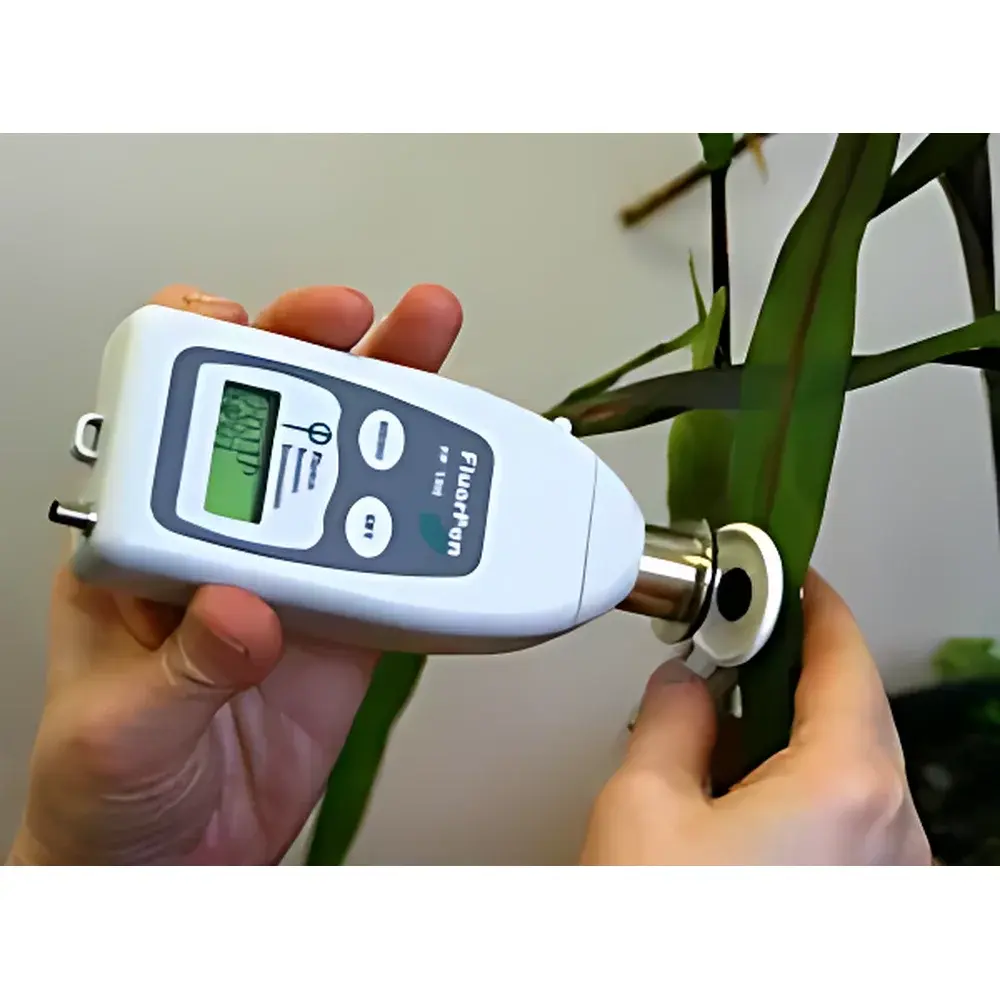
FP100MAX-D Handheld Pulse-Amplitude Modulated (PAM) Chlorophyll Fluorometer with Integrated Dark-Adaptation Leaf Clip
| [Origin | Europe |
|---|---|
| Manufacturer Type | Authorized Distributor |
| Import Status | Imported |
| Model | FP100MAX-D |
| Price | Upon Request |
| Measurement Parameters | Fo, Ft, Fm, Fm′, QY (Fv/Fm & Fv′/Fm′), OJIP transient kinetics, NPQ₁ & NPQ₂, Light Curves 1–3 |
| Actinic Light Range | 0–3000 µmol·m⁻²·s⁻¹ |
| Measuring Light | Blue LED (625 nm, optional red/white) |
| Detection Wavelength Range | 697–750 nm |
| PAR Sensor | 400–700 nm, output in µmol·m⁻²·s⁻¹ |
| Data Storage | 100,000 measurements (4 MB internal memory) |
| Interface | Bluetooth / USB / RS-232 |
| Display | 2×8 character monochrome LCD |
| Power | 4×AAA alkaline or rechargeable batteries (70 h continuous operation) |
| Dimensions | 120 × 57 × 30 mm |
| Weight | 180 g |
| Operating Temp. | 0–55 °C, RH: 0–95% non-condensing |
| Firmware | Upgradable BOIS |
| Software | FluorPen 2.0 (Windows 2000+, real-time remote control, GPS geotagging, Excel export)] |
Overview
The FP100MAX-D Handheld Pulse-Amplitude Modulated (PAM) Chlorophyll Fluorometer is a field-deployable, research-grade instrument engineered for non-invasive, quantitative assessment of photosynthetic performance in intact plant leaves. It operates on the principle of pulse-amplitude modulation fluorometry, which isolates the variable fluorescence signal from background noise by applying weak measuring light pulses synchronized with high-intensity saturating pulses. This enables precise quantification of photochemical and non-photochemical energy dissipation pathways within Photosystem II (PSII). The integrated dark-adaptation leaf clip ensures standardized measurement conditions—critical for reproducible determination of baseline parameters such as Fo (minimal fluorescence) and Fm (maximal fluorescence)—without requiring external clamps or manual timing. Designed for rigorous field and greenhouse applications, the FP100MAX-D delivers laboratory-level data fidelity in a rugged, portable form factor optimized for longitudinal monitoring and high-throughput phenotyping.
Key Features
- Integrated dark-adaptation leaf clip with mechanical shutter—eliminates operator-dependent dark adaptation timing and ensures consistent Fo/Fm acquisition
- Multi-parameter fluorescence profiling: simultaneous acquisition of Fo, Ft, Fm, Fm′, quantum yield (QY = Fv/Fm or Fv′/Fm′), NPQ₁/NPQ₂, OJIP transient kinetics, and three customizable light-response curves
- Adjustable actinic light intensity (0–3000 µmol·m⁻²·s⁻¹) and spectral options (standard blue LED at 625 nm; optional red or white LEDs for species-specific excitation)
- Onboard PAR sensor (400–700 nm range) with real-time µmol·m⁻²·s⁻¹ readout and automatic averaging across 20 consecutive measurements
- GPS geotagging capability for spatially referenced physiological mapping—essential for field trials, ecological transects, and precision agriculture studies
- Robust firmware architecture with BOIS (Bio-Optical Instrument System) upgradability and support for future parameter extensions
- Sealed, waterproof two-button interface and auto-power-down after 5 minutes of inactivity—engineered for reliability in humid, dusty, or rain-exposed environments
Sample Compatibility & Compliance
The FP100MAX-D is validated for use with broadleaf and needle-type vascular plant leaves—including crop species (e.g., wheat, maize, soybean), model organisms (Arabidopsis thaliana), forest trees, and aquatic macrophytes—provided leaf thickness falls within the clip’s aperture tolerance (≤1.5 mm). Its non-destructive optical design avoids tissue compression artifacts common in contact-based meters. All fluorescence protocols align with internationally accepted methodologies described in Schreiber et al. (1995), Maxwell & Johnson (2000), and the Plant Phenomics Society’s Best Practices for In Vivo Chlorophyll Fluorescence Imaging. Data integrity complies with GLP-aligned documentation standards: timestamps, GPS coordinates, environmental metadata (PAR, temperature), and user-defined experimental IDs are embedded in every exported dataset. While not FDA-certified (as it is a research instrument, not a diagnostic device), its software export functions support 21 CFR Part 11–compatible audit trails when used with FluorPen 2.0 in controlled laboratory settings.
Software & Data Management
FluorPen 2.0 software provides full instrument control, real-time visualization of fluorescence transients, and post-acquisition analysis of OJIP kinetics (including J-step, I-step, P-rise parameters), NPQ relaxation kinetics, and light-curve fitting using standard models (e.g., Eilers & Peeters, 1988). The software supports batch processing of field-collected datasets, georeferenced heatmaps via integrated GPS coordinates, and direct export to CSV or Excel-compatible formats for statistical analysis in R, Python (Pandas), or MATLAB. Internal storage retains up to 100,000 measurements with full parameter sets; data transfer occurs via Bluetooth (class 2, up to 10 m), USB 2.0, or RS-232 serial connection. Firmware updates are delivered via secure HTTPS download and installed through the software interface—ensuring long-term compatibility with evolving analytical workflows and regulatory documentation requirements.
Applications
- Photosynthetic efficiency screening in crop breeding programs—quantifying genotype-by-environment interactions under drought, heat, or salinity stress
- Early detection of biotic stress (e.g., fungal infection, herbivory) and abiotic stress (e.g., heavy metal exposure, nutrient deficiency) prior to visible symptom development
- Functional characterization of PSII mutants and transgenic lines in molecular plant biology
- Evaluation of pesticide mode-of-action and phytotoxicity thresholds via rapid QY depression assays
- In situ assessment of canopy-level photosynthetic heterogeneity in agroecosystems and natural vegetation gradients
- Ecophysiological studies of plant–microbe symbioses (e.g., mycorrhizal colonization, rhizobial nodulation) and plant–protist interactions
- Long-term monitoring of vegetation health in restoration ecology and climate change impact assessments
FAQ
What is the difference between Fv/Fm and Fv′/Fm′, and when should each be measured?
Fv/Fm reflects maximum quantum yield of PSII under dark-adapted conditions and indicates intrinsic photochemical capacity. Fv′/Fm′ is measured under light-adapted states and reports operating efficiency during steady-state photosynthesis. Use Fv/Fm for stress screening; use Fv′/Fm′ to assess dynamic acclimation.
Can the FP100MAX-D measure fluorescence in conifer needles or thick succulent leaves?
Yes—provided the leaf clip fully encloses the measurement area without gaps. For very thick or curved samples, minor trimming or selection of flattened sections is recommended to ensure uniform illumination and signal capture.
Is the PAR sensor calibrated traceable to NIST standards?
The onboard PAR sensor is factory-calibrated against a reference quantum sensor certified to ISO 17025-accredited standards; calibration certificates are available upon request for audit documentation.
Does FluorPen 2.0 support automated batch analysis of OJIP curve parameters?
Yes—version 2.0.4+ includes scriptable macros for extracting OJIP-derived indices (e.g., PIABS, RC/CSm, ψEo) across thousands of files, with customizable reporting templates.
How does the instrument handle ambient light interference during field measurements?
The PAM methodology inherently suppresses ambient light via lock-in amplification; additionally, the leaf clip’s light-tight design and synchronized pulse timing minimize stray-light contamination—even under full midday sun.





