
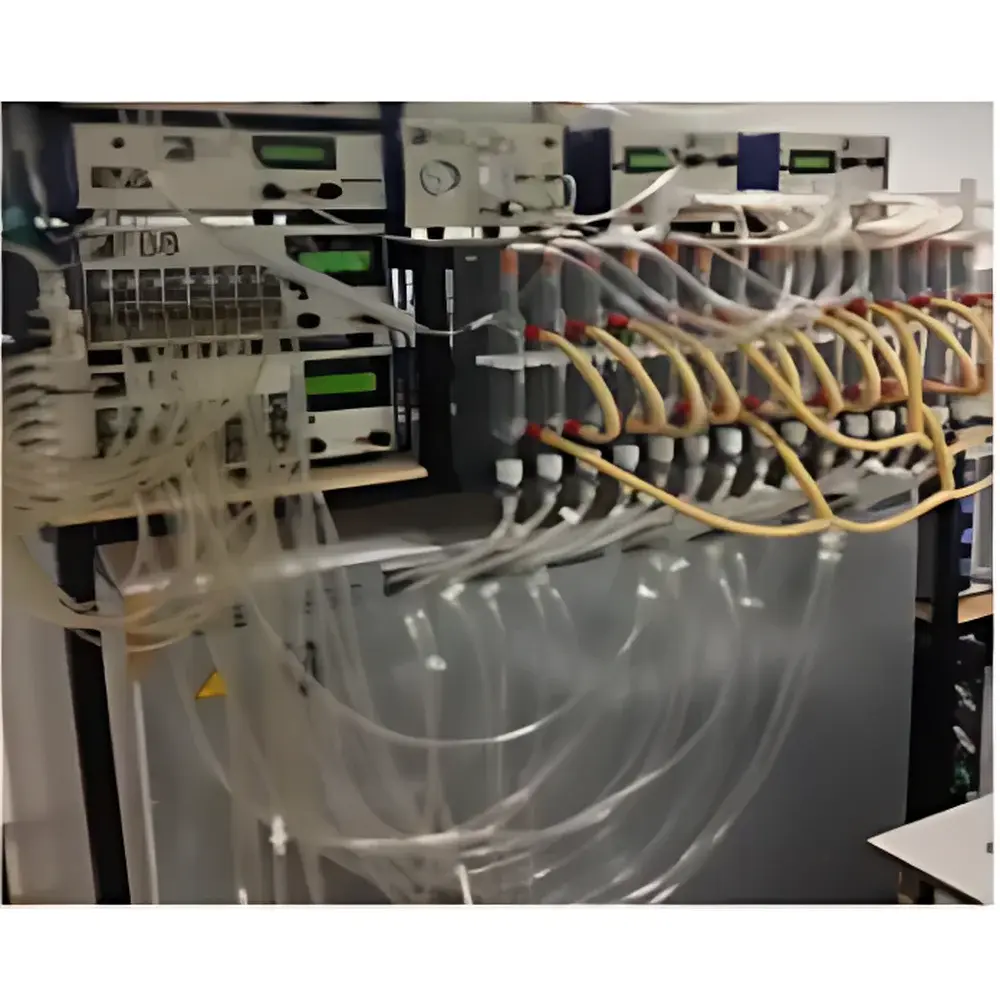
Soillab SoilLab Multi-Channel Laboratory Soil Respiration Measurement System
| Origin | USA |
|---|---|
| Manufacturer Type | Authorized Distributor |
| Origin Category | Imported |
| Model | SoilLab |
| Pricing | Upon Request |
Overview
The Soillab SoilLab Multi-Channel Laboratory Soil Respiration Measurement System is a precision-engineered platform designed for controlled, quantitative assessment of soil gas exchange dynamics under laboratory conditions. It operates on the principle of dynamic closed-chamber or open-flow gas exchange measurement, integrating real-time, high-resolution analysis of CO₂, H₂O, CH₄, and O₂ fluxes across multiple soil samples simultaneously. The system employs non-dispersive infrared (NDIR) spectroscopy with dual-wavelength detection for CO₂ and CH₄—ensuring high specificity, minimal cross-sensitivity, and automatic pressure/temperature compensation per ASTM D6348 and ISO 13877. Its modular architecture enables flexible configuration for studies ranging from microbial respiration kinetics to root–soil–atmosphere carbon partitioning, supporting mechanistic investigations into biogeochemical cycling, climate feedbacks, and ecosystem functional integrity.
Key Features
- Modular, expandable design: Supports scalable channel configurations—4-, 8-, or 16-channel gas routing via RM-8-Bev or RM-4-Bev-Stop multiplexers.
- Multi-analyte capability: Standard CO₂ + H₂O quantification; optional CH₄ and O₂ modules enable comprehensive greenhouse gas (GHG) and respiratory stoichiometry analysis.
- High-fidelity gas sensing: CA-10 CO₂ analyzer (0–15% range, <0.1 ppm resolution, <1 s response); RH-300 hygrometer (0.2–100% RH, 0.001% RH resolution, dew point output); MA-10 CH₄ analyzer (0–10%, 1 ppm resolution).
- Programmable flow control: MFS-2 (10–2000 mL/min) and optional MFS-5 (25–5000 mL/min) mass flow controllers ensure stable, reproducible sample delivery across all channels.
- Integrated environmental monitoring: Four analog temperature inputs (0.001 °C resolution) support concurrent air and soil temperature profiling—critical for Q₁₀ derivation and thermal normalization.
- Dual-mode operation: Configurable for both closed-chamber (static accumulation) and open-flow (dynamic draw-through) protocols per ISO 16634-2 and US EPA Method TO-15 guidelines.
- Robust data acquisition: UI-2 8-channel, 16-bit A/D converter with 10 Hz sampling rate; 12 total analog inputs including four temperature channels.
- Field-deployable power options: Operates on 12 V DC (battery or solar compatible) or 220 V AC—validated for continuous lab use and mobile field-lab applications.
Sample Compatibility & Compliance
The SoilLab system accommodates standard 500 mL RC-V hardened glass respiration chambers, compatible with intact soil cores, rhizoboxes, microcosms, and invertebrate bioassays (e.g., earthworm, nematode, or collembolan respiration assays). Its gas-tight architecture and low dead-volume manifolds minimize dilution artifacts and ensure compliance with GLP-aligned experimental protocols. All analytical modules meet NIST-traceable calibration standards, and the full system supports audit-ready metadata logging—including timestamped chamber ID, flow rate, temperature, pressure, and sensor diagnostics—to satisfy FDA 21 CFR Part 11 requirements when used in regulated environmental toxicology or bioremediation validation studies. Data integrity is reinforced by Expedata software’s built-in electronic signature, version-controlled method templates, and immutable raw-data archiving.
Software & Data Management
Expedata software serves as the unified control, acquisition, and processing environment. It provides real-time visualization of all sensor streams, automated multi-channel sequence scheduling, and integrated calculation of derived metrics—including basal respiration rates (µmol CO₂ m⁻² s⁻¹), respiratory quotient (RQ = CO₂/O₂), Q₁₀ (calculated via Arrhenius regression over ≥3 temperature steps), and CH₄ oxidation potential. Raw time-series data are exported in CSV and HDF5 formats, supporting downstream statistical modeling in R, Python (Pandas, SciPy), or MATLAB. The software includes batch-processing tools for normalization to soil moisture, organic matter content, or microbial biomass-C (when paired with external PLFA or qPCR data), and generates publication-ready plots compliant with journal formatting standards (e.g., PLOS ONE, Global Change Biology).
Applications
- Quantifying microbial metabolic activity via basal respiration and respiratory quotient (RQ) as indicators of community stress under heavy metal contamination or pesticide exposure.
- Partitioning autotrophic (root) vs. heterotrophic (microbial) contributions to total soil respiration using root exclusion techniques (trenching, mesh barriers) and O₂ co-measurement.
- Evaluating soil carbon sequestration potential of agronomic practices (cover cropping, reduced tillage, biochar amendment) through repeated flux monitoring across seasonal cycles.
- Assessing methanogenic and methanotrophic activity gradients in wetland soils, rice paddies, or landfill cover systems—supporting IPCC Tier 2 GHG inventory reporting.
- Monitoring invertebrate respiratory responses to xenobiotics in ecotoxicological screening, aligned with OECD Test No. 221 (Earthworm Reproduction Test) and ISO 11268-1.
- Validating biogeochemical models (e.g., CENTURY, DNDC) by providing high-temporal-resolution flux constraints for parameterization and sensitivity analysis.
FAQ
What gas analyzers are included in the standard configuration?
The base system includes the CA-10 CO₂ analyzer and RH-300 H₂O analyzer. CH₄ and O₂ modules are available as factory-installed options.
Can the system measure soil respiration continuously over extended periods?
Yes—continuous unattended operation is supported for up to 30 days with stable power, calibrated gas standards, and periodic zero/span verification.
Is the software compliant with 21 CFR Part 11 for regulated research?
Expedata supports electronic signatures, audit trails, and role-based access control; full Part 11 compliance requires site-specific validation documentation and IT infrastructure alignment.
How is temperature sensitivity addressed during CO₂ measurement?
All gas analyzers incorporate real-time, on-board temperature and barometric pressure compensation algorithms traceable to NIST SRM 1971, ensuring ≤1% measurement uncertainty across 0–45 °C.
What chamber types are compatible with the RC-V 500 mL respiration vessel?
The RC-V chamber accepts custom inserts for root boxes, segmented soil columns, or fauna-containing microcosms; optional gasket kits enable sealing on irregular surfaces such as soil monoliths or peat blocks.
Related Products







