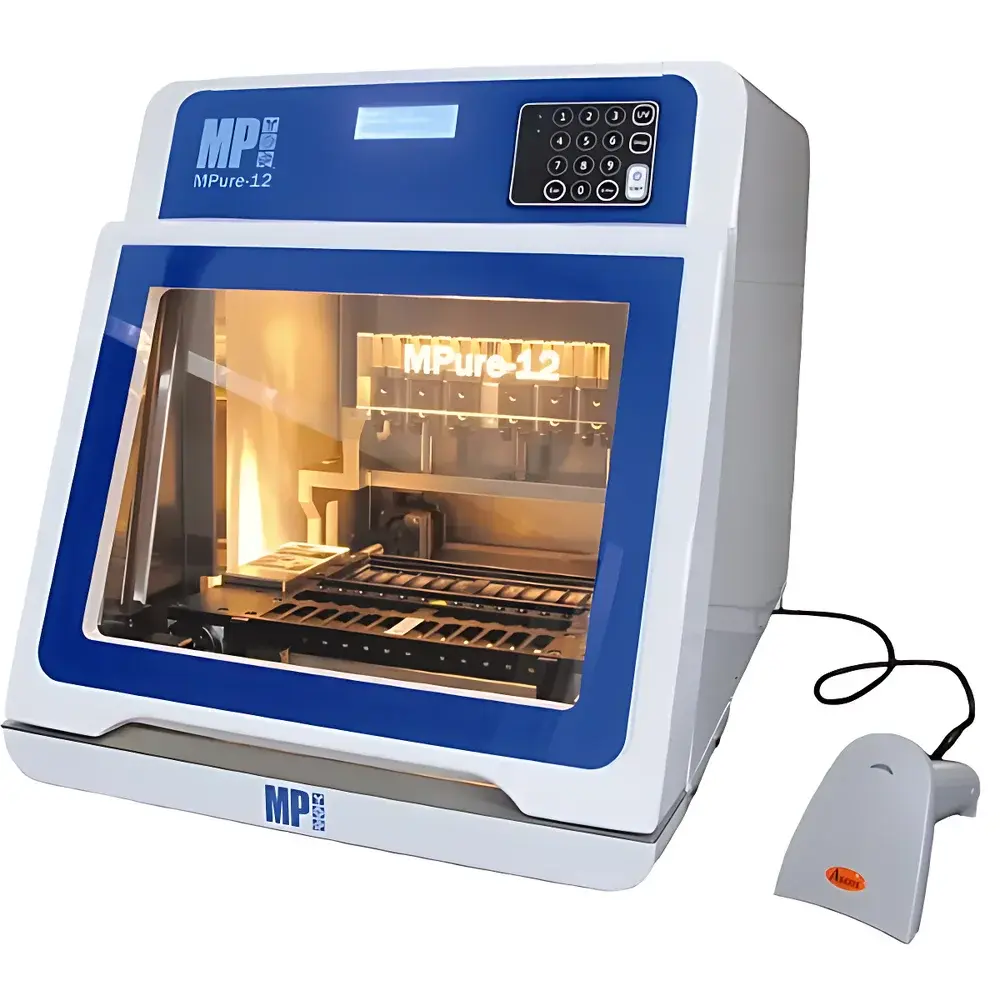
MP Instruments MPure-12 Automated Magnetic Bead-Based Nucleic Acid Purification System
| Brand | MP |
|---|---|
| Origin | USA |
| Manufacturer Type | Authorized Distributor |
| Origin Category | Imported |
| Model | MPure-12 |
| Instrument Type | Magnetic Bead-Based Purification |
| Automation Level | Dedicated Fully Automatic |
| Throughput per Run | 12 samples |
| Sample Volume Range | 50–1000 µL |
| Processing Time per Batch | 35–70 minutes |
Overview
The MP Instruments MPure-12 Automated Magnetic Bead-Based Nucleic Acid Purification System is a benchtop, stand-alone platform engineered for precision, reproducibility, and operational safety in molecular biology laboratories. It employs a validated magnetic bead separation principle—where nucleic acids selectively bind to functionalized paramagnetic particles under controlled chaotropic and pH conditions—followed by sequential washing and elution steps within a fully enclosed, single-use consumable architecture. Unlike open-platform liquid handlers or vacuum-based systems, the MPure-12 integrates sample lysis, binding, washing, and elution into a closed-loop workflow, minimizing manual intervention and eliminating aerosol-mediated cross-contamination risks. Designed for routine use in clinical diagnostics, translational research, and biobanking environments, the system complies with core requirements for Good Laboratory Practice (GLP) workflows and supports traceability-ready operation when paired with MP’s barcoded assay kits.
Key Features
- Enclosed, single-use consumable architecture: Each run utilizes a pre-assembled, membrane-sealed reagent cartridge and individual reaction chambers—eliminating carryover between samples and reducing hands-on time.
- Patented polygonal reaction chamber design: Optimized geometry enhances bead dispersion, improves lysis efficiency, and maximizes nucleic acid recovery while minimizing shear-induced fragmentation.
- Unidirectional robotic liquid handling: A single-arm pipetting system moves exclusively in one plane, physically isolating reagent reservoirs from sample positions and increasing inter-sample distance to mitigate splash or droplet transfer.
- Integrated UV-C decontamination module: Automatically activated before and after each run; irradiates internal surfaces including the reagent tray zone and sample deck to inactivate residual nucleic acids and microbial contaminants.
- Barcode-driven protocol selection: Pre-configured assays are loaded via integrated scanner—enabling rapid method assignment without software configuration or PC dependency.
- Modular, O-ring–free piston design: Reduces maintenance frequency and eliminates seal degradation as a source of variability; service intervals are extended beyond 18 months under standard usage.
- USB-based firmware and protocol updates: Enables secure, offline deployment of new extraction protocols or regulatory-compliant audit log enhancements.
Sample Compatibility & Compliance
The MPure-12 accommodates diverse input matrices—including whole blood (EDTA/K₂EDTA), saliva, buccal swabs, cultured cells, plasma, serum, and tissue homogenates—using 15 validated, CE-IVD–marked MPure-12 assay kits. All kits include pre-aliquoted, lyophilized or stabilized reagents in sealed cartridges, ensuring lot-to-lot consistency and eliminating manual reagent preparation errors. The system meets ISO 13485 design control principles for in vitro diagnostic instrumentation and supports compliance with CLIA, CAP, and EU IVDR Annex I essential requirements. While not FDA 510(k)-cleared as a standalone device, its output nucleic acids meet purity criteria specified in ISO/IEC 17025–accredited QC testing (A260/A280 ≥ 1.8; A260/A230 ≥ 2.0) and are routinely accepted for downstream applications including qPCR, NGS library prep, and Sanger sequencing.
Software & Data Management
The MPure-12 operates independently of external computers—no OS, drivers, or network connection required. All protocols reside onboard in non-volatile memory and are selected via barcode scan. Audit trails—including run timestamps, operator ID (via optional RFID badge integration), protocol version, sample count, and volume parameters—are stored internally for ≥1,000 runs and exportable via USB in CSV format. The system does not implement FDA 21 CFR Part 11 electronic signature functionality natively but provides timestamped, immutable logs suitable for GLP/GMP documentation when combined with laboratory-controlled SOPs and manual sign-off procedures.
Applications
- High-fidelity genomic DNA isolation from low-input clinical specimens (e.g., 200 µL whole blood yielding >5 µg gDNA with integrity >40 kb confirmed by pulsed-field or TAE gel electrophoresis).
- Consistent RNA extraction for RT-qPCR with CVs <5% across 20 replicates using β-globin amplification.
- Viral nucleic acid recovery from complex matrices—detection limit of 5 IU/mL for Parvovirus B19 in EDTA blood, demonstrating linearity over 5-log dynamic range.
- Scalable processing across variable white blood cell counts (1.8–22 × 10³/µL) with linear yield correlation (R² > 0.99) across 100–400 µL input volumes.
- Biobank-standardized nucleic acid archiving where batch-to-batch reproducibility and contamination control are critical for longitudinal cohort studies.
FAQ
Does the MPure-12 require a connected computer to operate?
No—the instrument is fully self-contained with embedded firmware and touch-screen interface; only barcode scanning and USB updates require external peripherals.
Can I process fewer than 12 samples in a single run?
Yes—each cartridge supports 1–12 independent channels; unused positions remain sealed and inert, preventing reagent waste or cross-talk.
Are MPure-12 reagent cartridges compatible with other extraction platforms?
No—they are mechanically and chemically optimized exclusively for the MPure-12’s fluidic path, magnet array geometry, and thermal profile.
What validation data is available for regulatory submissions?
MP provides kit-specific analytical performance summaries (precision, accuracy, LOD/LOQ, robustness) aligned with CLSI EP05-A3 and EP17-A2 guidelines; full validation packages available under NDA/NDA-support agreement.
Is routine calibration required?
No scheduled calibration is mandated; however, volumetric verification using gravimetric assessment of dispensed water is recommended quarterly per ISO/IEC 17025 internal quality control protocols.
Related Products