
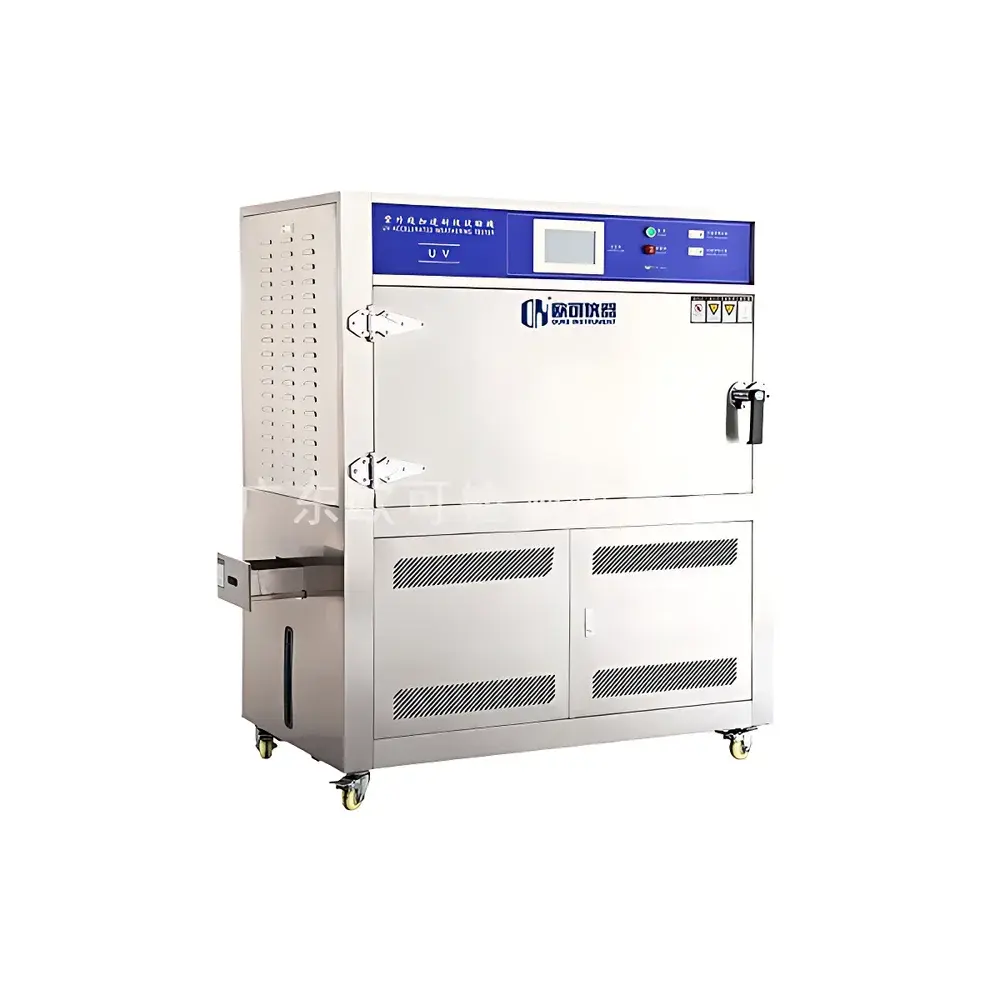
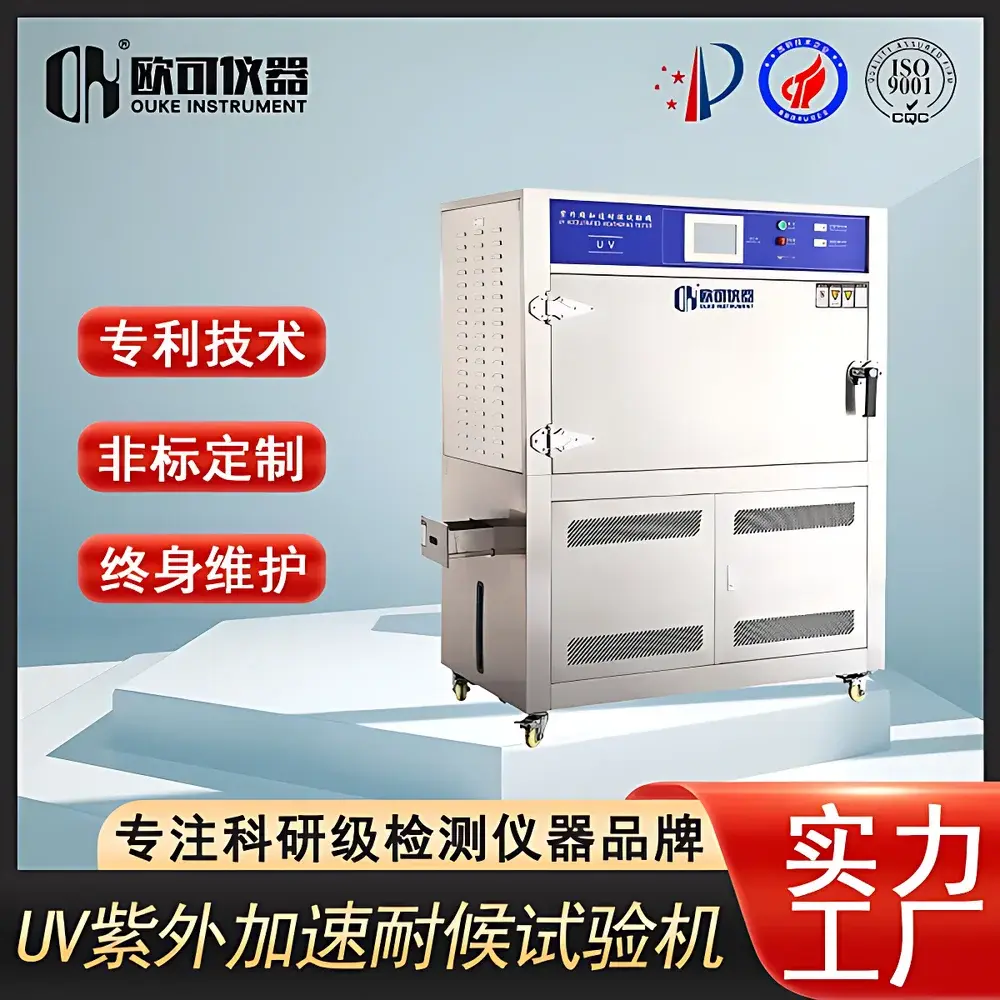
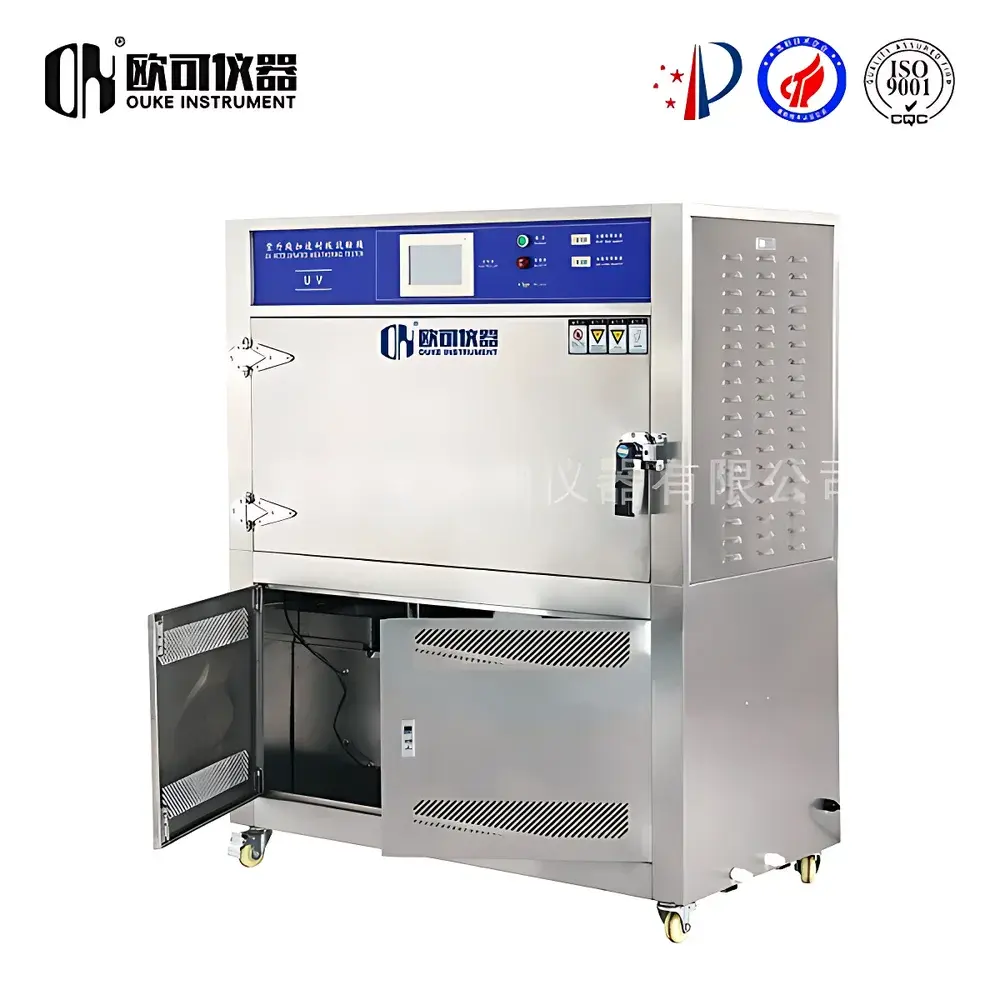
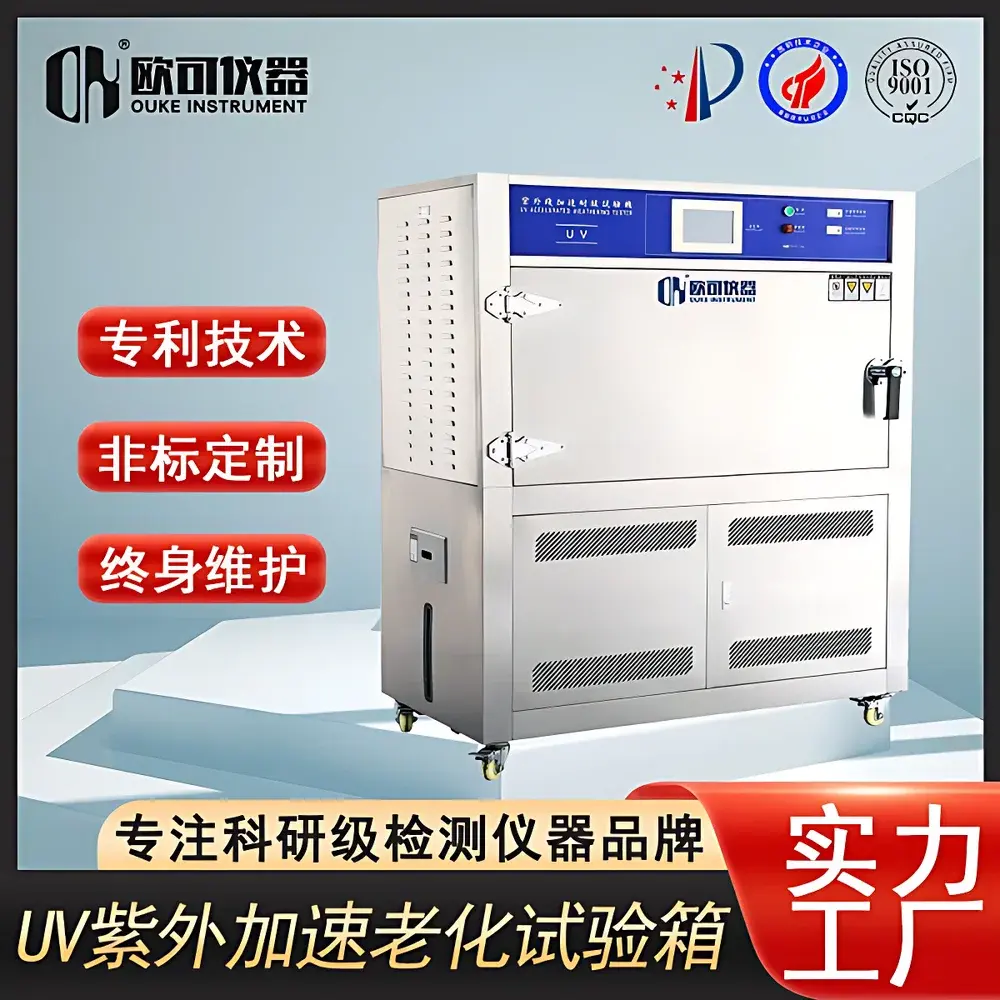
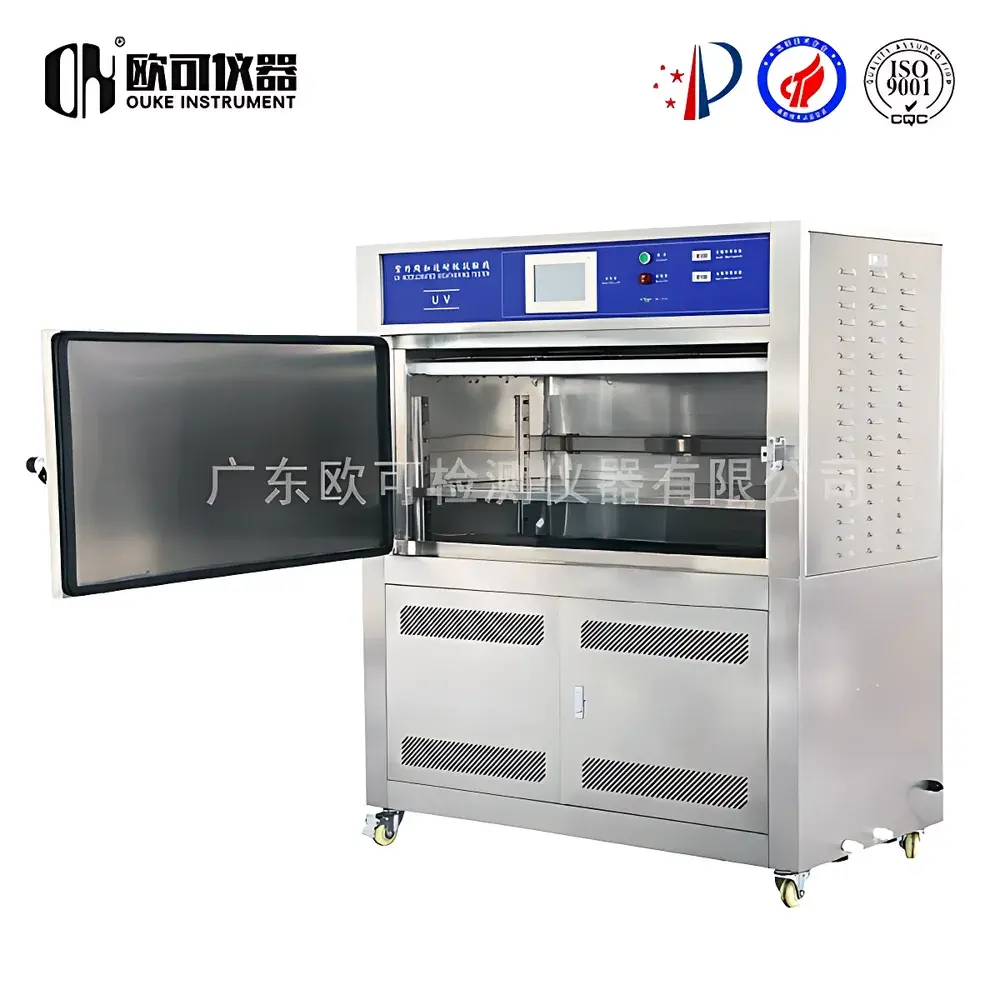
OK Instruments OK-UV-290 UV Aging Test Chamber
| Brand | OK Instruments |
|---|---|
| Origin | Guangdong, China |
| Manufacturer Type | Direct Manufacturer |
| Model | OK-UV-290 |
| Price | USD 3,100 (FOB Guangdong) |
| Humidity Range | ≥95% RH (in-chamber actual value) |
| UV Lamp Power | 40 W per lamp |
| Irradiance Range | 0.72 W/m² (at specimen plane) |
| Exposure Duration | 1–9999 h, programmable |
| Irradiation Temperature Setpoint | 75 °C |
| UV Wavelength Peak | 300 nm |
| Internal Chamber Dimensions (L×W×H) | 1170 × 400 × 400 mm |
| Temperature Range | Ambient to 75 °C |
| Temp. Control Accuracy | ≤ ±0.5 °C |
| Temp. Uniformity | ≤ ±2 °C or ≤ ±3% of setpoint |
| UV Spectrum | 280–400 nm (UVA/UVB) |
| Lamp Lifetime | ~2000 h (typical) |
| Construction | Interior & exterior SUS304 stainless steel |
| Heating System | U-shaped titanium alloy high-speed heating elements |
| Safety Protections | Interlocked door cut-off for UV lamps, over-temperature protection, low-water-level cutoff |
| Power Supply | AC 220 V ±5%, 50 Hz |
Overview
The OK Instruments OK-UV-290 UV Aging Test Chamber is an engineered environmental simulation system designed to accelerate photochemical degradation of polymeric, coating, automotive, and architectural materials under controlled ultraviolet irradiation, thermal stress, and condensation cycles. It operates on the principle of fluorescent UV lamp-based exposure—mimicking critical short-wavelength solar radiation (280–400 nm), particularly UVA (315–400 nm) and UVB (280–315 nm)—while maintaining precise temperature and humidity profiles to replicate real-world outdoor weathering mechanisms. Unlike xenon arc or carbon arc testers, this chamber prioritizes repeatability and spectral stability for standardized UV-driven failure mode analysis, including polymer chain scission, chromophore bleaching, surface microcracking, chalking, gloss loss, and oxidative embrittlement. Its architecture conforms to the physical test boundary conditions defined in ASTM G154 (Standard Practice for Operating Fluorescent Ultraviolet (UV) Lamp Apparatus for Exposure of Non-Metallic Materials), ISO 4892-3 (Plastics — Methods of exposure to laboratory light sources — Part 3: Fluorescent UV lamps), and SAE J2020 (Surface Vehicle Recommended Practice for Accelerated Exposure of Automotive Exterior Materials Using Fluorescent UV and Condensation).
Key Features
- Fluorescent UV lamp array with nominal peak emission at 300 nm and full spectral output spanning 280–400 nm—optimized for UVB/UVA balance per ASTM D4587 and ISO 4892-3 Class 1A requirements
- Precisely regulated black-panel temperature control up to 75 °C with ≤ ±0.5 °C accuracy and ≤ ±2 °C uniformity across the specimen plane
- High-humidity condensation cycle capability: sustained ≥95% RH within the working chamber during dark/cool-down phases to simulate dew formation and moisture ingress
- Programmable exposure duration from 1 to 9999 hours, supporting multi-step test protocols (e.g., 4-h UV / 4-h condensation cycles)
- Robust SUS304 stainless steel construction—interior and exterior—resistant to UV-induced corrosion and condensate erosion
- U-shaped titanium alloy heating system enabling rapid thermal stabilization and minimal overshoot during temperature transitions
- Interlocked safety circuitry: automatic UV lamp deactivation upon door opening, plus independent over-temperature and low-water-level cutoffs
- Front-access lamp replacement design with calibrated lamp holders ensuring consistent irradiance geometry and minimizing operator exposure risk
Sample Compatibility & Compliance
The OK-UV-290 accommodates flat or low-profile specimens up to 114 cm wide × 40 cm deep × 40 cm high (internal usable volume: 187 L), suitable for coated panels, plastic sheets, sealants, adhesives, textiles, and automotive trim components. Specimen mounting fixtures are compatible with standard ASTM G154 rack configurations. The system supports full traceability for GLP-compliant testing environments when integrated with external data loggers and audit-ready calibration records. It meets essential regulatory prerequisites for material qualification in automotive OEM supply chains (e.g., Ford WERCS, GMW14872), building product certification (ASTM D4329 for PVC siding), and medical device packaging validation (ISO 11607 Annex A). While not inherently 21 CFR Part 11 compliant, its analog control interface may be retrofitted with digital controllers offering electronic signatures, audit trails, and user access levels.
Software & Data Management
The OK-UV-290 utilizes a microprocessor-based digital controller with LED display and membrane keypad for manual parameter entry. It records real-time chamber temperature and elapsed exposure time, with non-volatile memory retaining settings through power interruption. For advanced data integrity, optional RS485 Modbus RTU or Ethernet interfaces enable integration into centralized lab management systems (LIMS) or SCADA platforms. When paired with third-party software (e.g., LabVIEW or custom Python scripts), users can generate automated reports aligned with ISO/IEC 17025 documentation standards—including calibration certificate references, operator ID stamps, and timestamped event logs for UV-on/off transitions, temperature excursions, and fault triggers.
Applications
This chamber serves as a primary tool for comparative durability screening across industries: evaluating UV stabilizer efficacy in polyolefins and ABS resins; validating weather resistance of waterborne architectural coatings per ASTM D4799; assessing colorfastness and gloss retention in automotive clearcoats (SAE J2020); qualifying UV-curable ink adhesion on flexible packaging substrates; and verifying long-term integrity of photovoltaic module encapsulants under damp-heat + UV stress. It is routinely deployed in QC laboratories for incoming raw material verification, R&D labs for formulation optimization, and contract testing facilities supporting ISO 17025-accredited reports.
FAQ
What UV lamp types are supported?
The OK-UV-290 is configured for standard UVA-340 or UVB-313 fluorescent tubes (40 W each), compliant with ASTM G154 spectral requirements. Custom lamp configurations (e.g., UVA-351) are available upon request.
Is irradiance monitoring included?
No built-in radiometer is standard; however, the chamber features a calibrated irradiance port (per ISO 4892-3 Annex B) for periodic verification using NIST-traceable handheld UV meters.
Can the unit operate continuously for extended durations?
Yes—designed for unattended 24/7 operation with redundant thermal fusing and self-diagnostic startup checks.
What maintenance intervals are recommended?
UV lamps require replacement every ~2000 operational hours; chamber gaskets and water reservoir filters should be inspected quarterly; stainless steel interior surfaces require weekly wipe-down with deionized water to prevent mineral residue buildup.
Does the system support multi-stage cycling (e.g., UV + condensation + dark)?
Yes—the controller supports up to three programmable phases per cycle, enabling fully automated UV irradiation, condensation, and dark recovery sequences.



