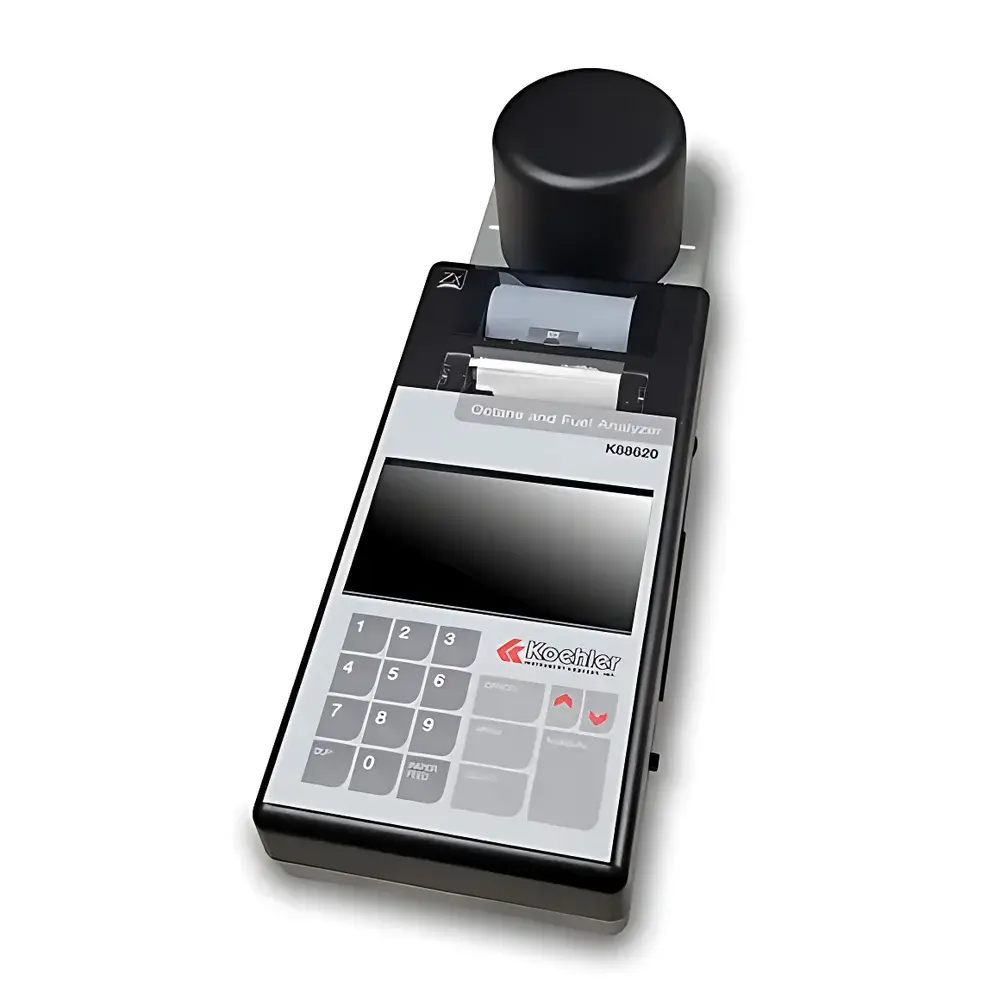
Koehler K88629 Portable Octane Number and Cetane Number Analyzer
| Brand | Koehler |
|---|---|
| Origin | USA |
| Manufacturer Status | Authorized Distributor |
| Product Origin | Imported |
| Model | K88629 |
| Measurement Parameters | Gasoline Octane Number, Diesel Cetane Number |
| Portability | Portable |
| Detection Principle | Near-Infrared (NIR) Transmission Spectroscopy |
| Measurement Range | Octane Number: 40–120 |
| Cetane Number | 20–100 |
| Accuracy | ±0.5 ON |
| Measurement Time | <20 s |
| Sample Volume | 225 mL |
| Repeatability | Equivalent to ASTM D2699 and D2700 |
Overview
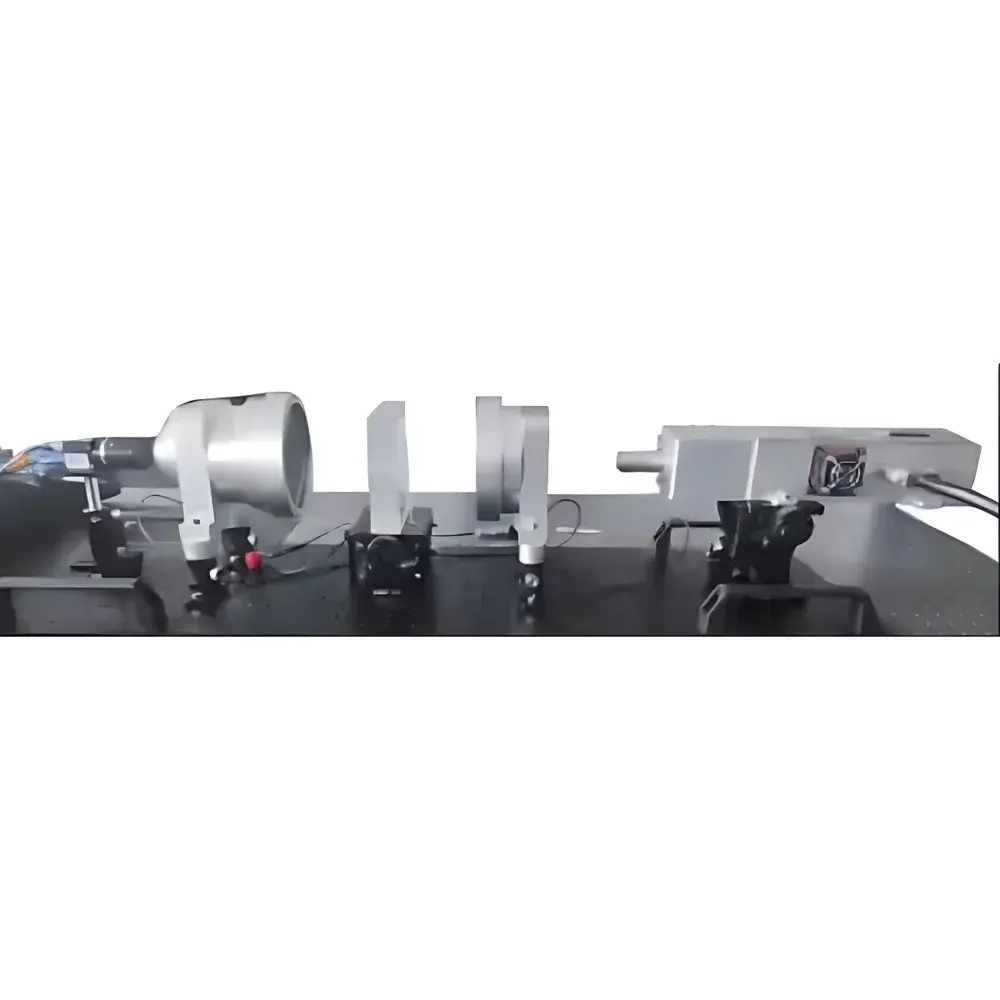
The Koehler K88629 Portable Octane Number and Cetane Number Analyzer is a field-deployable, microprocessor-controlled spectrophotometric instrument engineered for rapid, reliable determination of gasoline octane number (ON) and diesel cetane number (CN) using near-infrared (NIR) transmission spectroscopy. Unlike traditional engine-based methods requiring large-scale laboratory infrastructure, the K88629 implements a robust optical architecture comprising 14 narrow-band NIR light-emitting diodes (LEDs) and a silicon photodetector array, enabling quantitative analysis based on characteristic hydrocarbon absorption signatures in the 1100–2500 nm range. The analyzer operates on the principle that fuel composition—particularly branching, aromaticity, and paraffinic content—directly modulates NIR absorbance profiles, which are correlated to reference values established via primary ASTM standard test methods. Its design fulfills traceability requirements by anchoring calibration models to CFR engine-derived reference data per ASTM D2699 (RON), D2700 (MON), and D613 (CN), ensuring metrological consistency across field and lab environments.
Key Features
- Field-portable architecture: Compact footprint (29 × 22 × 15 cm), lightweight (<3.5 kg), and dual-power capable—operates on six AA alkaline batteries or AC adapter (220–240 V, 50/60 Hz)
- ASTM-equivalent performance: Repeatability and accuracy validated against CFR engine benchmarks per ASTM D2699, D2700, and D613
- Multi-fuel capability: Factory-calibrated for unleaded gasoline and ethanol-blended fuels (E10, E15, E85); supports user-defined calibration for up to eight additional fuel types
- Integrated quality assurance: Real-time temperature monitoring with audible/visual alerts outside operational range (7–38 °C); automatic background normalization prior to each measurement; lid-open detection to prevent stray-light interference
- Onboard data handling: High-contrast LCD display, built-in thermal printer (date/time-stamped ON/CN reports), and RS-232 serial interface for secure data export to LIMS or QA databases
- Optical cell design: Sealed cubic quartz cuvette with 75 mm pathlength, optimized for 225 mL sample volume and minimal evaporation during analysis
Sample Compatibility & Compliance
The K88629 accepts liquid hydrocarbon samples meeting ASTM D4057 (standard practice for manual sampling of petroleum products) and D4177 (automatic pipeline sampling). It is compatible with conventional gasoline, reformulated gasoline, oxygenated blends (MTBE, ethanol), and middle-distillate diesel fuels—including ultra-low-sulfur diesel (ULSD) and biodiesel blends (B5–B20). All calibrations are developed and verified under GLP-compliant protocols. Instrument output satisfies documentation requirements for ISO/IEC 17025-accredited testing laboratories and supports audit readiness for FDA 21 CFR Part 11 when paired with validated data management software. Regulatory alignment includes ASTM D2699 (Research Octane Number), D2700 (Motor Octane Number), D613 (Cetane Number), and D975 (diesel fuel specifications).
Software & Data Management
The analyzer ships with Koehler Calibration Manager software for Windows-based calibration model development, validation, and version control. Raw spectral data, measurement metadata (timestamp, ambient temperature, operator ID), and result logs are stored internally and exportable via RS-232 to CSV or proprietary .kcal formats. Audit trails include calibration history, firmware revision logs, and user-access records. When integrated into enterprise QA systems, the K88629 supports electronic signature capture and role-based access control—enabling compliance with GMP Annex 11 and 21 CFR Part 11 for regulated fuel testing workflows.
Applications
- Refinery off-gas and finished product release testing at loading racks or tank farms
- Field verification of fuel quality during transportation or retail distribution
- On-site troubleshooting of blending anomalies or contamination events
- Contractor and third-party inspection services requiring portable, CFR-traceable ON/CN data
- Academic and government research programs evaluating alternative fuel formulations
- Emergency response scenarios where rapid fuel characterization informs combustion safety assessments
FAQ
Does the K88629 require periodic recalibration against primary standards?
Yes—annual recalibration using NIST-traceable reference fuels is recommended, and full validation per ASTM D6299 should be performed after any firmware update or optical component replacement.
Can the instrument measure both RON and MON simultaneously?
Yes—it directly computes and displays (R+M)/2, RON, and MON from a single NIR scan using embedded chemometric models trained on CFR engine datasets.
Is GPS integration optional or mandatory?
GPS functionality is optional and enabled only when the Koehler GPS accessory module is connected; geotagged results enhance chain-of-custody documentation for regulatory submissions.
What happens if the sample temperature falls outside 7–38 °C?
The analyzer halts measurement execution and displays “TEMP OUT OF RANGE” with audible alert—preventing non-compliant data generation per ASTM environmental stipulations.
How is measurement traceability maintained without an onboard reference standard?
Traceability is achieved through factory-applied calibration models anchored to CFR engine test data certified by Koehler’s ISO/IEC 17025-accredited reference laboratory, with full uncertainty budgets documented in the Certificate of Conformance.