
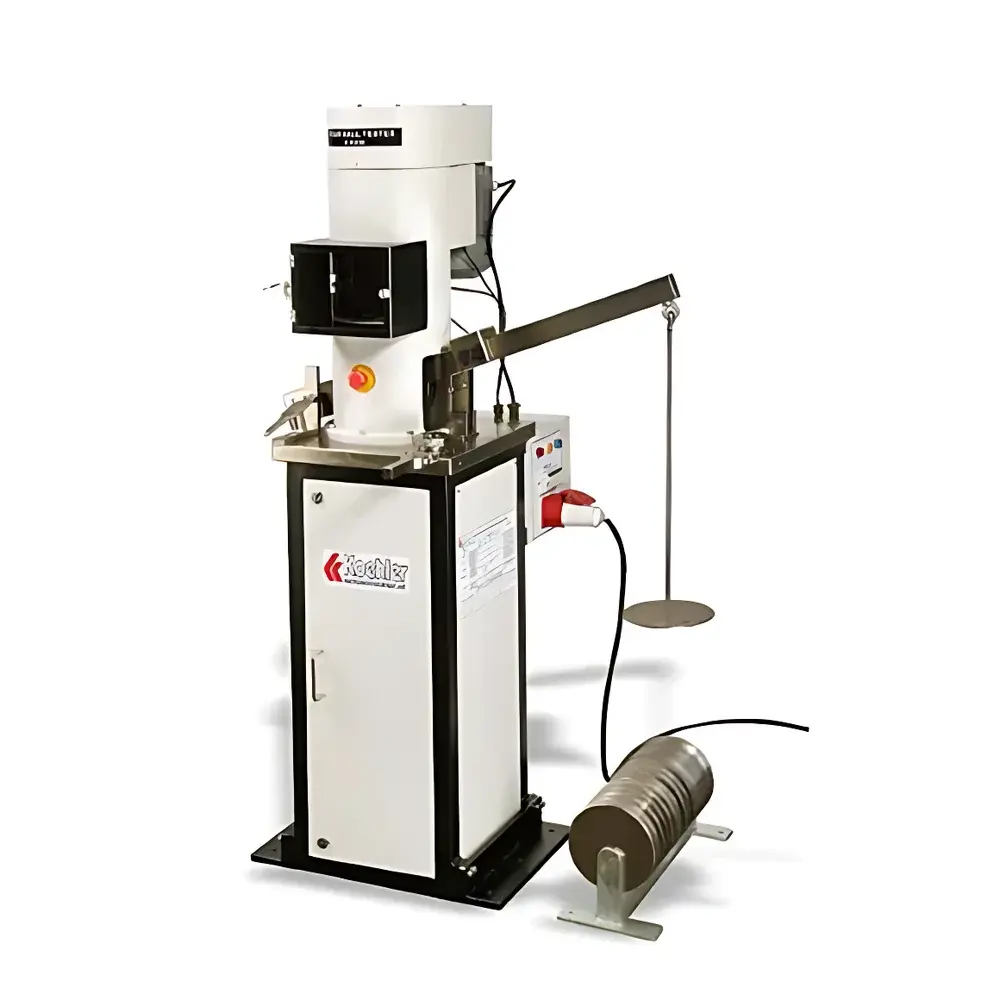
Koehler K93100 Four-Ball Wear and Extreme Pressure Tester
| Brand | Koehler |
|---|---|
| Origin | USA |
| Model | K93100 |
| Power Supply | 220 V / 60 Hz (3-phase) or 440 V / 50 Hz (3-phase) |
| Motor | 1.5 kW |
| Test Speeds | 1200, 1440, 1760 rpm (optional: 1000/3000 or 300/3000 rpm) |
| Test Duration Range | 1–9999 min |
| Ball Diameter | 12.7 mm |
| Transport Weight | 620 kg |
| Transport Volume | 1.27 m³ |
| Compliant Standards | ASTM D2266, D2596, D2783, D4172, D5183 |
| Includes | TriboDATA software, calibrated weights, ball holder assembly, ball cup, ball extractor, ball rack, ball clamp, base plate, hand tools, wrenches, electrical controller, interconnect cables, calibration & test report |
Overview
The Koehler K93100 Four-Ball Wear and Extreme Pressure Tester is a precision-engineered tribological instrument designed for standardized evaluation of lubricant performance under controlled sliding contact conditions. Based on the classical four-ball configuration—three stationary steel balls held in a triangular cup and one rotating upper ball—the system applies axial load to generate conformal point contact, enabling quantitative assessment of both anti-wear (AW) and extreme pressure (EP) properties of oils and greases. The instrument operates in strict accordance with internationally recognized test methods, including ASTM D2266 (wear scar measurement), ASTM D2596 (load wear index), ASTM D2783 (EP performance), ASTM D4172 (four-ball wear test for lubricating oils), ASTM D5183 (high-temperature EP testing), and IP 239. Load application, rotational speed, and bath temperature are independently regulated via closed-loop electronic control systems, ensuring high reproducibility across repeated tests and inter-laboratory comparisons.
Key Features
- Simultaneous capability for both anti-wear (WP) and extreme pressure (EP) testing within a single platform, eliminating need for separate instrumentation
- High-accuracy load measurement via calibrated load cell, supporting variable normal loads up to 10,000 N (configurable per method requirements)
- Real-time acquisition and logging of critical parameters: applied load, friction torque, elapsed time, and bath temperature
- Digitally controlled motor drive delivering precise, stable rotational speeds—including standard 1200, 1440, and 1760 rpm, plus optional dual-range configurations (e.g., 300/3000 rpm)
- Integrated TriboDATA software for automated data acquisition, real-time visualization, statistical analysis, and export-compatible reporting (CSV, PDF, XML)
- Rugged cast-iron frame with vibration-damped base and thermal-stable oil bath assembly for long-duration, high-temperature testing
- Modular design supports seamless integration of optional accessories—including the Koehler-recommended Dinolite-based four-ball microscope system
Sample Compatibility & Compliance
The K93100 accommodates standard 12.7 mm (½-inch) AISI E52100 steel balls conforming to ASTM E29 specifications. It accepts both liquid lubricants and NLGI-grade greases without modification, with optional grease cup inserts available for enhanced containment during high-temperature EP trials. All mechanical and electronic subsystems meet CE marking requirements and comply with IEC 61000 electromagnetic compatibility standards. The system architecture supports audit-ready operation under GLP and GMP environments: TriboDATA software includes user access control, electronic signatures, and full audit trail functionality compliant with FDA 21 CFR Part 11. Calibration certificates traceable to NIST standards are provided with each unit, and routine verification protocols align with ISO/IEC 17025 laboratory accreditation criteria.
Software & Data Management
TriboDATA is a Windows-based, modular data acquisition and analysis suite specifically developed for tribological test instruments. It acquires synchronized analog and digital signals from load cells, torque transducers, thermocouples, and encoder feedback at configurable sampling rates (up to 100 Hz). The interface enables live plotting of torque vs. time, load vs. time, and temperature profiles, with overlay comparison of multiple test runs. Post-test analysis includes automatic wear scar diameter detection (when paired with Dinolite microscope), calculation of load wear index (LWI), weld point determination, and statistical summary (mean, SD, CV%) per ASTM D2596 Annex A1. Reports are exportable in industry-standard formats and support metadata tagging for LIMS integration. Software updates and validation documentation are maintained under Koehler’s formal software lifecycle management program.
Applications
- Formulation development and quality control of engine oils, gear oils, hydraulic fluids, and industrial greases
- Evaluation of additive packages—especially ZDDP, MoDTC, and borate esters—for wear inhibition and film strength enhancement
- Screening of bio-based and synthetic base stocks for tribological stability under boundary lubrication regimes
- Supporting OEM qualification testing per SAE J2360, GMW16038, or Ford WSS-M2C945-A specifications
- Academic and government research in contact mechanics, tribofilm formation kinetics, and surface degradation mechanisms
- Third-party certification testing for API, ACEA, and JASO licensing programs
FAQ
What standards does the K93100 support out-of-the-box?
The system is factory-configured and validated for ASTM D2266, D2596, D2783, D4172, D5183, and IP 239. Custom method scripting is supported via TriboDATA’s open protocol interface.
Is the instrument suitable for testing greases at elevated temperatures?
Yes—the oil bath is rated for continuous operation up to 150 °C, and optional heated grease cups extend functional range to 200 °C with active temperature control and thermal shielding.
Can wear scar measurements be performed without removing balls from the cup?
When equipped with the Dinolite four-ball microscope option, non-invasive, in-situ imaging is enabled via angled optical path and dedicated mounting bracket, minimizing handling error and contamination risk.
How is calibration maintained over time?
The system includes annual recalibration kits and NIST-traceable reference weights. Load cell and torque sensor calibrations follow ISO 376 procedures, with documented uncertainty budgets provided in the initial calibration report.
Does the K93100 support remote monitoring or networked operation?
TriboDATA supports TCP/IP communication and OPC UA server mode, allowing integration into centralized lab automation networks and secure remote supervision via authenticated client connections.






