
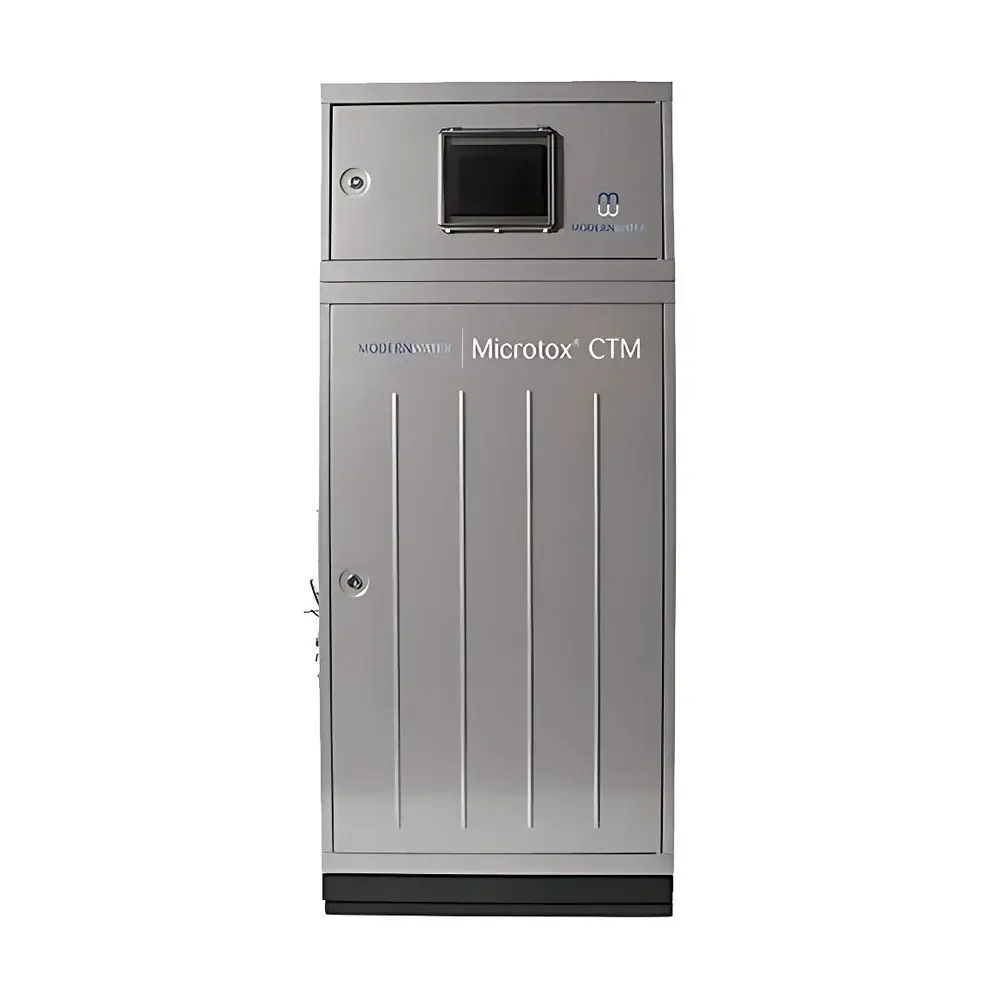
Modern Water Microtox® CTM Continuous Toxicity Monitor
| Brand | Modern Water |
|---|---|
| Origin | United Kingdom |
| Model | Microtox® CTM |
| Instrument Type | Online Continuous Monitoring System |
| Biological Sensor | Aliivibrio fischeri (formerly Vibrio fischeri) |
| Operating Temperature | 5–30 °C |
| Photonic Detection Range | 1–120,000,000 photon counts per assay |
| Assay Duration | 5 minutes |
| Sample Flow Rate | 100–200 mL/min |
| Power Supply | 100–240 V AC, 50–60 Hz, 480 W |
| Display | 180 mm color touchscreen |
| Data Interfaces | Ethernet, USB, 4–20 mA output, relay alarm, optional GPRS/Wi-Fi |
| Certifications | CE, RoHS, WEEE |
| Enclosure Material | Anodized aluminum |
| Dimensions (Main Unit) | 1250 × 750 × 365 mm (H×W×D) |
| Weight | ~70 kg |
| Maintenance Interval | Monthly (~2 hours) |
| Reagent Format | Lyophilized, vacuum-sealed vials |
Overview
The Modern Water Microtox® CTM Continuous Toxicity Monitor is an engineered online biosensor system designed for real-time, unattended assessment of acute aquatic toxicity in source water, drinking water distribution networks, wastewater effluents, and natural surface waters. It employs the bioluminescent marine bacterium Aliivibrio fischeri as a standardized biological endpoint—leveraging its well-documented, quantifiable reduction in light emission upon exposure to toxicants. This principle, grounded in ISO 11348-3 and ASTM D5660-19 protocols, enables detection of broad-spectrum chemical stressors—including heavy metals (e.g., Cu²⁺, Zn²⁺), organophosphates, chlorinated hydrocarbons, phenols, and industrial surfactants—without requiring compound-specific calibration. Unlike discrete laboratory assays or physicochemical methods (e.g., ICP-MS or GC-MS), the CTM delivers integrated biological response data within 5 minutes, reflecting synergistic, antagonistic, or additive effects across complex contaminant mixtures. Its deployment supports early warning functions under regulatory frameworks such as the EU Water Framework Directive (WFD), US EPA’s Drinking Water Protection Program, and WHO Guidelines for Safe Drinking-water, where rapid biological integrity assessment complements traditional compliance monitoring.
Key Features
- True continuous operation with user-defined self-test intervals (3–24 hours), ensuring data integrity without manual intervention
- 28-day autonomous monitoring cycle enabled by factory-lyophilized, vacuum-packaged A. fischeri reagents—reconstituted on-site and stable under controlled temperature (5–30 °C)
- Integrated diagnostics engine with automated error logging, sensor health verification, and fault isolation for remote troubleshooting
- Modular architecture supporting optional pre-filtration, auto-sampling during alarm events, and configurable alarm relays (dry contact) or analog 4–20 mA outputs
- Robust aluminum enclosure rated for indoor or sheltered outdoor installation (IP54 equivalent), compatible with wall-mount or freestanding configurations
- Compliance-ready data handling: timestamped photonic measurements stored locally and exportable via Ethernet/USB; audit trail functionality supports GLP-aligned operational records
Sample Compatibility & Compliance
The Microtox® CTM accepts raw or filtered aqueous samples at ambient pressure and temperatures between 5–35 °C. It accommodates turbid, colored, or low-conductivity matrices typical of rivers, reservoirs, groundwater, seawater, and treated wastewater—provided suspended solids are reduced below 10 NTU via optional inline filtration. The system meets CE marking requirements for electromagnetic compatibility (EN 61326-1) and safety (EN 61010-1), complies with RoHS 2011/65/EU and WEEE 2012/19/EU directives, and aligns with ISO/IEC 17025 principles for measurement traceability when operated with certified reference materials (e.g., ZnSO₄ standard at 5 mg/L). Its biological response correlates directly with EC₅₀ values established in peer-reviewed literature, enabling cross-study comparability under OECD Test No. 201 and ISO 11348 series standards.
Software & Data Management
The embedded firmware provides intuitive navigation via a 180 mm resistive touchscreen interface, displaying real-time luminescence decay curves, toxicity index trends (% inhibition vs. control), and system status dashboards. Data are logged at user-selectable intervals (minimum 1-minute resolution) and retained onboard for ≥30 days. Export formats include CSV and PDF reports compliant with internal QA/QC documentation workflows. Remote access is supported through secure HTTP/HTTPS protocols, enabling centralized monitoring across distributed sites. Optional integration with SCADA platforms or LIMS systems is achieved via Modbus TCP or custom API endpoints. All critical operations—including reagent initialization, calibration validation, and alarm threshold configuration—are digitally signed and time-stamped to satisfy FDA 21 CFR Part 11 requirements for electronic records and signatures in regulated environments.
Applications
- Early-warning surveillance for accidental or intentional contamination in municipal intake and distribution systems
- Compliance monitoring of wastewater treatment plant effluents prior to environmental discharge or reuse applications
- Ecological risk assessment of receiving waters impacted by agricultural runoff, industrial outfalls, or urban stormwater
- Validation of advanced oxidation or membrane-based treatment efficacy through dynamic biological response profiling
- Supporting incident response protocols during chemical spills, algal bloom events, or infrastructure failures where rapid triage is essential
FAQ
How does the Microtox® CTM differ from laboratory-based Microtox® analyzers?
The CTM is purpose-built for unattended, online operation with fully automated fluidics, temperature stabilization, and 28-day reagent longevity—whereas lab instruments require daily reagent preparation, manual sample loading, and operator supervision.
Can the system detect non-chemical stressors such as UV radiation or extreme pH?
No—the CTM is calibrated for dissolved chemical toxicity; significant deviations in pH (8.5) or UV exposure must be mitigated upstream to avoid nonspecific bacterial inhibition unrelated to target contaminants.
Is regulatory approval required to deploy the CTM for compliance reporting?
While not a standalone compliance instrument under most national frameworks, its data are accepted as supplementary evidence in early-warning programs and incident investigations when operated per ISO 11348-3 and documented in validated SOPs.
What maintenance tasks are performed monthly?
Typical activities include visual inspection of tubing integrity, cleaning of optical windows, verification of reagent lot expiry, and validation of control sample response against historical baselines—all documented via the onboard logbook.
Does the system support third-party data aggregation platforms?
Yes—through open Ethernet communication, it interfaces with industry-standard platforms including Ignition SCADA, Siemens Desigo, and cloud-based environmental intelligence suites via configurable RESTful endpoints or OPC UA gateways.







