
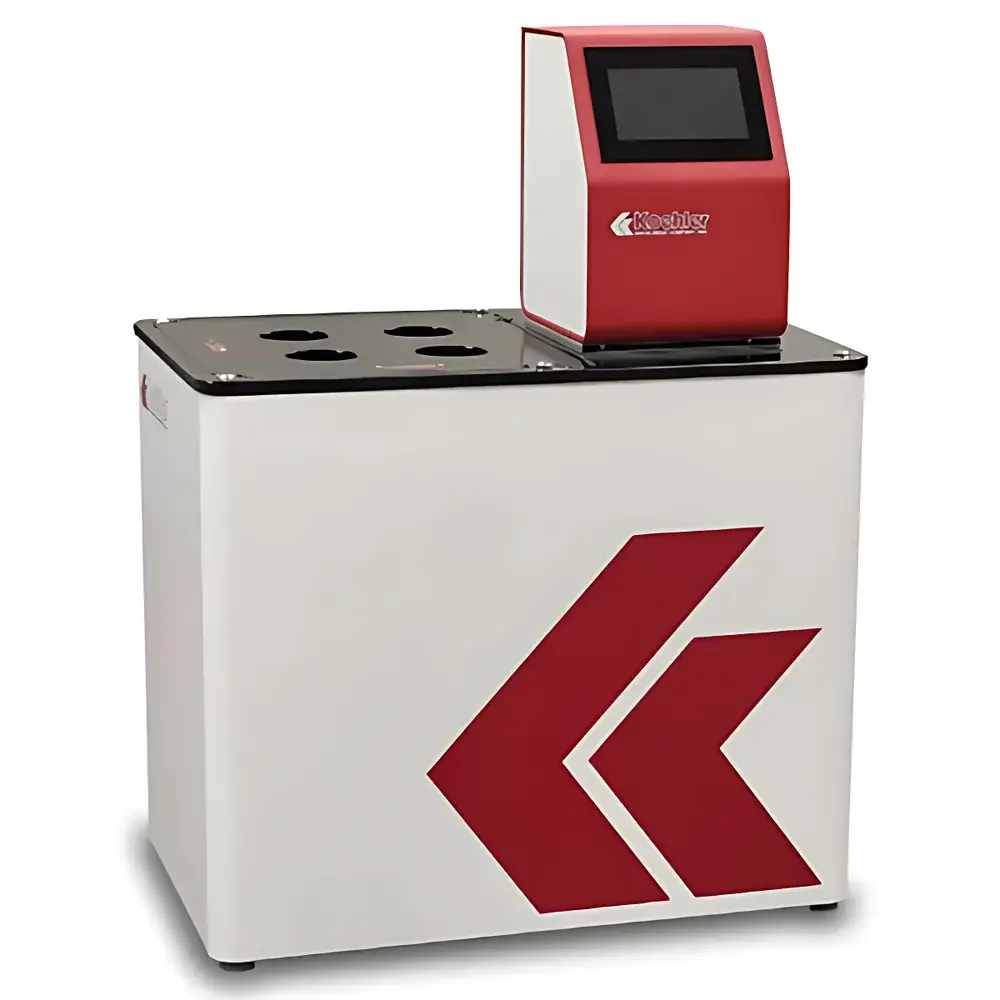
Koehler K64339 Copper Strip Corrosion Tester for Petroleum Products
| Brand | Koehler |
|---|---|
| Origin | USA |
| Manufacturer Status | Authorized Distributor |
| Product Origin | Imported |
| Model | K64339 |
| Pricing | Upon Request |
Overview
The Koehler K64339 Copper Strip Corrosion Tester is a precision-engineered instrument designed to evaluate the corrosivity of petroleum products toward copper, in strict accordance with globally recognized standard test methods—including ASTM D130, ASTM D4048, ISO 2160, IP 154, DIN 51759, FTM 791-5325, and NF M 07-015. It operates on the principle of controlled thermal exposure: a standardized, polished copper strip is immersed in a defined volume (30 mL) of sample under precisely regulated temperature and time conditions. After completion of the test period, the strip is cleaned and visually compared against the ASTM Copper Corrosion Standard Color Chart to assign a corrosion rating from Class 1 (no perceptible change) to Class 4 (severe darkening or pitting). This classification serves as a critical quality control metric for refining, blending, and certification workflows across aviation fuels, motor gasoline, naphthas, kerosene, diesel, distillate fuel oils, lubricants, and industrial solvents.
Key Features
- Two operational configurations: oxygen bomb mode (for aviation gasoline, jet turbine fuel, and natural gasoline per ASTM D130 Annex A) and open-tube bath mode (for diesel, fuel oil, automotive gasoline, Stoddard solvent, kerosene, and lubricating oils)
- Robust dual-wall stainless steel construction—insulated, corrosion-resistant, and engineered for long-term thermal stability
- High-precision temperature control system with ±0.05°C stability at 105°C (221°F), achieved via PID-regulated 1000 W heating and calibrated platinum resistance thermometer feedback
- Dual-bath capacity options: 4-bomb (K64310/K64319) or 8-bomb (K64320/K64329) configurations; optional convertible tube rack enables flexible reconfiguration to 4-position open-tube testing
- ASME-compliant stainless steel oxygen bombs rated for 100 psi (689 kPa) service pressure; equipped with O-ring sealed threaded lids and integrated 1/8″ vent grooves for controlled, safe pressure release
- Integrated overtemperature protection circuit that automatically de-energizes the heater upon exceeding user-defined safety threshold—ensuring personnel and equipment safety
- Welded stainless steel inner bath vessel and powder-coated carbon steel outer enclosure with built-in support structure for consistent positioning of test vessels
Sample Compatibility & Compliance
The K64339 accommodates a broad spectrum of hydrocarbon-based samples requiring copper strip corrosion assessment. Its dual-mode architecture ensures full compliance with method-specific requirements: oxygen bomb immersion for volatile, low-flash-point products (e.g., aviation fuels), and open-tube water bath immersion for less volatile distillates and lubricants. All mechanical and thermal performance parameters meet or exceed the dimensional, pressure, temperature, and timing tolerances specified in ASTM D130 and related standards. The instrument’s design supports GLP-aligned laboratory practices, including traceable calibration records, documented maintenance logs, and unambiguous operator procedures—all essential for regulatory submissions and third-party audit readiness.
Software & Data Management
The K64339 is a benchtop, manually operated instrument with no embedded microprocessor or digital interface. Temperature setpoint, dwell time, and bath level monitoring are performed via analog dials and visual indicators. While it does not include proprietary software, its operation integrates seamlessly into LIMS and electronic lab notebook (ELN) environments through standardized manual data entry protocols. Test documentation—including sample ID, operator initials, bath temperature verification logs, exposure duration, and final corrosion rating—can be structured to satisfy FDA 21 CFR Part 11 requirements when paired with validated electronic recordkeeping systems and appropriate signature controls.
Applications
- Quality assurance of aviation turbine fuel (Jet A, Jet A-1) and aviation gasoline (Avgas 100LL) prior to dispatch or storage
- Routine screening of refinery intermediate streams and finished gasoline blends for sulfur compound-induced copper corrosion
- Stability evaluation of biodiesel blends (B5–B20) and hydrotreated feedstocks during oxidation aging studies
- Regulatory compliance testing for marine distillate fuels (DMA, DMZ) and rail diesel (EN 590, ASTM D975)
- Research-grade investigation of additive interactions—e.g., how corrosion inhibitors or metal deactivators modulate copper surface reactivity under accelerated thermal stress
- Contract laboratory services supporting API, ASTM, and ISO certification programs for petroleum product manufacturers and distributors
FAQ
What standards does the K64339 fully support?
ASTM D130 (including Annex A for oxygen bomb testing), ASTM D4048, ISO 2160, IP 154, DIN 51759, FTM 791-5325, and NF M 07-015.
Can the instrument test both volatile and non-volatile petroleum products?
Yes—the K64339 supports dual-mode operation: oxygen bomb configuration for volatile fuels and open-tube bath configuration for diesel, lubricants, and solvents.
Is the oxygen bomb pressure-rated and safety-certified?
Each stainless steel oxygen bomb is designed and tested to withstand 100 psi (689 kPa) internal pressure and features a machined vent groove to ensure gradual, controlled depressurization.
What is the maximum operating temperature and thermal stability specification?
Maximum bath temperature is 105°C (221°F), with temperature control stability maintained within ±0.05°C under steady-state conditions.
Does the unit require computer connectivity or dedicated software?
No—the K64339 is an analog, operator-controlled instrument; all functions are managed manually using calibrated dials and visual indicators.
How is calibration and verification performed?
Temperature calibration is conducted using NIST-traceable reference thermometers; bath uniformity verification follows ASTM D130 Appendix X1 guidelines, with periodic checks at multiple depth locations using certified RTDs.





