
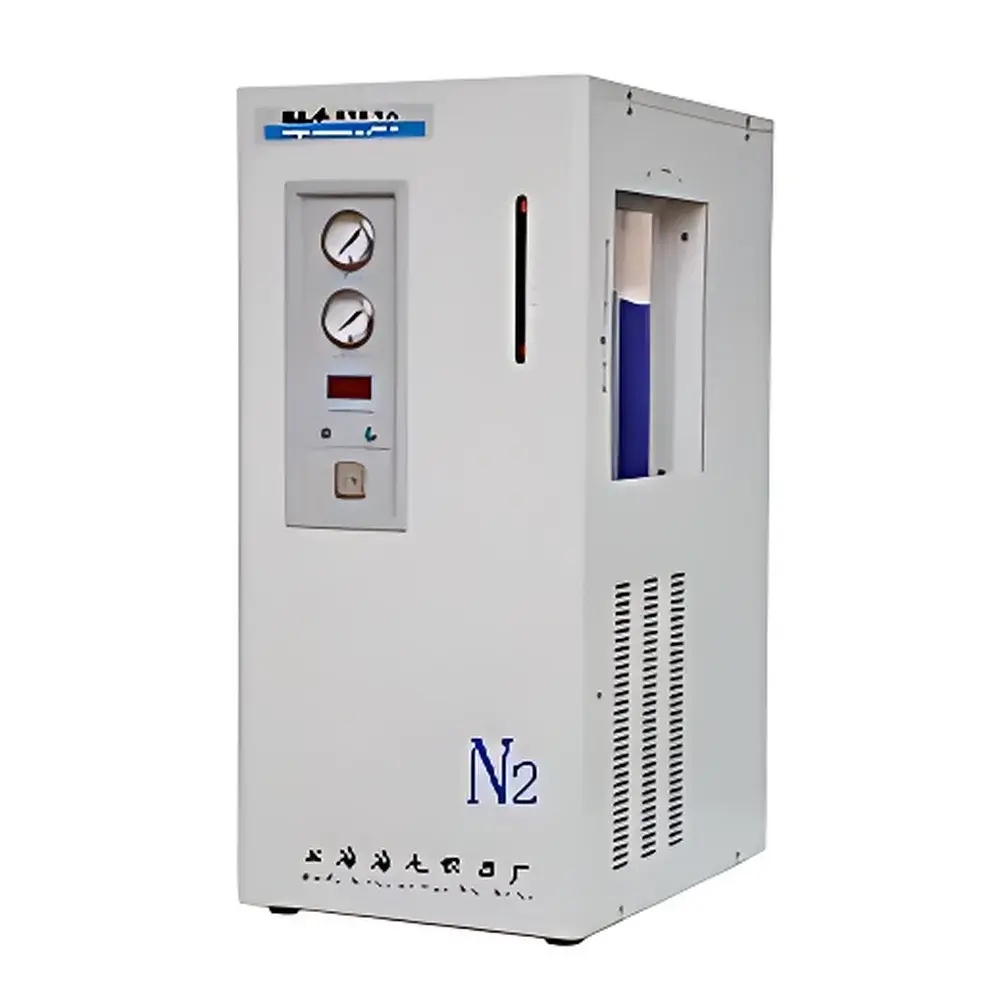
HLN-1L Nitrogen Generator by Henglong
| Origin | Shanghai, China |
|---|---|
| Manufacturer Type | Authorized Distributor |
| Country of Origin | PRC |
| Model | HLN-1L |
| Pricing | Available Upon Request |
| Purity | >99.999% N₂ |
| Flow Rate | 0–1 L/min |
| Output Pressure | 0–0.5 MPa (factory-set at 0.4 MPa) |
| Power Supply | 220 V ±10%, 50 Hz ±5% |
| Max. Power Consumption | 185 W |
| Operating Ambient | 10–40 °C, RH ≤85%, non-corrosive, low-dust environment |
| Warranty | 1-year system warranty |
Overview
The HLN-1L Nitrogen Generator is a compact, on-demand membrane-free nitrogen supply system engineered for continuous, high-purity gas generation in analytical laboratories and quality control environments. It employs a dual-cathode stainless steel electrolytic separation cell operating on the principle of water electrolysis—where deionized water is dissociated into hydrogen and oxygen gases, while nitrogen is selectively extracted from ambient air via pressure-swing adsorption (PSA) or, in this configuration, purified via electrochemical oxygen removal from compressed air feed. The instrument integrates an optimized electrolytic cell design with thermal management to sustain stable operation at low cell temperature, ensuring consistent purity and extended service life. Designed for integration with GC, LC-MS, FTIR, and other instrumentation requiring inert carrier or purge gas, the HLN-1L delivers laboratory-grade nitrogen without reliance on high-pressure cylinders or liquid nitrogen dewars—reducing logistical overhead, safety risk, and operational cost over time.
Key Features
- Dual-cathode stainless steel electrolytic separation cell with enhanced surface area and optimized flow dynamics, enabling simultaneous nitrogen generation and oxygen removal with improved thermal dissipation.
- Low-temperature cell operation (<45 °C under continuous load), minimizing electrolyte degradation and maximizing long-term stability of gas purity.
- Integrated anti-backflow protection mechanism—mechanically actuated check valve and hydrophobic barrier—to eliminate risk of electrolyte back migration into downstream instrumentation.
- Auto-shutoff solenoid valve activated upon power loss, preventing unregulated gas release and maintaining system integrity during unexpected outages.
- High-efficiency switching power supply (IEC 61000-3-2 compliant) delivering precise current regulation to the electrolytic stack, improving energy conversion efficiency and reducing harmonic distortion.
- Compact footprint (W × D × H ≈ 260 × 420 × 380 mm) and lightweight chassis (<18 kg), facilitating benchtop deployment in space-constrained labs or mobile analytical platforms.
Sample Compatibility & Compliance
The HLN-1L is compatible with standard 1/4″ and 1/8″ stainless steel or PTFE tubing interfaces and supports direct connection to gas chromatographs (e.g., Agilent 7890/8890, Thermo ISQ, Shimadzu GC-2030), nitrogen-purged autosamplers, and inert atmosphere gloveboxes. Its output meets ASTM D6866-22 requirements for carbon-14–free nitrogen in radiocarbon dating support systems and satisfies ISO 8573-1:2010 Class 1.2.1 specifications for particulate, moisture, and oil content when used with optional inline filtration (e.g., coalescing + desiccant + hydrocarbon traps). While not certified to FDA 21 CFR Part 11 out-of-the-box, its analog pressure and flow outputs are compatible with third-party data acquisition systems supporting audit-trail-enabled logging per GLP/GMP workflows.
Software & Data Management
The HLN-1L operates as a standalone hardware unit with no embedded microprocessor or digital interface; all operational parameters are monitored via front-panel LED indicators (power, pressure, purity status) and analog gauges (output pressure, flow rate). For laboratories requiring automated monitoring, optional analog-to-digital signal converters (4–20 mA or 0–10 V output modules) enable integration with LabVantage, STARLIMS, or custom SCADA platforms. All firmware-upgradable components—including pressure transducers and thermal cutoff sensors—are traceable to NIST-calibrated references, supporting IQ/OQ documentation packages for regulated environments.
Applications
- Carrier gas for capillary gas chromatography (GC) and GC-MS systems requiring ultra-high-purity nitrogen (≥99.999%) with minimal oxygen and moisture residuals.
- Purge gas for headspace samplers, thermal desorption units, and sample introduction modules where oxygen-sensitive compounds (e.g., organometallics, peroxides, nitroaromatics) must be preserved.
- Blanketing gas in synthesis reactors, lyophilizers, and solvent evaporation stations to maintain inert atmospheres during sensitive chemical processing.
- Zero-air generator feedstock conditioning—used upstream of catalytic scrubbers to remove residual O₂ prior to ozone generation or NOₓ calibration standards preparation.
- Support gas for FTIR spectrometers employing nitrogen-purged optical benches to minimize atmospheric CO₂ and H₂O absorption interference in mid-IR spectral windows.
FAQ
What is the expected lifetime of the electrolytic cell under continuous operation?
With proper feed air filtration (ISO 8573-1 Class 4 or better) and adherence to ambient humidity limits, the dual-cathode cell typically achieves ≥15,000 hours of service before performance drift exceeds specification—validated via annual purity verification using calibrated paramagnetic O₂ analyzers.
Does the HLN-1L require deionized water replenishment?
No—this model operates exclusively on compressed ambient air; it does not utilize liquid electrolyte or water feed. The “electrolytic” designation refers to internal oxygen-removal electrochemistry within the separation module, not external water input.
Can output pressure be adjusted beyond the factory setting of 0.4 MPa?
Yes—the integrated pressure regulator is user-adjustable up to 0.5 MPa; however, sustained operation above 0.45 MPa may reduce long-term diaphragm seal integrity and is not recommended for applications demanding >99.999% purity at full flow.
Is routine maintenance required beyond filter replacement?
Annual replacement of the inlet particulate/moisture coalescing filter (part #HLN-F1) and biannual inspection of solenoid valve response time are the only scheduled interventions. No electrolyte servicing, catalyst reconditioning, or sensor recalibration is necessary within the first three years.
How does the HLN-1L compare to PSA-based nitrogen generators in terms of purity consistency?
Unlike PSA systems—whose purity declines gradually with carbon molecular sieve aging—the HLN-1L maintains stable >99.999% N₂ across its entire flow range (0–1 L/min) due to electrochemical O₂ scavenging kinetics, making it preferable for applications with dynamic flow demand or stringent purity validation protocols.



