
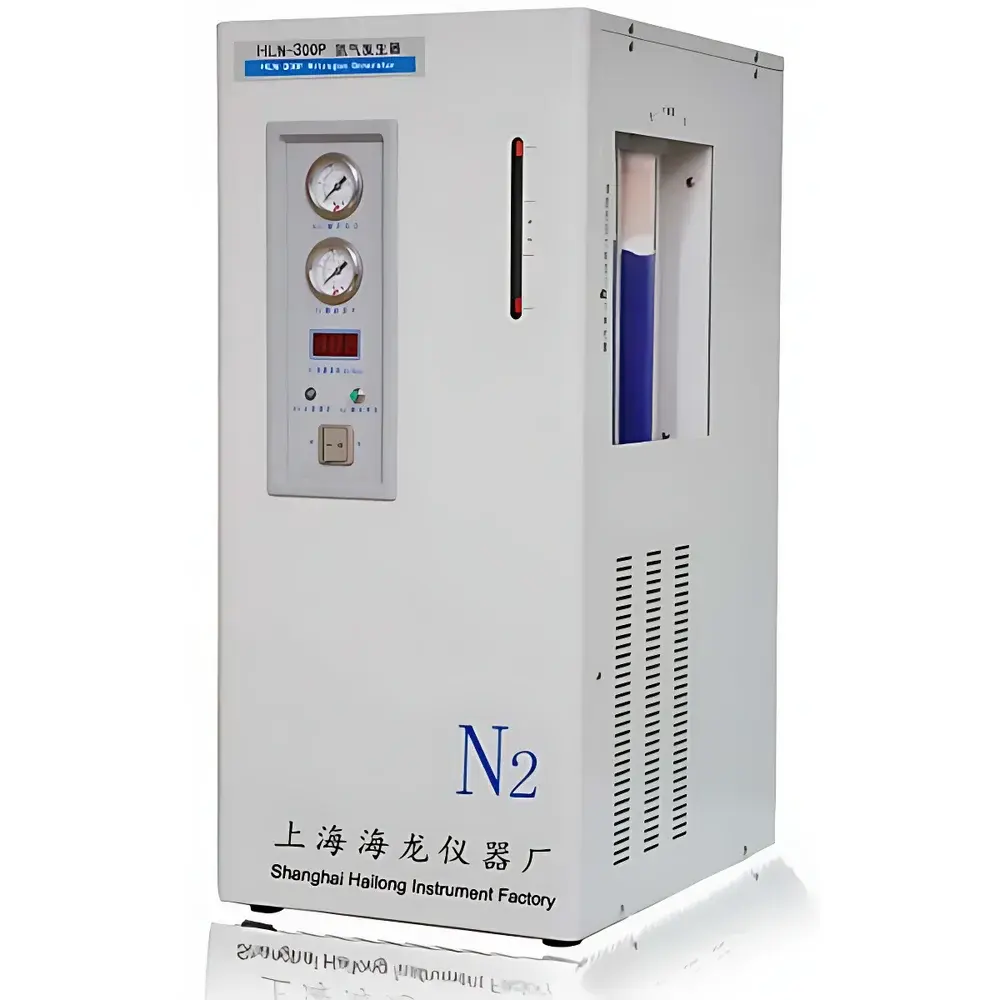
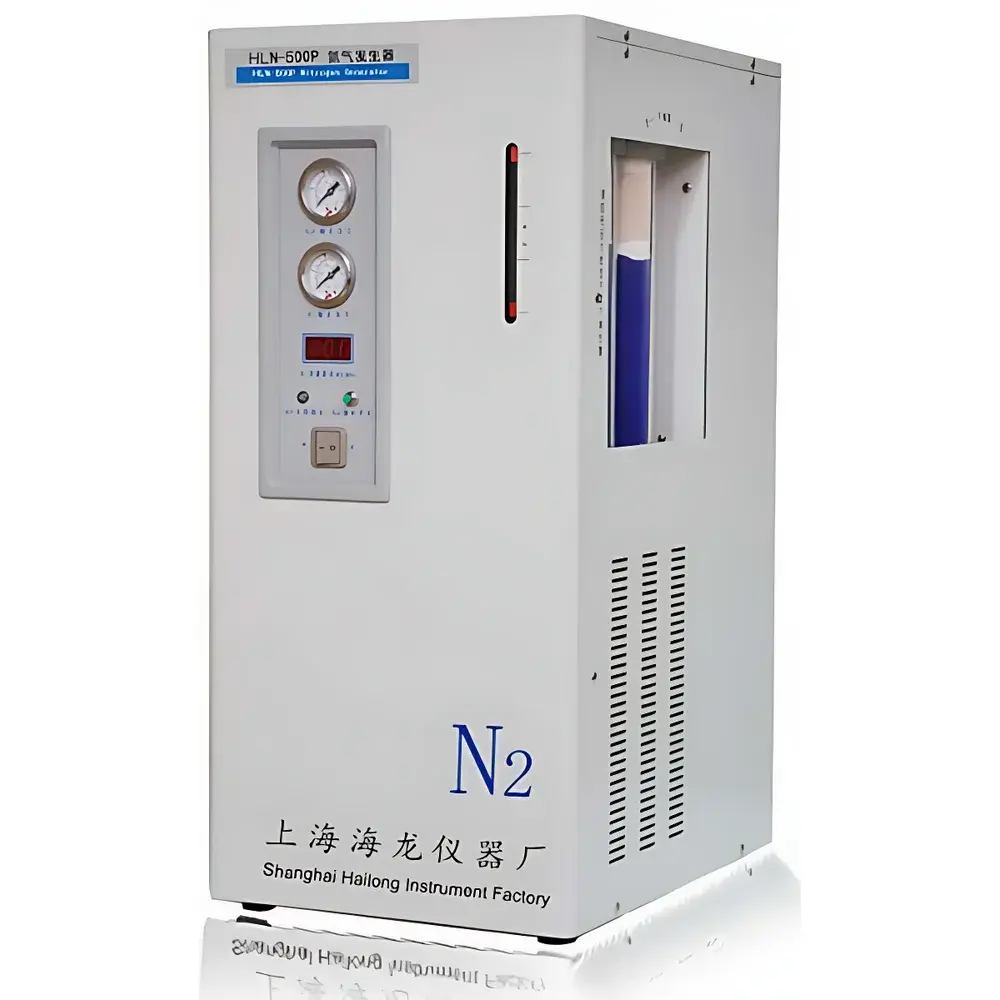
Haolong HLN-300P / HLN-500P Integrated Air-Compressed Electrolytic Nitrogen Generator
| Brand | Haolong |
|---|---|
| Origin | Shanghai, China |
| Model | HLN-300P, HLN-500P |
| Nitrogen Generation Principle | Electrolytic (PEM-free alkaline electrolysis) |
| Output Flow Rate | 0–300 mL/min (HLN-300P) / 0–500 mL/min (HLN-500P) |
| Output Pressure | 0–0.5 MPa (factory-set at 0.4 MPa) |
| Nitrogen Purity | >99.997% |
| Dew Point | 10–40 °C |
| Power Supply | 220 V ±10%, 50 Hz ±5% |
| Max. Power Consumption | 650 W (HLN-300P), 750 W (HLN-500P) |
| Dimensions (W×D×H) | 400 × 300 × 660 mm |
| Weight | 40 kg |
| Ambient Operating Conditions | 10–40 °C, RH ≤85%, non-corrosive, low-dust environment |
| Compressor Type | Oil-free diaphragm air compressor (integrated) |
Overview
The Haolong HLN-300P and HLN-500P are compact, integrated nitrogen generators engineered for continuous, on-demand supply of high-purity nitrogen gas in laboratory environments. Unlike membrane- or pressure swing adsorption (PSA)-based systems, these units utilize alkaline electrolytic separation — a proven electrochemical process wherein deionized water is decomposed into hydrogen and oxygen at the anode, while nitrogen is selectively generated from ambient air via catalytic separation within a dual-cathode stainless steel electrolytic cell. Oxygen is vented as a byproduct; hydrogen is safely recombined or purged. The integrated oil-free diaphragm air compressor eliminates dependency on external compressed air infrastructure, enabling plug-and-play deployment in analytical labs, GC carrier gas applications, glove boxes, and inert atmosphere workstations.
Key Features
- Dual-cathode stainless steel electrolytic cell with enlarged electrode surface area — enhances thermal stability, reduces operating temperature, and improves long-term reproducibility of nitrogen output.
- Simultaneous oxygen removal and nitrogen generation ensure efficient gas separation without catalyst degradation or consumable media replacement.
- Patented anti-backflow liquid trap prevents electrolyte migration into downstream instrumentation — critical for protecting sensitive detectors (e.g., ECD, TCD) and chromatographic columns.
- Automatic pressure stabilization and fail-safe shutdown: gas flow ceases immediately upon power loss or pressure deviation beyond set thresholds (0.4 MPa nominal), minimizing system exposure to overpressure or unregulated flow.
- High-efficiency switched-mode power supply optimizes current density across the electrolytic stack, improving energy conversion ratio and reducing heat load per unit gas output.
- Self-contained architecture — includes built-in air compression, filtration, drying, and electrochemical generation in a single 40 kg chassis (400 × 300 × 660 mm), suitable for benchtop or under-bench installation.
Sample Compatibility & Compliance
The HLN series delivers nitrogen meeting stringent purity requirements for trace-level analytical applications. With >99.997% N₂ (i.e., ≤30 ppm total impurities — primarily residual O₂ and H₂O), it satisfies method prerequisites for gas chromatography (GC) carrier gas per ASTM D6299 and ISO 8573-1 Class 2 compressed air equivalency. The dew point range of 10–40 °C corresponds to ISO 8573-1 Class 4–5 moisture specification, compatible with most GC injectors and detectors when used with optional inline desiccant or chilled traps. While not certified to FDA 21 CFR Part 11 out-of-the-box, the generator’s stable output, mechanical interlocks, and deterministic shutdown behavior support integration into GLP/GMP workflows where instrument qualification (IQ/OQ/PQ) and audit-ready maintenance logs are maintained externally.
Software & Data Management
The HLN-300P and HLN-500P operate as standalone hardware units with no embedded microcontroller or digital interface. All operational parameters — including real-time pressure indication (via analog gauge), flow rate (calibrated rotameter), and status LEDs for power, pressure lock, and electrolyte level — are locally monitored. For laboratories requiring data capture, third-party analog-to-digital signal loggers (e.g., Omega OM-DAQPRO or Campbell Scientific CR1000X) may be connected to the 0–5 V pressure feedback output (available on request). No proprietary software, cloud connectivity, or firmware updates are provided — aligning with security-conscious lab policies that restrict networked peripherals in analytical instrument zones.
Applications
- Carrier gas for capillary GC and GC-MS systems requiring consistent, low-oxygen nitrogen streams.
- Blanketing and purging in sample preparation hoods, solvent evaporation stations, and moisture-sensitive synthesis setups.
- Zero-air generation support (when paired with catalytic oxidizers) for environmental air monitoring calibrations.
- Inert atmosphere maintenance in glove boxes used for battery material handling or organometallic chemistry.
- Supply source for nitrogen-driven pneumatic controls in automated liquid handlers or autosamplers where oil-free gas is mandatory.
FAQ
What is the expected service life of the electrolytic cell?
Under normal operation (≤8 hrs/day, ambient 20–25 °C, filtered feed water), the dual-cathode cell typically maintains rated performance for 12,000–15,000 operating hours before gradual efficiency decline necessitates refurbishment or replacement.
Does the unit require deionized water? What grade is recommended?
Yes — Type II deionized water (resistivity ≥1 MΩ·cm, TOC < 50 ppb) is required to prevent scaling and electrode passivation. Tap water or distilled water alone is unsuitable due to ionic contamination risk.
Can the output pressure be adjusted beyond 0.4 MPa?
The internal pressure regulator is factory-set to 0.4 MPa and is not user-adjustable. Exceeding 0.5 MPa voids warranty and risks diaphragm compressor fatigue or seal failure.
Is routine maintenance required beyond water refills?
Yes — quarterly inspection of air inlet filters, annual replacement of the coalescing filter cartridge (part #HLN-FIL-01), and biannual verification of electrolyte concentration (KOH solution, 25–30% w/w) are recommended per the operator manual.
How does ambient temperature affect dew point stability?
Dew point varies directly with ambient conditions: at 10 °C ambient, typical output dew point is ~10 °C; at 40 °C ambient, it rises to ~40 °C. For sub-0 °C dew point requirements, a dedicated refrigerated or adsorption dryer must be installed downstream.



