
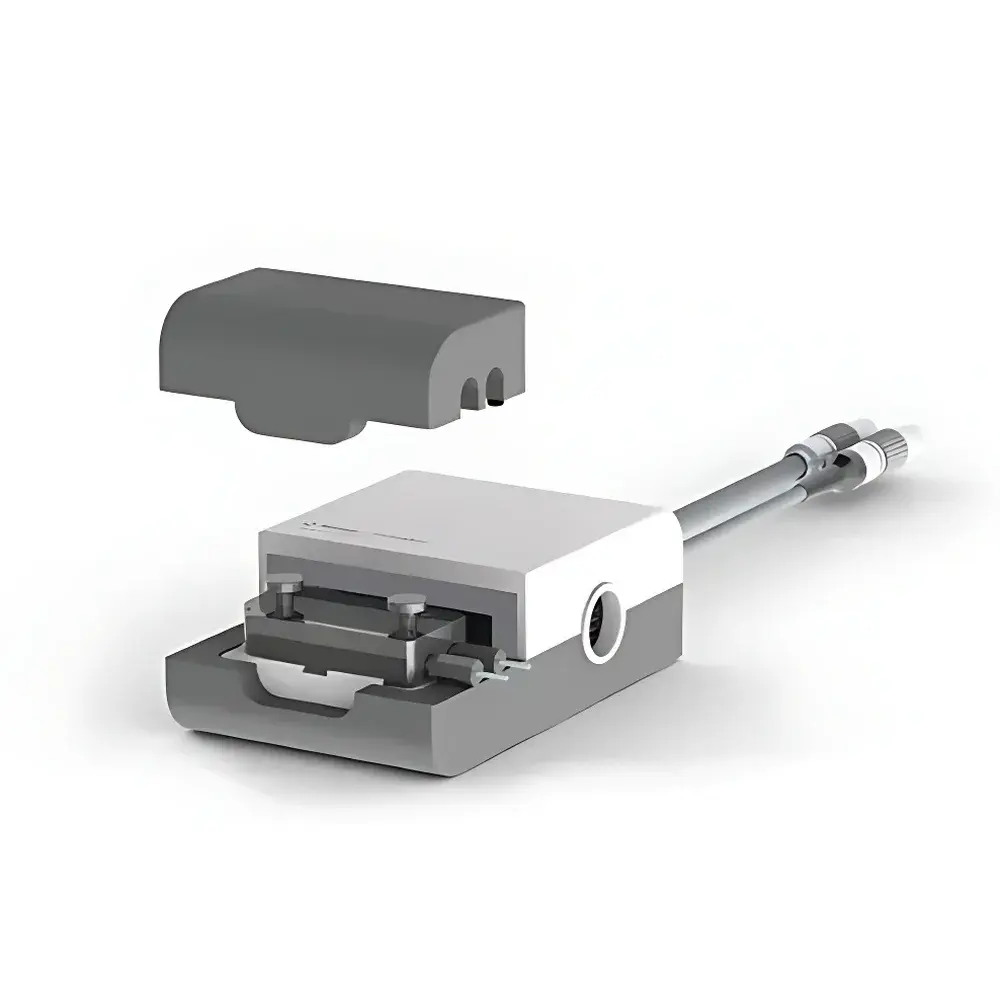
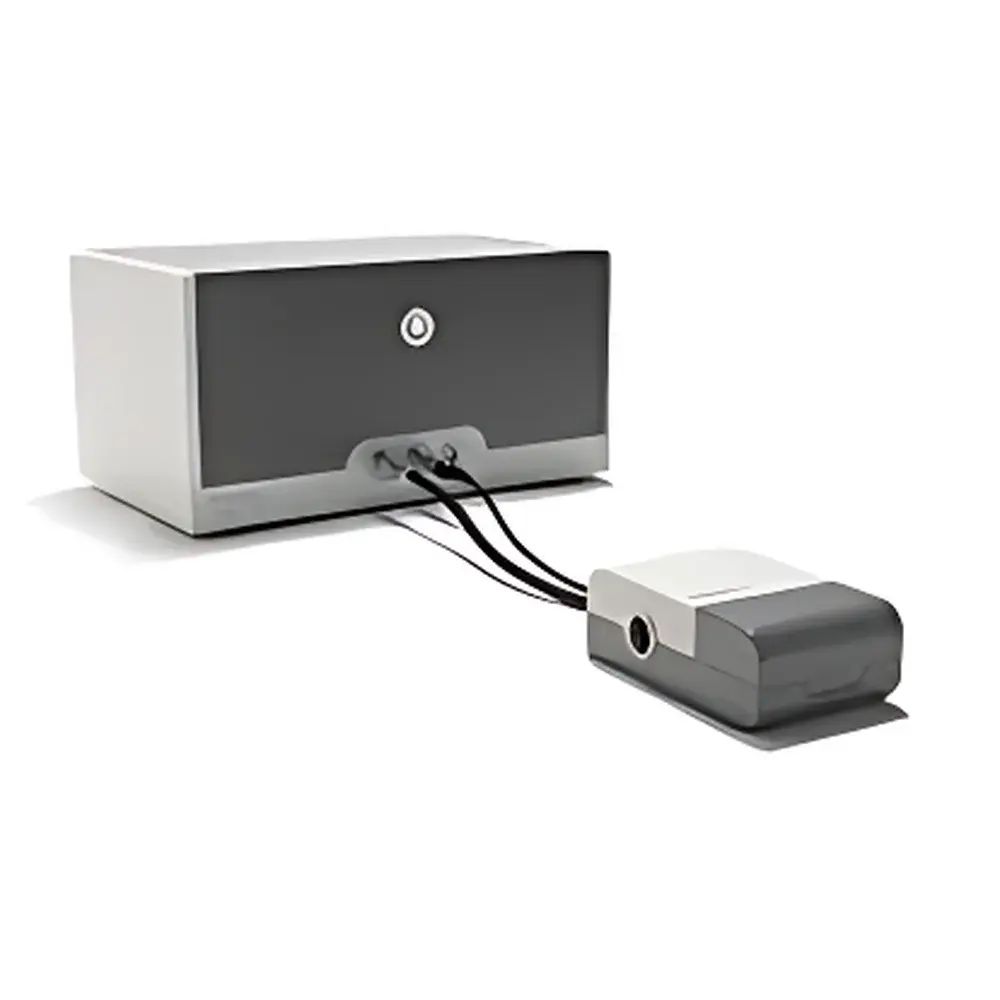
QSense Initiator Quartz Crystal Microbalance with Dissipation Monitoring (QCM-D)
| Brand | QSense |
|---|---|
| Origin | Finland |
| Manufacturer Type | Authorized Distributor |
| Import Status | Imported |
| Model | QSense Initiator |
| Price | Upon Request |
| Minimum Sample Volume | 40 µL |
| Temperature Range | 15–65 °C |
| Frequency Range | 1–70 MHz |
Overview
The QSense Initiator Quartz Crystal Microbalance with Dissipation Monitoring (QCM-D) is a rigorously engineered, single-channel real-time surface interaction analyzer designed for label-free, in situ characterization of molecular adsorption, desorption, and structural evolution at solid–liquid and solid–gas interfaces. Operating on the piezoelectric resonance principle, the instrument employs AT-cut quartz crystals oscillating at fundamental and harmonic frequencies (1–70 MHz) under applied AC voltage. Mass changes on the sensor surface induce measurable shifts in resonance frequency (Δf), while energy dissipation (ΔD) — quantified via ring-down decay analysis after excitation cessation — directly correlates with the viscoelastic properties of the adsorbed layer. Unlike conventional QCM, QCM-D simultaneously resolves both mass (including hydrodynamically coupled solvent) and mechanical rigidity, enabling differentiation between rigid monolayers, soft polymer brushes, hydrated protein films, or multilayer assemblies. The QSense Initiator implements this dual-parameter detection with high temporal resolution, thermal stability (±0.02 °C over 20–45 °C operating range), and robust fluidic control optimized for continuous-flow experiments.
Key Features
- Single-channel QCM-D platform optimized for liquid-phase flow experiments, featuring integrated precision temperature control (15–65 °C) and low-dead-volume microfluidics.
- Intuitive, workflow-driven software interface minimizing configuration overhead—designed for rapid method setup, real-time monitoring, and immediate interpretation without advanced training.
- High-sensitivity detection: mass resolution down to ~0.5 ng/cm² (5 pg/mm²) and dissipation resolution down to ~0.04 × 10⁻⁶ in aqueous environments.
- Modular sensor compatibility: supports standard 5 MHz and high-frequency (10–70 MHz) QCM-D crystals; accommodates custom-coated surfaces including gold, silicon oxide, polymers, SAMs, and biomimetic lipid bilayers.
- No-label, non-invasive operation—preserves native conformation and function of proteins, peptides, polysaccharides, surfactants, and nanoparticles during dynamic interaction studies.
- Compact benchtop architecture with minimized footprint and simplified chip loading mechanism—reducing operator-induced variability and improving experimental reproducibility.
Sample Compatibility & Compliance
The QSense Initiator accepts a broad spectrum of sample types across academic and industrial R&D settings: soluble biomolecules (e.g., antibodies, enzymes, extracellular vesicles), synthetic polymers, colloidal dispersions, micellar systems, and functionalized nanoparticles. Its open-flow cell design enables compatibility with buffered aqueous solutions, organic solvents (with appropriate sensor coating), and gas-phase exposures. All hardware and firmware comply with CE marking requirements for laboratory instrumentation. Software supports audit-trail generation and user-access logging—facilitating alignment with GLP and GMP documentation practices. While not FDA 21 CFR Part 11–certified out-of-the-box, the system’s data export architecture (CSV, HDF5) and metadata-rich file structure enable integration into validated LIMS or ELN environments per ISO/IEC 17025 and ASTM E2500-22 guidelines.
Software & Data Management
QSense Instrument Control Software provides real-time visualization of frequency and dissipation shifts across up to five harmonics (n = 1, 3, 5, 7, 9), synchronized with flow events and temperature logs. Built-in fitting modules support Sauerbrey mass estimation, Voigt-based viscoelastic modeling, and hydration-corrected mass derivation. Raw data files retain full experimental context—including sensor ID, calibration constants, fluidic parameters, and environmental timestamps—ensuring traceability. Export options include tab-delimited ASCII, MATLAB-compatible .mat, and HDF5 formats suitable for downstream analysis in Python (NumPy/Pandas), R, or commercial platforms such as OriginLab or GraphPad Prism. Remote access and batch processing are supported via optional API extensions.
Applications
- Protein–surface interactions: binding kinetics, conformational rearrangement, and fibril formation on biosensor surfaces.
- Lipid membrane biophysics: supported bilayer formation, peptide insertion, and pore-forming toxin activity.
- Polymer science: stimuli-responsive hydrogel swelling, polyelectrolyte multilayer assembly, and antifouling coating performance.
- Nanomaterial characterization: nanoparticle adhesion strength, corona formation dynamics, and aggregation onset in complex media.
- Colloid and interface chemistry: surfactant adsorption isotherms, foam/film stability mechanisms, and emulsion interfacial rheology.
- Quality-by-Design (QbD) development: process parameter mapping for chromatographic resin fouling or filtration membrane conditioning.
FAQ
What is the minimum required sample volume for a standard flow experiment?
The active sensing volume above the crystal is approximately 40 µL; total system dead volume (including tubing and connectors) is ~200 µL.
Can the QSense Initiator operate with non-aqueous solvents?
Yes—provided the sensor coating is chemically compatible (e.g., hydrophobic SAMs for organic phases) and fluidic components are solvent-resistant; consult material compatibility charts before use.
Is multi-harmonic data acquisition mandatory for quantitative analysis?
While single-harmonic measurements suffice for rigid-layer approximations, multi-harmonic (≥3 odd harmonics) acquisition is essential for accurate viscoelastic modeling and hydration correction.
Does the system support automated sequential injection or gradient elution protocols?
Basic stepwise injections are fully programmable; advanced gradient or multi-step protocols require external syringe pump synchronization via TTL trigger interface.
How is temperature stability maintained during long-term measurements?
A Peltier-based thermal module with PID feedback control ensures ±0.02 °C stability over 24+ hour acquisitions, with real-time monitoring logged alongside QCM-D signals.




