
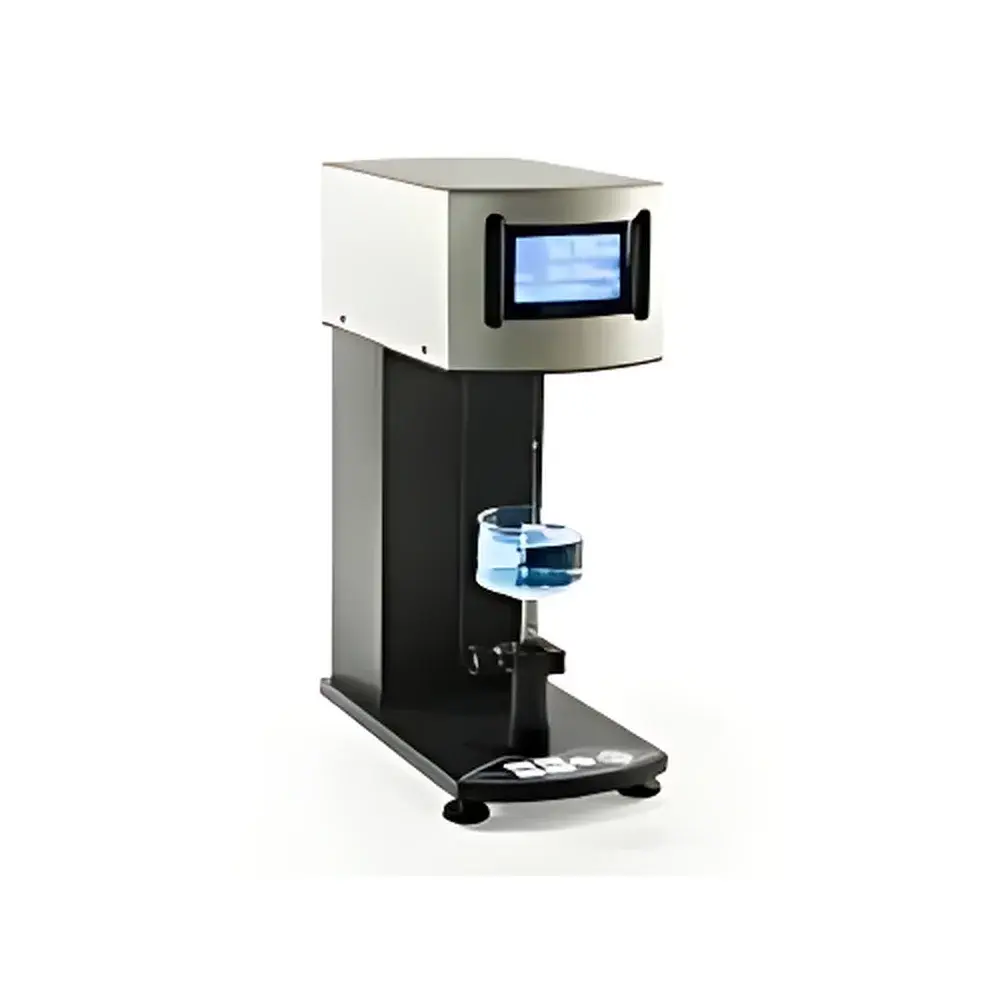
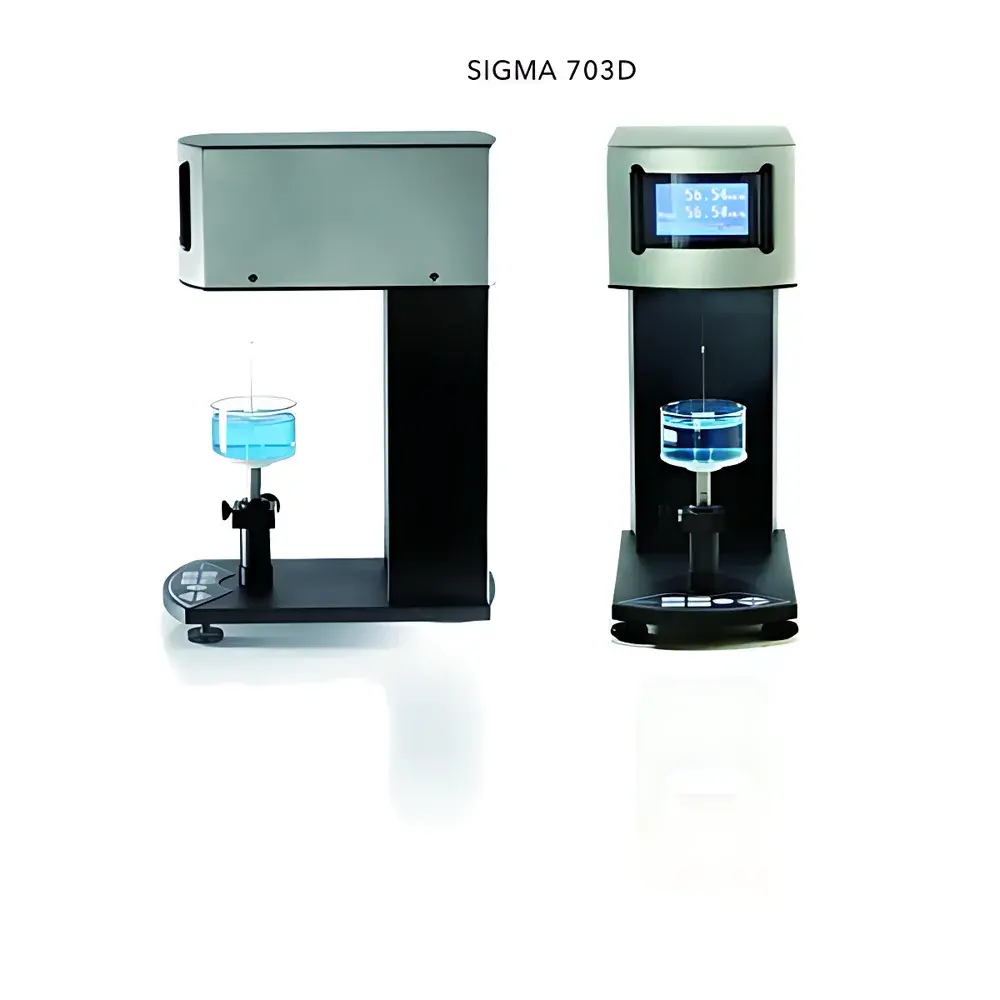
Attension Sigma 703D Surface & Interfacial Tensiometer
| Brand | Attension |
|---|---|
| Origin | Finland |
| Model | Sigma 703D |
| Measurement Principle | Wilhelmy Plate / Du Noüy Ring Method (Force-Based Gravimetric) |
| Temperature Control Options | Thermostatted Jacket, Immersion Probe, Vapor-Phase Chamber |
| Compliance Standards | ASTM D971, ISO 6295, ISO 1409, USP <1058> (for instrument qualification), GLP/GMP-ready data traceability |
| Data Output | Real-time digital display + USB/RS-232 export + optional printer interface |
| Accessories Included | Platinum plate, platinum ring, density sphere, calibration kit, ring correction tool, standard glass beakers |
Overview
The Attension Sigma 703D is a benchtop, stand-alone surface and interfacial tensiometer engineered for precision gravimetric measurement of interfacial phenomena at liquid–air, liquid–liquid, and solid–liquid boundaries. It operates on the fundamental principle of force balance: when a geometrically defined probe—such as a platinum plate or ring—is brought into contact with a liquid interface, the resulting wetting force is directly proportional to the interfacial tension (γ) and the probe’s perimeter. This force is measured with a high-resolution microbalance (±0.1 µN resolution typical), and corrected using established physical models—including the Huh & Mason correction for dynamic Wilhelmy plate measurements and the Zuidema & Waters model for ring-based determinations. Unlike optical systems reliant on profile fitting, the Sigma 703D delivers inherently absolute, SI-traceable values without assumptions about liquid density or contact angle. Its mechanical architecture is optimized for stability under ambient laboratory conditions, with vibration-damped base design and thermal mass management to minimize drift during extended CMC or dynamic contact angle protocols.
Key Features
- Standalone operation with integrated high-contrast LCD display—no PC required for routine surface tension, interfacial tension, or manual CMC measurements
- Dual-probe compatibility: Fully automated switching between platinum plate (Wilhelmy method) and platinum ring (Du Noüy method) via motorized probe lift mechanism
- Manual XYZ sample stage with micrometer-scale positioning for reproducible immersion depth control and fiber/wire contact angle studies
- Real-time force vs. time acquisition at up to 100 Hz sampling rate, enabling robust dynamic contact angle analysis (advancing/receding angles)
- Onboard temperature monitoring input (PT100-compatible) and support for external thermostatic jackets, vapor-phase chambers, or immersion probes for controlled measurements from 5 °C to 80 °C
- Direct thermal printer interface (via parallel or USB) for GLP-compliant hardcopy output with timestamp, operator ID, and measurement parameters
- Pre-loaded calibration routines for zero-force offset, buoyancy correction, and ring geometry validation per ISO 1409 Annex B
Sample Compatibility & Compliance
The Sigma 703D accommodates a broad range of sample geometries and states: flat substrates (films, wafers), cylindrical fibers, monofilaments, powders (via Washburn capillary rise), and bulk liquids—including opaque, viscous, or surfactant-laden systems where optical methods fail. For powder wettability, the instrument records mass gain during spontaneous capillary penetration into packed beds; for suspension stability, it quantifies sediment mass accumulation on a suspended probe over time. All measurement workflows align with internationally recognized standards: ASTM D971 for insulating oil interfacial tension, ISO 6295 for emulsion stability assessment, and ISO 1409 for polymer solution surface tension. When used with documented procedures, electronic records meet FDA 21 CFR Part 11 requirements for audit trail generation, user authentication, and data integrity—making it suitable for regulated QC environments in pharmaceuticals, lubricants, and coatings manufacturing.
Software & Data Management
While fully functional without software, the Sigma 703D integrates seamlessly with Attension’s OneAttension software suite (Windows-based). This platform enables automated CMC titration sequences, multi-liquid surface energy mapping (Owens–Wendt, Wu, van Oss–Chaudhury–Good models), and time-resolved sedimentation kinetics modeling. Raw force–distance and force–time datasets are exported in CSV and ASCII formats compatible with MATLAB, Python (Pandas), and JMP for advanced statistical analysis. Instrument configuration, calibration history, and measurement metadata are stored in encrypted local databases with configurable backup intervals. Audit trails record all parameter changes, user logins, and data exports—supporting full traceability for ISO/IEC 17025 accreditation and internal quality audits.
Applications
- Surfactant R&D: Determination of critical micelle concentration (CMC), adsorption efficiency, and interfacial elasticity via oscillatory tension measurements (with optional add-on module)
- Coating & Ink Formulation: Quantification of pigment dispersion stability through powder wettability indices and suspension sedimentation rates
- Electrical Insulating Fluids: Routine quality control of transformer oils per ASTM D971, detecting oxidation products and hydrolytic degradation via oil–water interfacial tension decay
- Biomaterial Surface Engineering: Contact angle hysteresis analysis of medical device polymers to predict protein adsorption propensity and cell adhesion behavior
- Food & Cosmetic Emulsions: Interfacial rheology screening of edible oil–water systems to optimize emulsifier selection and shelf-life prediction
- Membrane & Filter Development: Solid surface free energy mapping to correlate hydrophobicity/hydrophilicity with fouling resistance and flux decline
FAQ
What is the primary measurement principle used by the Sigma 703D?
It employs gravimetric force measurement via the Wilhelmy plate or Du Noüy ring method, relying on direct detection of interfacial wetting forces using a high-precision microbalance.
Can the Sigma 703D measure dynamic contact angles on fibers or thin films?
Yes—it supports both advancing and receding contact angle determination on cylindrical samples (e.g., textile fibers) and planar solids using programmable vertical probe motion and real-time force integration.
Is temperature control built-in or optional?
Temperature control is modular: the base unit includes inputs for external sensors and controllers, while thermostatted jackets, vapor chambers, and immersion probes are available as validated accessories.
Does the instrument comply with regulatory data integrity requirements?
When operated with OneAttension software and configured per SOP, it supports 21 CFR Part 11 compliance—including electronic signatures, audit trails, and role-based access control.
What accessories are supplied as standard with the Sigma 703D?
Platinum plate, platinum ring, stainless-steel density sphere, calibration weights, ring geometry correction tool, set of borosilicate glass beakers, and comprehensive user documentation including ISO-aligned validation templates.



