
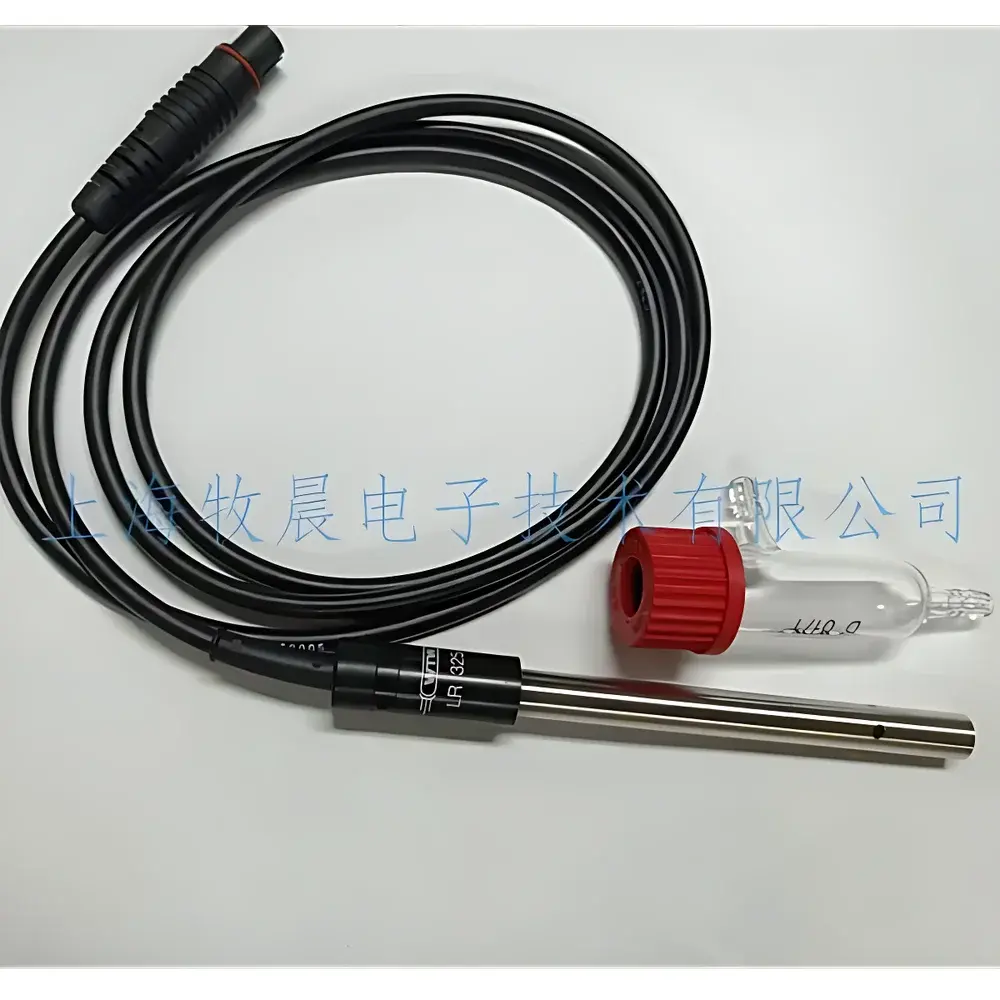
WTW LR 325/01 Ultra-Pure Water Conductivity Electrode
| Brand | WTW |
|---|---|
| Origin | Germany |
| Model | LR 325/01 |
| Detection Parameter | Single (Conductivity) |
| Portability | Portable |
| Application Environment | Laboratory |
| Conductivity Range | 0.001–200 µS/cm |
| Electrode Type | Two-Electrode |
| Cell Constant | 0.1 cm⁻¹ (±2%) |
| Temperature Sensor | Integrated NTC |
| Temp. Range | 0–100 °C (±0.2 K) |
| Max. Pressure | 2 bar at 20 °C |
| Housing Material | ASTM A240 316Ti Stainless Steel |
| Flow Cell | Integrated |
| Connection Interface | KI/LF-MIQ/S (505 543) |
Overview
The WTW LR 325/01 is a high-precision, two-electrode conductivity sensor engineered specifically for ultra-pure water (UPW) and low-conductivity boiler feedwater applications in regulated laboratory and pilot-scale process environments. Operating on the principle of AC conductometric measurement at a fixed frequency (typically 1 kHz), the electrode eliminates polarization effects common in DC-based systems and ensures stable, drift-free readings across its extended low-range span. Its cell constant of 0.1 cm⁻¹ is optimized for accurate quantification of conductivity values from 0.001 µS/cm — approaching theoretical limits of deionized water — up to 200 µS/cm, covering critical monitoring points in pharmaceutical water systems (PW, WFI), semiconductor UPW loops, and steam-cycle chemistry control. The integrated NTC temperature sensor enables real-time, automatic temperature compensation (ATC) per ISO 7888 and ASTM D1125 standards, with traceable accuracy of ±0.2 K over 0–100 °C.
Key Features
- Stainless steel (316Ti) housing with integrated flow-through cell — designed for inline or recirculating loop installation in clean utility water systems
- Two-electrode configuration with precisely calibrated cell constant of 0.1 cm⁻¹ (±2%), certified per DIN EN 27888 and WTW factory calibration protocol
- Integrated NTC temperature sensor (10 kΩ at 25 °C) enabling simultaneous temperature measurement and linear/nonlinear ATC in compatible transmitters
- Maximum operating pressure: 2 bar at 20 °C — suitable for low-pressure sampling manifolds and side-stream monitoring circuits
- Compact form factor (120 × 12 mm) with 1/2″ NPT male thread for standardized mechanical integration into stainless steel tubing assemblies
- Chemically inert wetted parts: 316Ti body, PEEK-insulated electrodes, and epoxy-graphite sensing surface resistant to oxidative sanitants (e.g., ozone, hydrogen peroxide)
Sample Compatibility & Compliance
The LR 325/01 is validated for continuous measurement in ultrapure water (resistivity > 18.2 MΩ·cm), purified water (PW), and boiler feedwater with total dissolved solids (TDS) < 100 ppb. It meets material compatibility requirements under USP , EP 2.2.38, and JP 2.07 for pharmaceutical water quality monitoring. When paired with WTW IQ Sensor Net transmitters (e.g., IQM 200, IQM 400) or third-party controllers supporting analog 4–20 mA or digital Modbus RTU output, the system supports audit-ready data logging compliant with FDA 21 CFR Part 11 (when configured with electronic signature and audit trail functionality). The electrode’s construction adheres to ASME BPE-2022 surface finish specifications (Ra ≤ 0.4 µm) for sanitary process connections.
Software & Data Management
The LR 325/01 operates seamlessly with WTW’s IQ Software Suite (v4.0+), enabling sensor configuration, calibration validation (including multi-point KCl standard verification), and diagnostic trending (e.g., electrode fouling index, temperature deviation alerts). When connected via KI/LF-MIQ/S interface cable (P/N 505 543), the sensor transmits raw conductivity, temperature, and status flags to IQ-based controllers, which apply configurable compensation algorithms (linear, non-linear, or user-defined polynomial). Data export supports CSV and XML formats compatible with LIMS integration (e.g., LabWare, STARLIMS) and automated reporting for GLP/GMP documentation workflows.
Applications
- Real-time monitoring of ultrapure water distribution loops in biopharmaceutical manufacturing facilities
- Boiler feedwater purity verification prior to high-pressure steam generation in power plants and cogeneration units
- In-line QC testing of purified water during WFI generation (still effluent and storage loop return)
- Validation of reverse osmosis (RO) and electrodeionization (EDI) system performance in semiconductor UPW plants
- Leak detection in double-tube heat exchangers used in closed-loop cooling water systems
- Calibration reference electrode for field-portable meters used in cleanroom environmental monitoring programs
FAQ
What is the recommended calibration frequency for the LR 325/01 in GMP environments?
Calibration should be performed before each use or at defined intervals not exceeding 24 hours, per USP and EU GMP Annex 15; bracketing with certified KCl standards (0.01 mol/kg and 0.1 mol/kg) is required.
Can this electrode be used in hot water systems above 80 °C?
The maximum rated temperature is 100 °C, but prolonged exposure above 80 °C may accelerate NTC drift; operation above 80 °C requires documented thermal stability verification per ICH Q5C.
Is the LR 325/01 compatible with non-WTW transmitters?
Yes — it outputs analog conductivity and temperature signals compatible with any transmitter accepting 0–2 V or 4–20 mA inputs with programmable cell constant entry and ATC support.
How is electrode fouling detected and mitigated?
Fouling is indicated by increasing zero offset (> ±0.002 µS/cm) or reduced sensitivity; mitigation includes periodic citric acid (2% w/w, 60 °C, 30 min) or NaOH (0.1 mol/L) cleaning cycles validated per WTW Technical Note TN-LR-02.
Does the electrode require a separate temperature probe when used with IQ transmitters?
No — the integrated NTC provides all required temperature data; external probes are redundant and may introduce measurement uncertainty.
Related Products




